
Affiliate Disclaimer: This article contains affiliate links. As an Amazon Associate, Mobility With Ease may earn a small commission from qualifying purchases at no additional cost to you.
Introduction
Caring for an aging parent or protecting your own independence often comes down to one essential goal: preventing falls before they happen. Most falls do not occur during risky activities. They happen during everyday tasks like getting out of bed, standing from a chair, or sitting down on the toilet. These short movements require balance, leg strength, and steady coordination. When any of these abilities decline — even slightly — the body becomes less stable, and the chance of losing balance increases.
For many families, the challenge is not knowing when extra support is needed. A person may appear steady while walking but struggle during transitions. That brief moment of rising or lowering the body is when instability often shows up first. A slight wobble when getting out of bed, a hand reaching for the wall when standing from the toilet, or a noticeable pause before rising from a chair can all signal that additional support would be helpful. Recognizing these early signs allows families to act before a fall occurs rather than reacting after one.
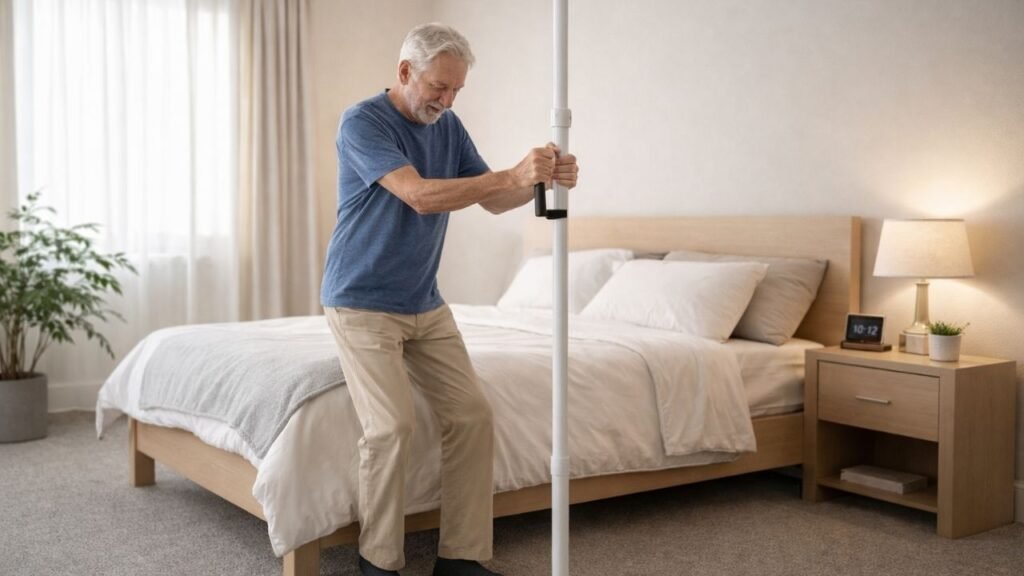
Transfer poles are one of the most practical and underused tools for improving home safety. Unlike wall-mounted grab bars that primarily provide side support, transfer poles offer firm vertical support from floor to ceiling. This upright design allows a senior to pull upward in a natural motion while keeping the body aligned over the feet. The result is improved balance, smoother movement, and less strain on the lower back and knees. For many households, this single addition creates safer, more predictable daily routines without requiring home renovation or permanent structural changes.
In this 2026 guide, we review the best transfer poles for seniors, explain how they reduce fall risk during common daily movements, and highlight what to look for before choosing one for your home. We cover tension-mounted models, bedside configurations, bathroom-specific designs, rotating handle systems, vaulted ceiling solutions, and heavy-duty bariatric options. Each recommendation is evaluated based on stability, weight capacity, ease of installation, and suitability for real-world home use.
Falls remain one of the leading causes of injury among older adults. Even a single fall can lead to hospitalization, loss of mobility, or long-term fear of movement. That is why choosing the right equipment is not just about comfort — it is about protecting long-term health, safety, and independence. Selecting from the best transfer poles available today ensures the support is stable, properly engineered, and suited to the specific room and user who will rely on it every day.
Why the Best Transfer Poles Matter for Seniors
Transfer poles address one of the most vulnerable moments in daily life: moving from one position to another. Standing up, sitting down, or shifting weight requires the body to coordinate balance, muscle strength, and timing simultaneously. Even small changes in leg strength, joint stability, or reaction speed can make these movements harder. For seniors, that brief shift in weight is often when balance feels least steady and when the risk of falling is highest.
Transitions also require proper body alignment. The hips must move forward, the feet must stay planted, and the upper body must stay centered over the base of support. If any part of that sequence is off, the body can tilt too far forward or backward. A vertical support pole provides a fixed point of contact during this shift, helping the user stay upright and aligned throughout the entire motion. Unlike furniture or countertops that may slide or tip, a properly installed transfer pole remains rigid and predictable.
Beyond physical strength, there is a confidence factor that plays a significant role in daily mobility. When someone feels unsure about standing, they may pause mid-movement or rush to finish quickly. Both hesitation and rushing can increase fall risk. Having a stable, easy-to-reach support surface reduces uncertainty and allows the person to move at a steady, controlled pace. Over time, this confidence can encourage more movement rather than less, which supports ongoing strength and balance.
According to the CDC, falls are a leading cause of injury among older adults, and many of those falls happen during routine activities inside the home. Transfer poles help distribute effort more evenly through the body during these activities. Instead of depending only on knee strength or grabbing nearby furniture that may shift under load, the user has a secure vertical anchor. This reduces strain on joints and lowers the risk of sudden imbalance. When the body has reliable external support during its weakest moments, daily movement becomes safer and more sustainable.
For broader environmental planning, consider making your home safer for seniors as part of a complete fall prevention strategy.
Doctor’s Note: Choosing the Right Transfer Pole
As a physician, I see many injuries that occur during simple daily movements. Most falls do not happen during complex activities. They happen when someone stands up too quickly, pivots without support, or lowers themselves without enough control. Standing from bed or transferring to the bathroom is often when instability first becomes noticeable. I recommend this type of vertical assist when a patient needs reliable support but does not require a full mechanical lift or caregiver assistance.
Choosing the right model starts with understanding the individual’s physical needs. Grip strength is important. If arthritis limits hand function, a padded or pivoting handle may provide better comfort and leverage. Leg strength and balance also matter. Some individuals benefit from a rotating support bar that locks into position, allowing smoother transitions without twisting the torso.
The home environment must also be considered. Ceiling height determines whether a standard tension-mounted pole will fit securely. Flooring type affects stability, especially on tile or hardwood surfaces. Placement near a bed or toilet should allow a natural reach without leaning or stretching. A poorly positioned pole can create new risks instead of reducing them.
In my experience, when the equipment matches both the person and the environment, confidence improves quickly. Patients often tell me they feel safer standing on their own. That reduction in anxiety is not just emotional—it encourages movement, which supports long-term strength and independence.

Best Transfer Poles for Seniors (Top Picks)
Floor-to-Ceiling Tension-Mounted Transfer Poles
Vive Floor to Ceiling Grab Bar
The Vive Floor to Ceiling Grab Bar provides a straightforward, tension-mounted solution for standing assistance without requiring tools or drilling. Crafted from durable steel, it safely supports up to 250 lbs and features a fixed U-shaped support handle that accommodates multiple grip angles. Its slim profile makes it suitable for tight spaces such as narrow bathrooms or beside a bed, and the tool-free installation means families can reposition it as needs change.
Pros:
- Tool-free tension installation
- Unique U-shaped handle offers multiple grip heights
- Slim design takes up minimal floor space
Cons:
- Weight capacity maxes out at 250 lbs
- Handle is stationary and does not rotate
- FITS CEILING HEIGHTS 7' 5" TO 9' – Perfect as a bathroom grab bar or a safety bar in the bedroom or living room, this tension-mounted freestanding support bar is easily height adjustable with the...
- MINIMIZE THE RISK OF FALLS: Our Vive Floor to Ceiling Grab Bar provides stabilizing support in any room of the house to aid in transfers, standing or sitting while minimizing the risk of hazardous...
- U-SHAPED GRAB BAR: Designed to provide an easy grip from any angle, the Vive Floor to Ceiling Grab Bar includes a U-shaped handle. The curved grab bar allows you to steady yourself with one or both...
Transfer Poles for Bedside Use
HealthCraft SuperPole with SuperTrapeze
Designed specifically for bedroom use, this floor-to-ceiling tension pole integrates an overhead SuperTrapeze bar. This allows users to pull themselves up from a lying position using a two-handed ladder-rung grip, making it significantly easier and safer to transition from lying down to sitting on the edge of the bed. The trapeze mechanism is especially valuable for seniors recovering from surgery or those with reduced core strength who struggle with the initial motion of sitting up from a flat position.
Pros:
- Perfect for bedside mobility and in-bed repositioning
- Ergonomic two-rung trapeze handle prevents wrist strain
- Clean, tool-free tension installation
Cons:
- Trapeze arm has a 150 lb limit (though the main pole supports 300 lbs)
- Overhead arm requires adequate ceiling clearance

- Ergonomic Support for Bed Safety: Going from lying down to standing is one of the most challenging movements - but the SuperPole with SuperTrapeze makes it effortless. Designed like rungs on a ladder...
- Prevent Falls & Stay Independent: Falls at home pose a major risk to seniors independence and quality of life, accounting for 50% of all fall-related hospitalizations. HealthCraft’s SuperPole has...
- Quick & Secure Installation, No Drilling Required: The SuperTrapeze is designed for easy, tool-free installation, attaching securely to the SuperPole without the need for drilling or permanent...
Bathroom & Toilet Transfer Poles
Signature Life Sure Stand Security Pole
The Signature Life Sure Stand Pole features premium anodized aluminum construction that naturally resists rust, making it an excellent tension-mounted choice for the humid environment of a bathroom. It safely supports up to 300 lbs and avoids the clinical look of standard medical equipment with its sleek, modern finish. For families who want safety equipment that blends into home decor rather than standing out as a medical device, this model offers a strong balance of function and appearance.
Pros:
- Rust-resistant anodized aluminum build
- Modern, non-clinical aesthetic blends into home decor
- Secure tension mount fits flat ceilings from 7 to 10 feet
Cons:
- Higher price point than basic steel poles
- Additional grab bar attachments must be purchased separately if desired

- Prevent Falls: The Sure Stand Security Poles provide seniors peace of mind with up to 300 pounds of support and leverage when standing; with two adjustable grab bars, your loved one can feel secure in...
- Tension-Mounted: With the Sure Stand Pole, senior home safety is made easier than ever; the adjustable design lets you securely place it anywhere in your home, from bathrooms to bedrooms and...
- Versatile Use: The Sure Stand Security Pole can be used anywhere assistance is needed; it works on both flat and vaulted ceilings 7 to 10 feet tall, giving you absolute flexibility when using this...
Transfer Poles with Rotating or Pivoting Handles
Stander Security Pole and Curve Grab Bar
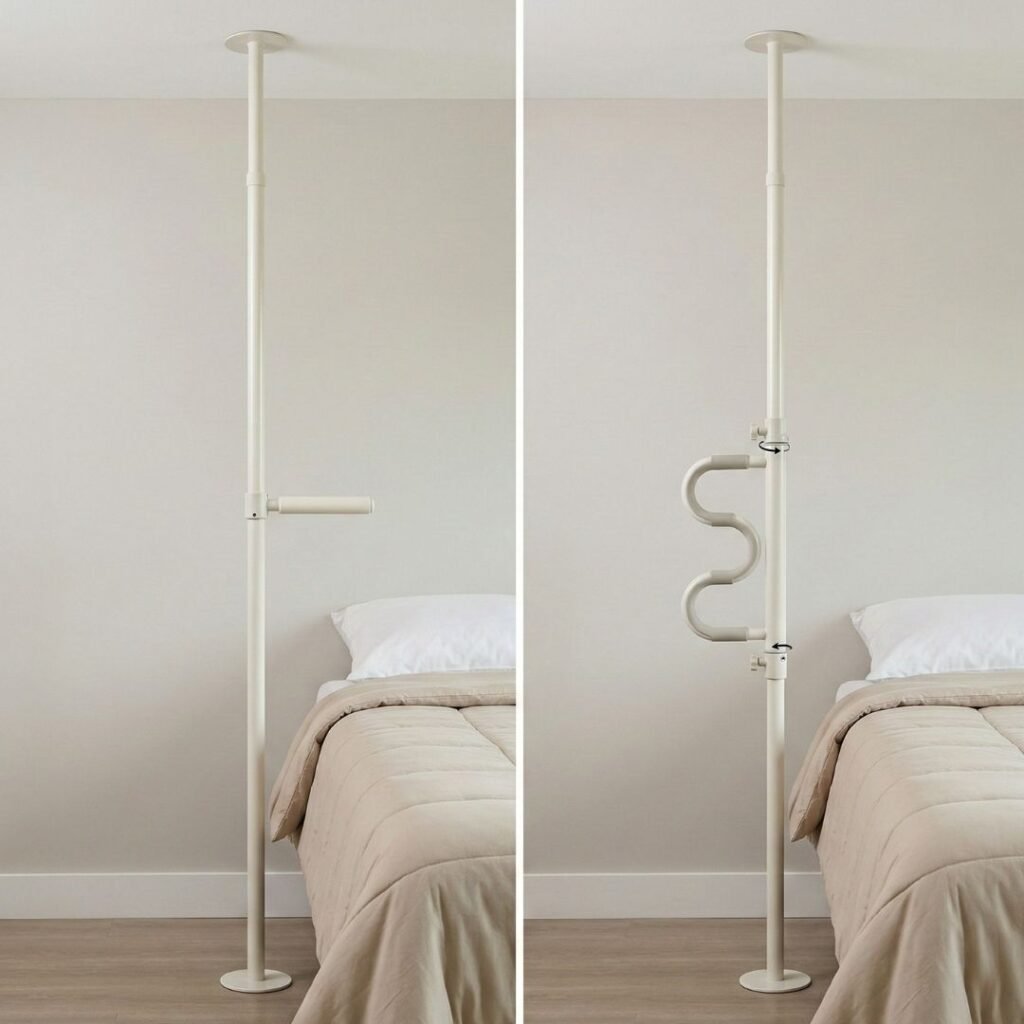
As one of the most popular transfer poles on the market, this model features a distinctive curved ladder-style grab bar that pivots a full 360 degrees and securely locks into place every 45 degrees. This allows users to get customized, multi-angle support when transferring from a wheelchair, toilet, or bed. The rotating design is particularly helpful in rooms where the user approaches the pole from different directions depending on the task, eliminating the need for multiple fixed grab bars.
Pros:
- Curved ladder-style handle for hand-over-hand climbing
- Bar rotates 360° and locks every 45°
- Easy no-drill tension installation
Cons:
- The curved bar takes up a slightly larger visual footprint
- Not compatible with vaulted ceilings out of the box
No products found.
Transfer Poles for Vaulted or High Ceilings
HealthCraft SuperPole with Angled Ceiling Plate
Standard tension poles cannot be used on slanted or vaulted ceilings because the compression force requires two parallel surfaces. This specific configuration of the HealthCraft SuperPole comes with a heavy-duty Angled Ceiling Plate adapter that screws directly into a ceiling joist, allowing the tension pole to be installed safely and securely on pitched ceilings. For homes with cathedral ceilings or angled bedroom ceilings, this is often the only safe option for floor-to-ceiling vertical support.
Pros:
- Safely accommodates vaulted and slanted ceilings
- Heavy-duty steel pole supports 300 lbs
- Professional-grade stability
Cons:
- Requires drilling into a ceiling joist (not purely tension-mounted at the top)
- Installation is more complex than standard flat-ceiling models

- Rock-Solid Stability, One-Piece Strength: Unlike flimsy, multi-piece designs, HealthCraft’s SuperPole is uniquely crafted from a single, solid piece of alloy steel (8-Feet). This variant includes...
- Prevent Falls & Stay Independent: Falls at home pose a major risk to seniors independence and quality of life, accounting for 50% of all fall-related hospitalizations. HealthCraft’s SuperPole has...
- Secure Stability Anywhere, No-Drill Grab Bar: Unlike traditional grab bars that usually require permanent installation in a fixed location, the SuperPole is tension-mounted, fitting standard 8-Feet...
Heavy-Duty & Bariatric Transfer Poles
HealthCraft SuperPole Heavy-Duty Pole (450-Pound Capacity)
Built specifically for higher weight requirements, the bariatric heavy-duty version of the HealthCraft SuperPole is constructed from reinforced alloy steel. It utilizes a powerful jackscrew expansion mechanism to provide an incredibly rigid, tension-mounted floor-to-ceiling fit that safely supports up to 450 pounds. For larger individuals or households where multiple family members may use the same pole, this model provides the highest weight capacity and structural stability available in a residential tension-mounted design.
Pros:
- Supports an impressive 450 lbs
- Reinforced, heavy-gauge steel construction
- Excellent stability with jackscrew tensioning
Cons:
- Considerably heavier to maneuver during initial setup
- Requires a very solid, flat ceiling joist to absorb the extra tension

- Rock-Solid Stability, One-Piece Strength: The HealthCraft’s SuperPole is uniquely crafted from a single, solid piece of alloy steel (8-Feet), delivering unmatched, wobble-free stability for safe...
- Prevent Falls & Stay Independent: Falls at home pose a major risk to seniors independence and quality of life, accounting for 50% of all fall-related hospitalizations. HealthCraft’s SuperPole has...
- Secure Stability Anywhere, No-Drill Grab Bar: Unlike traditional grab bars that usually require permanent installation in a fixed location, the SuperPole is tension-mounted, fitting standard 8-Feet...
What Is Transfer Poles Used For?
Transfer poles are assistive support devices designed specifically for sit-to-stand and stand-to-sit transitions. Their main purpose is to provide a steady vertical surface that a person can grip during movement. This helps guide the body upward when standing and control the body when lowering into a seated position. The vertical orientation works with the body’s natural upward motion, making it more biomechanically effective for standing than side-mounted grab bars that mainly offer horizontal or diagonal support.
Most transfer poles extend from floor to ceiling and use a pressure tension system to stay securely in place. Because they rely on compression rather than drilling, they can often be installed without permanent structural changes. This makes them a practical option for renters, families who want flexibility in placement, or households that may need to reposition the pole as mobility needs change over time. Installation typically takes less than an hour and requires no special tools beyond what is included with the product.
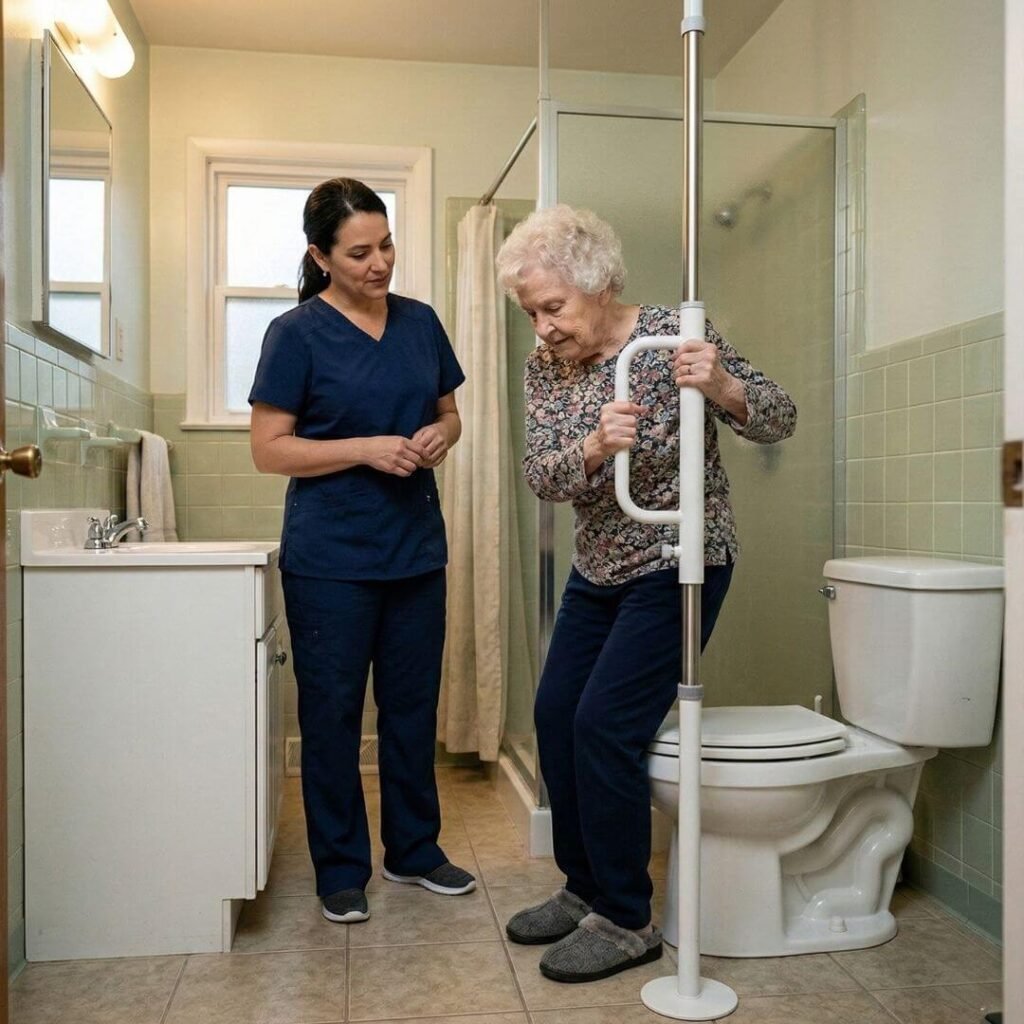
Transfer poles are commonly installed in bedrooms and bathrooms, where position changes happen several times a day. In the bedroom, the most common use is assisting with the transition from lying down to sitting on the edge of the bed, and then from sitting to standing. In the bathroom, they are most often placed beside the toilet to support controlled lowering and rising. These are the two rooms where the majority of in-home falls occur among older adults, which is why targeted support in these locations has the greatest impact on overall safety.
Transfer poles are especially helpful for individuals who can still stand on their own but feel unsteady during the movement itself. In these situations, the pole does not replace independence — it reinforces it by adding stability at the exact moment it is needed most. Many families find that this added support reduces the need for hands-on caregiver assistance, which protects both the senior and the caregiver from strain or injury.
In bedrooms, they may be used alongside bed rails for seniors for additional protection against rolling or sliding during sleep. In bathrooms, many families pair them with toilet safety rails for elderly or raised toilet seats for seniors to create layered support during different phases of the transfer. For complete layout guidance, see our guide on creating a senior-friendly bathroom.
For general assistive equipment education, refer to MedlinePlus – Home Care & Assistive Equipment.
How to Use Transfer Poles Safely
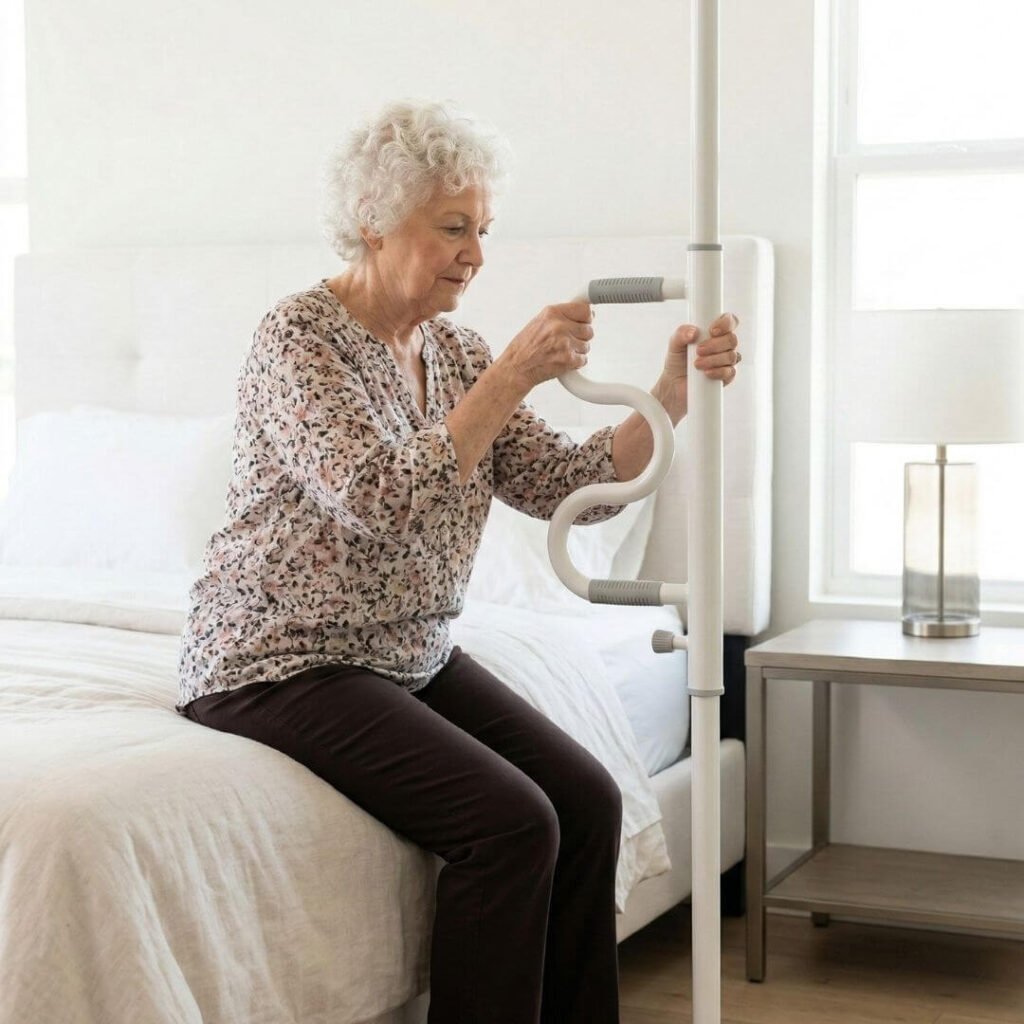
Check the positioning first. The pole should be placed where the user naturally reaches before standing. The hand should fall on the pole without stretching, twisting, or leaning forward. If the body has to shift off balance to grab it, the placement needs adjustment. In most homes, proper positioning is beside the bed at about hip level when seated, or directly next to the toilet where the hand can reach the pole before beginning to rise. Incorrect placement is one of the most common mistakes families make, and it can introduce risk rather than reduce it.
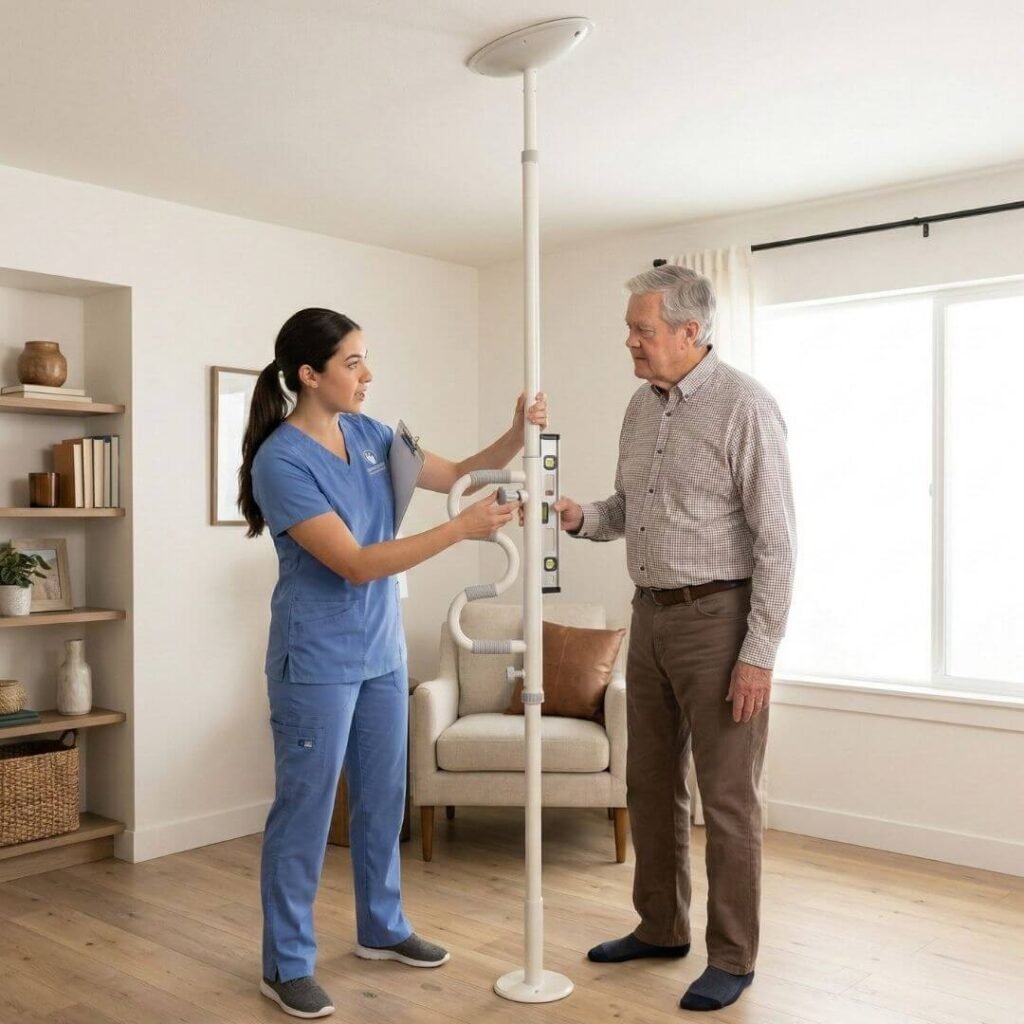
Ensure firm installation. Tension-mounted transfer poles must be tightly secured between the floor and ceiling. After installation, press firmly against the pole in different directions to confirm there is no movement. Even slight wobbling can increase risk during use. Follow the manufacturer’s instructions carefully, and re-check the tension regularly, especially if the pole is used daily. Changes in temperature, humidity, or floor surface compression can sometimes affect tightness over time. A weekly check takes only a few seconds and prevents gradual loosening from becoming a safety concern.
Maintain controlled movement during every transfer. When standing, the user should grip the pole firmly and keep their feet flat on the floor, shoulder-width apart. The goal is to push through the legs while using the pole for balance — not to pull the entire body weight upward with the arms. Relying too heavily on arm strength can strain the shoulders, wrists, and elbows, especially over repeated use. Slow, steady motion helps maintain alignment and reduces strain. Sitting down should also be done in a controlled way, lowering gradually while keeping a secure hold on the pole until fully seated.
Use proper body alignment throughout the movement. The head and chest should remain upright rather than leaning far forward. Keeping the body centered over the feet improves stability and prevents the forward momentum that often leads to stumbling. If dizziness occurs at any point during the transfer, the user should pause and sit back down safely before trying again. Dizziness during standing can be a sign of blood pressure changes and should be discussed with a healthcare provider.
Falls remain a leading cause of injury among older adults, and many occur during exactly these types of routine transfers. For a deeper understanding of how and why falls happen during daily activities, see our guide on understanding fall risks in seniors. When transfer poles are used correctly with proper positioning, firm installation, and controlled movement, they provide steady support that helps reduce the risk of sudden imbalance during the moments that matter most.
Lifestyle Synergy: Making Transfer Poles Work Better at Home
Transfer poles are most effective when they are part of a larger safety plan. A pole provides vertical support at a specific point, but the surrounding environment must also reduce risk. Clear walking paths, stable furniture, and secure flooring all work together to prevent trips and stumbles between the bed and the bathroom, or between the chair and the kitchen. Loose cords, clutter, or unstable area rugs can undo the benefits of even the best equipment by creating new hazards just steps away from the support device.
Good lighting is especially important in rooms where transfer poles are used. Bedrooms and bathrooms should have bright, even lighting without harsh glare that distorts depth perception. Motion-sensor night lights can help guide safe movement during nighttime bathroom trips, which are among the highest-risk moments for falls. When seniors can clearly see where they are stepping and where the pole is positioned, they are less likely to misjudge distance or lose balance during the reach.
In bathrooms, combining a transfer pole with toilet safety rails or a raised toilet seat creates layered protection that addresses multiple phases of the movement. Each device supports a different part of the transfer — from lowering down to stabilizing at the bottom to pushing back up. This approach spreads the physical demand across multiple support points rather than relying on a single surface, which reduces strain on any one joint or muscle group.
In the bedroom, placing a transfer pole beside the bed often improves confidence during both morning and nighttime transfers. Many families report that once a pole is installed in the right position, seniors feel more secure standing independently and are less likely to call for help during routine movements. Over time, this added confidence can reduce the need for hands-on caregiver assistance while still maintaining a high level of safety. For caregivers, this means less physical strain and fewer nighttime interruptions.
If a fall has already occurred, it is important to understand the appropriate next steps for recovery and prevention. See our guide on care for seniors after a fall for additional safety planning. For national safety guidance, the National Institute on Aging provides helpful fall prevention resources that complement home equipment strategies.
Physician’s Tips for Long-Term Use
Over time, mobility levels can improve or decline depending on health status, activity level, and medical events. I recommend reassessing equipment needs after any hospitalization, illness, or noticeable change in balance or strength. Recovery from surgery, medication adjustments, or even a period of reduced activity can affect coordination and leg power. A transfer pole that once felt stable and well-positioned may need height adjustment, repositioning, or even replacement as posture or movement patterns change.
Pay close attention to how the pole is being used day to day. If a senior begins pulling heavily with the arms instead of pushing through the legs, it may suggest reduced lower body strength that should be evaluated. If they hesitate before standing, avoid certain transfers, or begin gripping the pole with visible tension in the hands and forearms, new discomfort or fear may be developing. These early behavioral signs should not be ignored. Addressing them quickly — whether through physical therapy, medication review, or equipment adjustment — can prevent further decline and reduce fall risk before an incident occurs.
It is also helpful to review the home setup periodically. Small changes in furniture placement, flooring, or even seasonal items like holiday decorations can affect how the transfer pole supports movement. A rug that was not there during installation, a new nightstand that partially blocks the reach path, or a change in bed height after a mattress replacement can all reduce the effectiveness of the original setup. Regular evaluation ensures that the pole continues to meet the person’s current needs rather than reflecting past abilities or past room layouts.
Skin integrity is another consideration for long-term users. Frequent gripping can cause calluses, skin irritation, or blistering on the palms, especially if the pole surface is bare metal. Padded handle covers or cushioned grips can reduce friction and improve comfort. Users with diabetes or circulatory conditions should pay particular attention to hand skin health, as healing may be slower and small irritations can escalate.
Long-term success depends on consistent reassessment — not just hardware checks, but physical function checks. Transfer poles should support independence while encouraging safe movement. When appropriate, strengthening exercises or therapy should be added so the device remains a support tool, not a substitute for maintaining mobility. I recommend at minimum an annual review with a healthcare provider, or sooner if any change in strength, balance, or confidence is noticed.
Transfer Poles Comparison for Seniors (Features & Stability)
Frequently Asked Questions
1. What is a transfer pole used for?
Transfer poles provide vertical support to assist with standing, sitting, and repositioning. They help reduce fall risk during common movements such as getting out of bed or lowering onto a toilet. Many seniors use them to maintain independence at home.
2. How do transfer poles work?
Most transfer poles use a tension-mounted system between the floor and ceiling. This creates stable vertical support without drilling. The user grips the pole to stabilize themselves during transitions.
3. Are transfer poles safe for seniors?
When properly installed and used correctly, transfer poles are considered safe. Stability depends on correct tension adjustment and proper placement. Regular checks ensure continued safety.
4. Do transfer poles require drilling?
Most floor-to-ceiling transfer poles do not require drilling. They use tension to stay in place. However, certain ceiling types may require additional hardware.
5. Can a transfer pole be installed on a vaulted ceiling?
Standard models typically require a flat ceiling. Some extended or adapted models can accommodate higher ceilings, but sharply sloped surfaces may require specialized equipment.
6. Are transfer poles covered by Medicare?
Coverage depends on whether the device qualifies as durable medical equipment. It is advisable to review Medicare’s durable medical equipment coverage guidelines or speak with a provider.
7. What are the best transfer poles for seniors?
The best transfer poles for seniors are tension-mounted floor-to-ceiling models with stable bases, secure locking handles, and appropriate weight capacity for the user’s needs.
Final Thoughts
The best transfer poles offer a practical and effective way to improve safety during daily movements at home. Simple transitions like standing from bed or lowering onto a toilet can become safer and more controlled with proper vertical support. By giving seniors a stable surface to grip, transfer poles help reduce sudden loss of balance and lower the risk of preventable falls.
Choosing the best transfer poles for seniors requires careful attention to ceiling height, weight capacity, and handle design. Some individuals benefit from a slim bedside pole, while others may need a heavy-duty option with a pivoting handle for added leverage. Matching the pole to both the person and the room layout is essential for long-term success.
When installed correctly and used consistently, transfer poles can improve confidence and support independence. For many families, this small adjustment to the home environment makes everyday movements feel safer, more predictable, and less stressful.
Medical Disclaimer: This guide is for general educational purposes only and is not intended to serve as personalized medical advice. Always consult a qualified healthcare professional before making changes to medical equipment or care plans.
Last update on 2026-09-15 / Affiliate links / Images from Amazon Product Advertising API
