
Introduction
Stepping outside should feel like freedom, not a calculated risk. Yet for millions of older adults, the simple act of walking to the mailbox, crossing a parking lot, or strolling through a park comes with real physical danger. Outdoor mobility challenges for seniors are fundamentally different from indoor hazards because the environment is unpredictable — surfaces change without warning, weather shifts conditions by the hour, and there are no handrails along a gravel garden path. Most fall prevention guidance focuses on what happens inside the home, but roughly half of all falls among community-dwelling older adults occur outdoors, often on surfaces and in conditions that could have been anticipated and managed.
If you are a caregiver, family member, or an older adult who wants to stay active, understanding where outdoor risks come from is the first step toward managing them. This guide covers the most common outdoor mobility challenges — curbs, uneven terrain, loose surfaces, and weather — along with practical strategies grounded in the same principles physical therapists and geriatric physicians use every day.
Why Outdoor Mobility Matters for Aging Adults
Staying mobile outdoors is not a luxury for seniors — it is directly tied to physical health, mental wellbeing, and long-term independence. Older adults who stop going outside because of fear or difficulty lose muscle strength and cardiovascular fitness faster, which ironically increases their fall risk even further. Research from the National Institute on Aging consistently shows that regular physical activity, including walking outdoors, reduces the risk of falls, heart disease, depression, and cognitive decline.
The problem is not that seniors should avoid the outdoors. The problem is that outdoor environments are designed for able-bodied adults who can step over a curb without thinking and adjust quickly when the ground is wet. For an older adult dealing with reduced vision, slower reflexes, joint stiffness, or the side effects of multiple medications, these everyday surfaces become genuine obstacles. Understanding the scope of outdoor mobility challenges for seniors means recognizing that the environment itself — not just the individual — needs attention.
The CDC reports that falls are the leading cause of injury and injury-related death among adults aged 65 and older. While indoor falls receive most of the attention — and understanding fall risks in seniors is essential — outdoor falls tend to happen to more active seniors — and the injuries are often severe because of harder surfaces like concrete and asphalt.
The Three Pillars of Safe Outdoor Mobility
When geriatric specialists assess outdoor mobility challenges for seniors, they generally evaluate three core areas: surface awareness, environmental conditions, and assistive strategies. These three pillars provide a framework for understanding where outdoor risks come from and how to manage them systematically rather than reacting to hazards one at a time.
Surface awareness refers to the ability to recognize and respond to changes in the ground beneath your feet. Outdoors, surfaces change constantly — from smooth sidewalk to cracked pavement, from pavement to gravel, from flat ground to a curb or a slope. A senior who walks confidently on a level kitchen floor may struggle the moment the surface becomes uneven, loose, or angled. Training yourself or your loved one to scan the ground a few feet ahead rather than looking straight down is one of the simplest and most effective habits for preventing outdoor falls.
Environmental conditions include everything the weather and the time of day throw at you — rain, ice, wind, heat, glare, and fading daylight. These conditions change the rules of outdoor walking entirely. A sidewalk that is perfectly safe at noon on a dry Tuesday becomes dangerously slippery after a morning frost. Environmental awareness means checking conditions before going out and having a plan for when conditions change while you are already outside.
Assistive strategies are the tools, techniques, and habits that bridge the gap between what the environment demands and what the senior’s body can provide. This includes choosing the right footwear, using a cane or walker correctly on outdoor surfaces, planning routes that avoid known hazards, and knowing when to ask for help or simply stay in. Together, these three pillars form the foundation of safe outdoor mobility for aging adults.
What Unsafe Outdoor Mobility Actually Looks Like
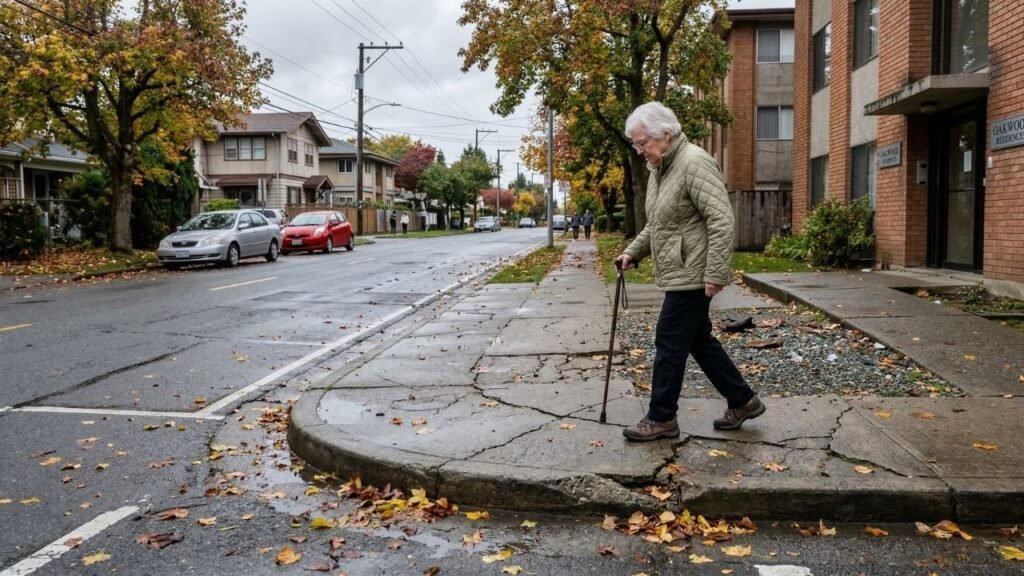
One of the biggest barriers to addressing outdoor mobility challenges for seniors is the assumption that if a fall has not happened yet, the risk must be low. But outdoor fall hazards are cumulative, and near-misses often go unreported. A typical unsafe scenario might look completely routine on the surface — an older adult walking to a neighbor’s house on a mild afternoon. But look closer.
The sidewalk has a two-inch lip where one section of concrete has shifted upward from tree root growth. The senior is wearing flat-soled loafers that provide no ankle support and minimal traction. There is a curb at the end of the block with no curb cut, requiring a step-down onto asphalt. The walking route crosses a stretch of decorative gravel in front of a building entrance. Each of these details represents a fall risk on its own. Together, these hazards create a gauntlet that an older adult may navigate without realizing how close each step comes to a loss of balance.
Caregivers can do something remarkably simple that changes how they see these risks: walk the route yourself while deliberately looking at the ground every few seconds. Notice where the surface changes, where the curbs are, where the gravel starts, and where water pools after rain. This exercise takes ten minutes and reveals hazards you would never see from a car window.
Navigating Curbs, Steps, and Uneven Surfaces
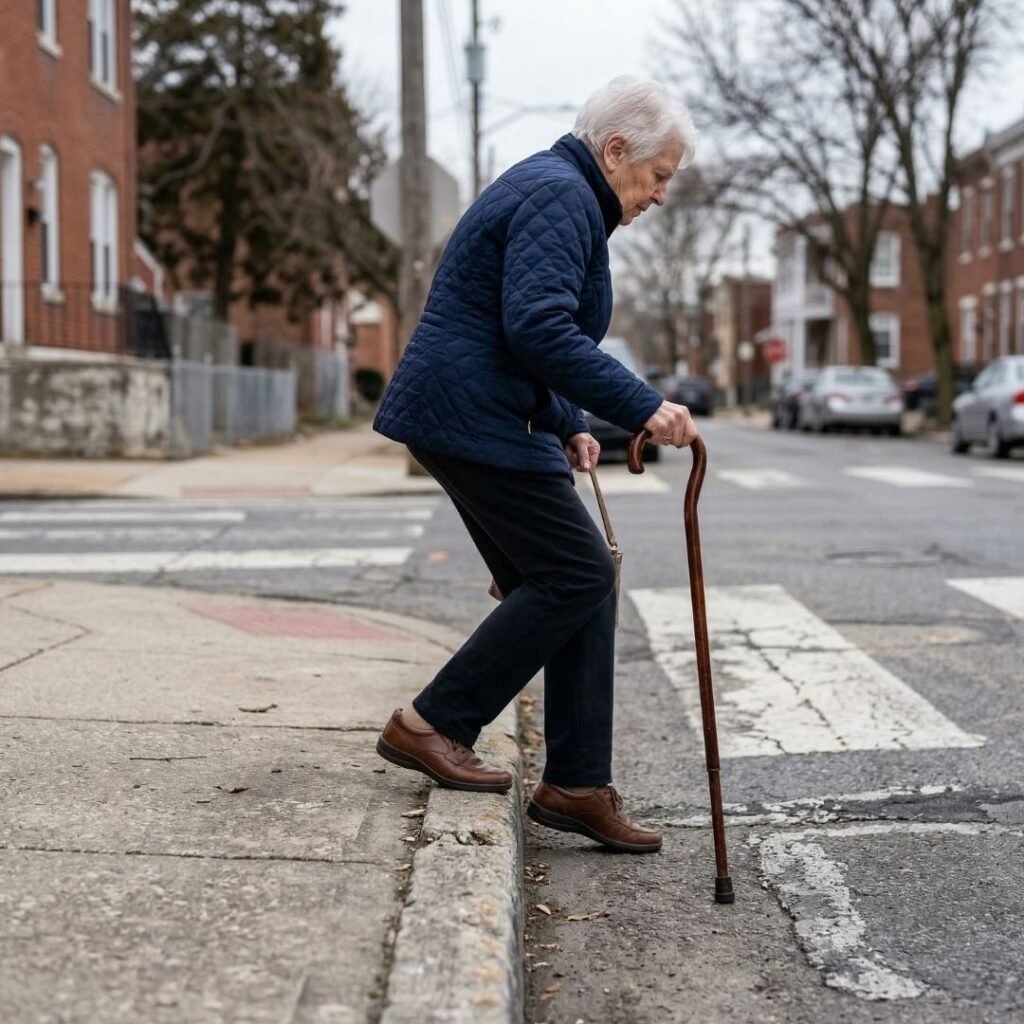
Curbs are among the most common outdoor mobility challenges for seniors because they are everywhere and they require a precise combination of balance, depth perception, and leg strength. A standard curb is four to six inches high — a height that barely registers for a younger adult but demands significant effort from someone with weak quadriceps, stiff knees, or impaired depth perception. Stepping up onto a curb requires lifting the entire body weight on one leg. Stepping down requires controlled lowering, which is even harder because the brain must gauge the exact distance to the lower surface.
The safest approach to a standard curb without a ramp is to face it squarely, not at an angle. When stepping up, the stronger leg goes first. When stepping down, the weaker leg or the cane goes first, followed by the stronger leg. If using a walker, the walker should be placed on the upper surface first when going up, and lowered to the street level first when stepping down. These sequences feel counterintuitive at first, but they keep the body’s center of gravity stable throughout the transition.
Uneven sidewalks present a different kind of risk. Tree roots, frost heave, and settling can create lips, cracks, and tilted sections that are easy to miss, especially in low light. The key habit is scanning the path several feet ahead rather than looking down at your feet. This gives the brain time to register a surface change and adjust the stride. Seniors who use walking poles for stability have an advantage here because the poles provide advance tactile information about the surface before the feet arrive.
Outdoor steps — at building entrances, park paths, and parking garages — require the same approach as curbs but with added caution because multiple steps create a rhythm that can mask a sudden change in step height or depth. Always use the handrail when one is available, and pause at the top or bottom rather than trying to transition directly from walking to climbing.
Handling Gravel, Grass, Sand, and Loose Terrain
Loose surfaces rank among the most serious outdoor mobility challenges for seniors because they violate a basic assumption — that the ground will stay still when you push off it. On gravel, sand, or wet grass, part of your force is absorbed by the shifting surface, reducing traction and making every step less stable.
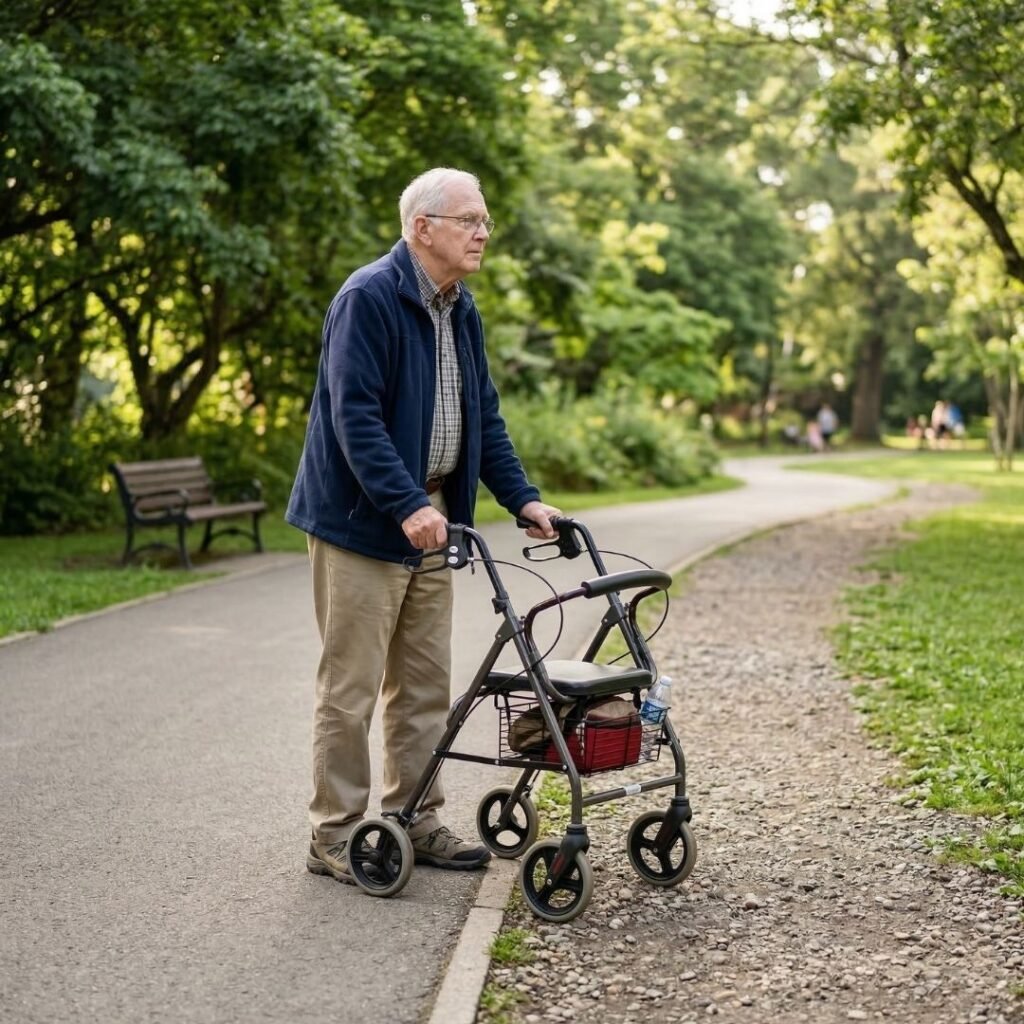
Gravel is particularly dangerous because it looks solid but behaves unpredictably under pressure. Small stones roll, larger stones tilt, and the depth is never consistent. A senior walking across a gravel parking area or garden path should take short, flat steps rather than normal heel-to-toe strides. Keeping the feet lower to the ground and wider apart reduces the chance of a stone rolling underfoot.
Grass can hide holes, dips, tree roots, and sprinkler heads beneath a seemingly smooth surface. Wet grass is especially slippery — the combination of moisture and organic material creates a low-friction surface that catches many seniors off guard. Stick to mowed, well-maintained grass and avoid walking on it after rain or heavy dew.
Sand is exhausting and unstable because it requires significantly more energy to walk through while providing almost no firm footing. For older adults who enjoy beach access, walking on wet packed sand near the waterline is far safer than dry loose sand. All-terrain wheelchairs with wide, low-pressure tires can make beach or trail access possible for seniors who cannot walk on sand safely.
Weather-Related Challenges: Rain, Ice, Heat, and Wind
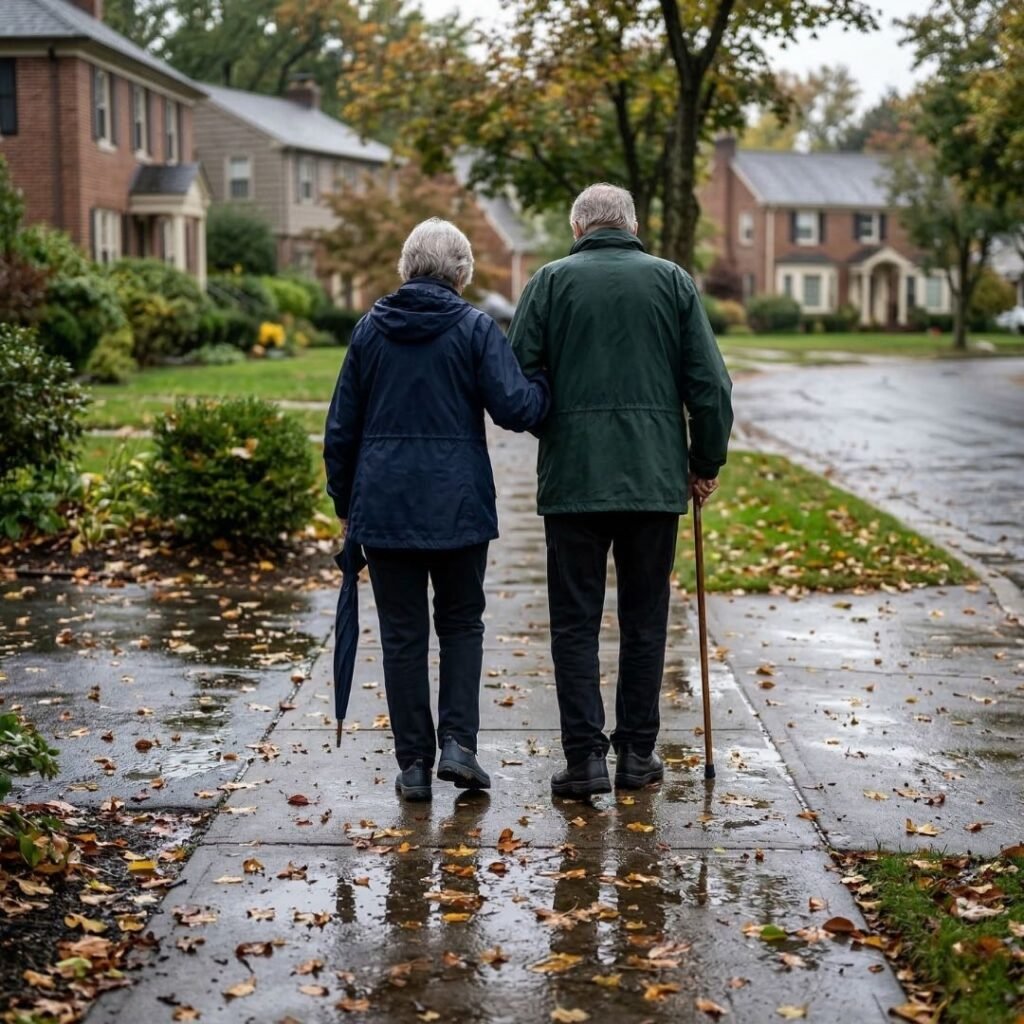
Weather transforms outdoor mobility challenges for seniors from manageable to dangerous in a matter of hours. The same sidewalk that was perfectly safe yesterday becomes a fall risk today because it rained overnight and no one cleared the wet leaves. Weather-related fall prevention starts before the senior steps outside — checking the forecast, assessing current conditions from a window, and deciding whether the trip is worth the risk.
Rain makes nearly every outdoor surface more slippery, but the most dangerous period is the first fifteen minutes of a rainstorm. That is when water mixes with oil, dust, and debris to create a slick film. Concrete, metal grates, and painted crosswalk markings all become significantly more hazardous when wet. Rubber-soled shoes with deep treads provide substantially better grip than smooth-soled alternatives.
Ice is the single most dangerous weather condition for senior outdoor mobility. Black ice — a thin, transparent layer on pavement — is nearly invisible and causes falls with no warning. Seniors should avoid going outside during or immediately after freezing rain. If walking on potentially icy ground is unavoidable, the safest technique is the penguin walk — short, flat-footed steps with the feet slightly turned outward and the arms held low for balance.
Heat is an underappreciated hazard. High temperatures cause fatigue, dizziness, and dehydration, all of which impair balance and reaction time. Seniors taking diuretics or blood pressure medications are especially vulnerable. Walking during the coolest parts of the day — early morning or evening — and staying hydrated significantly reduce heat-related fall risk.
Wind can physically push an unsteady senior off balance, especially someone who is frail or using a walking aid that catches the wind. Sustained winds above fifteen miles per hour warrant extra caution, and gusty conditions near buildings can be particularly disorienting.
Special Considerations: Wheelchair and Walker Users, Post-Surgery Recovery, and Dementia
Outdoor mobility challenges for seniors are amplified for those who use assistive devices. A standard walker works well on smooth indoor floors but catches on cracked pavement, gravel, and grass. Rollators perform better outdoors but can roll unexpectedly on slopes or loose ground. Seniors using rollators should keep the brakes partially engaged on any downhill surface and fully locked whenever they stop.
Wheelchair users face a distinct set of challenges. Standard wheelchairs have narrow tires that sink into gravel, get stuck in grass, and lose traction on wet surfaces. Curbs without ramps are complete barriers. Seniors who rely on wheelchairs outdoors should consider mobility devices that support independence designed for varied terrain, including models with wider tires and all-terrain capability. Even with the right equipment, outdoor wheelchair use requires route planning — knowing where the curb cuts are, which paths are paved, and where accessible entrances are located.
Seniors recovering from hip replacement, knee surgery, or a recent fall face temporary but significant outdoor limitations. Surgical restrictions on weight-bearing and twisting make outdoor surfaces far more challenging. Stick to flat, paved surfaces with predictable conditions, and only increase outdoor activity as the physical therapist approves. A single fall during recovery can undo months of surgical repair.
Seniors living with dementia face challenges that go beyond the physical. Cognitive impairment affects judgment, spatial awareness, and the ability to recognize hazards. A person with moderate dementia may walk toward a curb without slowing down or become disoriented and wander from a safe route. Outdoor time remains important for cognitive and emotional health, but it should be supervised, on familiar routes, and during consistent times of day to reduce confusion.
Frequently Asked Questions
1. What are the most common outdoor fall hazards for seniors?
The most common outdoor fall hazards include uneven sidewalks, curbs without ramps, loose gravel or mulch, wet or icy surfaces, cracked pavement, and tree roots that lift walkway sections. Decorative surfaces like cobblestone and brick are also problematic due to uneven joints and slipperiness when wet. The highest-risk moments are surface transitions — stepping from concrete onto grass, or from a flat sidewalk down a curb — because these require rapid adjustments in balance.
2. How can seniors safely navigate curbs without a ramp?
When stepping up a curb, the senior should face it squarely and lead with the stronger leg, then bring the weaker leg up to meet it. When stepping down, the cane or weaker leg goes first, followed by the stronger leg. If using a walker, place it on the upper level first when going up, or lower it to the street first when going down. Avoid approaching curbs at an angle, as this shifts the center of gravity sideways and increases the chance of a stumble. If the curb feels too high or the senior is unsteady, walking to the nearest curb cut or ramp is always the safer choice.
3. Is it safe for elderly adults to walk on gravel or uneven ground?
It depends on the individual’s balance, strength, and footwear. Seniors with good balance and sturdy shoes with deep treads can walk on packed gravel cautiously by taking short, flat steps. Loose or deep gravel, however, is risky for most older adults because it shifts underfoot and provides no stable base. Uneven ground — such as a yard with hidden dips or a trail with exposed roots — should be approached with extra caution and ideally with a walking aid. If balance is impaired or the senior has a history of falls, avoiding loose and uneven surfaces entirely is the safest approach.
4. What weather conditions are most dangerous for senior mobility?
Ice is the most dangerous weather condition for outdoor falls in seniors, particularly black ice that forms an invisible layer on pavement. Wet surfaces immediately after rain are the second highest risk, especially when combined with fallen leaves or painted markings on the ground. Extreme heat increases fall risk indirectly through dehydration, dizziness, and fatigue. Strong wind can physically destabilize a frail senior or someone using a walking aid. Any combination of these factors — such as wind-driven rain on a cold day — multiplies the risk significantly.
5. What type of footwear helps prevent outdoor falls in older adults?
The best outdoor footwear for fall prevention has a firm rubber sole with deep treads, a low wide heel for stability, a snug ankle fit to prevent rolling, and a lightweight design. Shoes should fasten securely with laces or velcro rather than being slip-on, because loose shoes can catch on uneven surfaces. Avoid smooth leather soles, high heels, and open-back sandals. In wet or icy conditions, removable traction devices can provide additional safety.
Final Thoughts
Outdoor mobility challenges for seniors are real and they are everywhere — in the curb at the end of the driveway, the gravel in the church parking lot, the wet leaves on the sidewalk after an autumn rain. But these challenges do not have to mean the end of outdoor activity. The seniors who stay active the longest are not the ones who avoid going outside. They are the ones who learn to read the environment, choose appropriate footwear, use assistive devices without hesitation, plan routes that minimize hazards, and accept help when conditions exceed their abilities.
Start with the most immediate risk. If your loved one walks the same route regularly — to the mailbox, to a neighbor’s house, around the block — walk that route yourself and look at it through the lens of someone with stiff knees, reduced vision, and slower reflexes. Note where the curbs are, where the surface changes, where water collects, and where there is no handrail. Then address what you can — choose a safer route, improve footwear, add a walking aid, or simply accompany them on the sections that pose the greatest risk. Each adjustment on its own is small. Together, they create the kind of outdoor safety that allows a senior to keep stepping outside with confidence rather than fear.
Medical Disclaimer: The information provided on this website is for educational purposes only and should not replace professional medical advice. Always consult your physician or qualified healthcare provider regarding any medical condition or treatment decisions.
