
Affiliate Disclaimer: This article contains affiliate links. As an Amazon Associate, Mobility With Ease may earn a small commission from qualifying purchases at no additional cost to you.
For most adults, putting on a pair of socks is so automatic that it barely registers as a task. For older adults living with arthritis, hip pain, balance problems, or recovery from surgery, that same simple action can become one of the most painful and risky moments of the day. Bending forward to reach the foot strains the lower back, compresses the hips, and shifts the body’s center of gravity in a way that can easily lead to a fall. The best sock aids for seniors are designed to eliminate that movement entirely, allowing an older adult to put on socks while sitting safely upright in a chair.
Sock aids are part of a broader category of dressing tools that includes long-handled shoe horns, dressing sticks, reachers, and button hooks. Together, these inexpensive tools restore something far more important than convenience — they restore independence. A senior who can dress without help in the morning starts the day with confidence rather than frustration, and family caregivers gain back precious time. This 2026 guide walks through the top sock aids and dressing tools available right now, how to choose the right one, and how to use them safely.
Why Sock Aids and Dressing Tools Matter for Seniors
The act of getting dressed places more demand on the body than most people realize. Bending over to pull on a sock requires hip flexion past 90 degrees, lumbar spine rotation, and a brief shift of weight onto one side of the body. For a younger person, none of this is notable. For a senior with reduced flexibility, weakened core muscles, or post-surgical restrictions, the same motion can trigger pain, dizziness, or a loss of balance. Sock aids for seniors solve this by holding the sock open in a rigid cradle that the foot slides into, eliminating the need to reach forward at all.
Beyond pure physical safety, dressing aids preserve dignity. Many seniors avoid asking for help with dressing because the task feels too personal, too intimate, or too small to bother a family member with. The result is often that they wear the same easy-to-pull-on clothes day after day, or they skip socks entirely and risk cold feet and reduced circulation. A simple sock aid changes that dynamic. According to the National Institute on Aging, supporting daily living independence is one of the most important factors in successful aging in place. Tools that allow a senior to dress themselves contribute directly to that goal.
For families, dressing tools also reduce the daily caregiver workload. Each independent task a senior can perform is one less interruption to a caregiver’s day, and one less moment of strain on their own back from helping with bending tasks. The economic and emotional return on a fifteen-dollar sock aid for seniors is hard to overstate. Family caregivers consistently report that the morning dressing routine is one of the most physically demanding parts of their day, especially for those who care for a parent or spouse with limited mobility. A simple sock aid can shave fifteen to twenty minutes off the morning routine and remove the lifting and bending that puts caregivers at risk for their own back injuries. Over months and years, the cumulative savings in time, energy, and physical strain are significant.
Doctor’s Note: Choosing the Right Sock Aid for Seniors
In my practice, I see patients struggle with dressing far more often than they admit. Most don’t bring it up unless I ask directly, and even then they often dismiss it as “just one of those things.” But when I follow up about their pain, their fall history, and their morning routine, dressing turns out to be a flashpoint for many of them. I recommend a sock aid for nearly every patient over 70, and I require one for every patient recovering from hip or knee replacement surgery.
When I help a patient choose among sock aids for seniors, I look at three things. First, grip strength — patients with arthritis or weak hand muscles need a sock aid with thick foam handles and a longer pull cord, because thin nylon straps can dig into the palms. Second, sock type — a senior who wears medical compression stockings needs a rigid metal donner, not a flexible plastic cradle. And third, the user’s back and hip flexibility, because a longer pull cord allows the user to stay upright in their chair instead of leaning forward even slightly.
I also tell every patient that the sock aid is only one piece of a complete dressing kit. A long-handled shoe horn, a dressing stick, and a reacher together make the entire morning routine safer. The combined cost is usually under fifty dollars, and the impact on quality of life is immediate. I have had patients cry the first time they put on socks without help after months of relying on a spouse or home health aide. That is how meaningful these small tools can be.
Best Sock Aids and Dressing Tools for Seniors (Top Picks)
Below are our top picks for sock aids for seniors and the supporting dressing tools that round out a complete daily living kit. Each product was selected based on grip-friendly design, durability, and real-world feedback from older adults and caregivers.
Best Overall
RMS Sock Aid Kit (Easy On / Easy Off with Stocking Remover)
The RMS Sock Aid Kit earns the top overall spot because it solves both halves of the problem. The kit includes a flexible sock aid for putting socks on and a separate stocking remover for taking them off — a feature most kits skip entirely. The long pull cord is generous enough for tall users, and the foam-padded handles are easy to grip even with arthritic hands. The flexible cradle works with regular cotton socks, athletic socks, and most light compression styles, making it the most versatile sock aid for seniors on the market in 2026.
Pros
- Includes both a sock aid and a stocking remover
- Long 38-inch pull cord for tall users
- Foam-padded handles are easy on arthritic hands
- Works with most sock types including light compression
Cons
- Flexible design is not ideal for heavy medical-grade compression stockings
- Larger storage footprint than minimalist sock aids

- Note: This product is not for use with compression socks or compression stockings. Recommended regular sock types: ankle socks, flat socks, knee socks, calf length socks, athletic socks, dress socks...
- The 2-Piece Set Kit Includes: One Deluxe Sock Aid with Foam Handle and One Sock or Stocking Remover / Doffer. Sock Aid Kit is the fast & easy way to put on & take off your socks or stocking.
- The Deluxe Sock Aid - The shell is soft and flexible, specially designed for individuals who have weak hand strength, making it easy to insert socks onto the sock aid.
Best Combo Kit
Vive Sock Aid Device for Seniors and Shoe Horn Kit
The Vive Sock Aid & Shoe Horn Kit bundles two of the most essential dressing tools into a single affordable package. The sock aid features adjustable soft foam handles, a flexible shell that fits socks of all sizes, and a nonslip lining inside the cradle that keeps the sock from sliding off as it glides over the heel. The included 23-inch detachable shoe horn lets the user slip into casual, athletic, or dress shoes without bending, and separates into two pieces for easy storage and travel. For seniors buying their first set of dressing aids, this combo eliminates the guesswork of choosing tools separately and covers the two pieces most people use every morning.
Pros
- Two essential tools in one affordable package
- Adjustable foam handles reduce hand strain
- Nonslip lining keeps the sock seated in the cradle
- Detachable shoe horn for portable storage and travel
Cons
- Not designed for medical-grade compression stockings
- 23-inch shoe horn may be short for very tall users
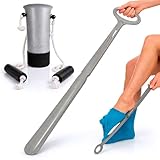
- EASILY PUT ON AND TAKE OFF SOCKS AND SHOES: Promoting greater independence, the Vive sock and shoe assist kit provides daily assistance for putting on and taking off socks, hosiery and shoes. Ideal...
- ADJUSTABLE SOCK AID: Constructed with a strong, yet flexible shell, the sock assist can be used to put on socks of all sizes with greater ease. A nonslip lining on the base of the sock aid ensures the...
- LONG HANDLED SHOE HORN: Eliminating the need to bend and twist to put on shoes, the Vive detachable shoe horn measures 23” in length and includes a large oval handle for a comfortable grip and easy...
Best for Compression Socks
Jobst Stocking Donner
Compression stockings are notoriously difficult to put on, even for healthy adults. They require firm, even tension to slide over the heel, and any wrinkle or twist can cause discomfort or restrict circulation. The Jobst Stocking Donner is a rigid metal frame designed specifically for medical-grade compression stockings up to 30–40 mmHg. The user stretches the stocking over the frame, places their foot inside the opening, and the frame guides the stocking up over the heel without bunching. For seniors with venous insufficiency, lymphedema, or post-surgery swelling, this is the only sock aid that reliably works.
Pros
- Designed for high-grade medical compression stockings
- Sturdy metal frame holds the stocking taut
- Reduces the strain of fighting tight elastic
- Doctor-recommended for circulation patients
Cons
- More expensive than standard sock aids
- Requires more setup time per use
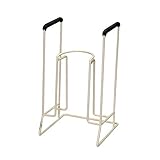
- PUT ON COMPRESSION STOCKINGS - Steel frame holds hosiery so you can step in from a seated or standing position.
- COMFORTABLE GRIP - Foam-coated handles provide a trusty grip while you are putting on medical socks.Do not use bleach
- FOR THOSE RECOVERING OR ELDERLY - Ideal for those who have restricted bending motion or limited use of their hands
Best Reacher / Grabber
Vive Folding Reacher Grabber (32″)
A reacher is the most-used dressing tool for many seniors, and the Vive 32-inch Folding Reacher Grabber is the most practical version on the market. The folding design makes it easy to store in a drawer, slip into a tote bag, or pack for travel — a feature that one-piece reachers do not offer. The trigger is sensitive enough for arthritic hands to operate without strain, and the rotating jaw allows the user to grasp objects from any angle. At 32 inches, it is long enough to reach the floor from a seated position and high enough to grab items from a standard closet shelf, while folding in half when not in use.
Pros
- Folds in half for compact storage and travel
- Sensitive trigger ideal for arthritic hands
- Rotating jaw grips at any angle
- Heavy-duty construction for daily use
Cons
- 32-inch length may be longer than shorter users need
- Folding hinge adds a small pinch point if folded carelessly

- 32” OF ADDED REACH: Easily reach dropped items, high shelving and behind furniture and appliances with the 32” folding reacher by Vive. Featuring a rotating jaw and comfort grip trigger, the...
- PATENTED FOLDING DESIGN: Easily folding in half for compact storage, the folding reacher features a unique hinge that locks into place with a simple push button. Constructed with a lightweight...
- ROTATING PRECISION CLAW: Measuring 4” wide, the folding reacher claw is lined with a rubberized material for a nonslip grip on any surface, including smooth glass. The claw can be rotated 90 degrees...
Best Long-Handled Shoe Horn
Vive Extra Long Handled Shoe Horn (31.5″)
A long-handled shoe horn solves the same problem as a sock aid but for shoes. At 31.5 inches, the Vive Extra Long Shoe Horn lets the user slip into shoes while standing fully upright or seated, without bending the back or hips. The stainless steel construction is far more durable than plastic versions, and the curved tip glides smoothly into the back of the shoe without scraping the heel. The extra-long reach makes it especially useful for taller seniors and for those wearing boots, where shorter shoe horns simply do not reach.
Pros
- Sturdy stainless steel construction lasts for years
- Extra-long 31.5-inch length suits tall users and boots
- Smooth curved tip protects shoe interiors
- Hooked handle for easy hanging storage
Cons
- Metal can feel cold to the touch
- Length may be more than shorter users need
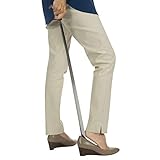
- EXTRA LONG SHOE HORN: Easily put on shoes while standing without bending or twisting with the Vive stainless steel shoe horn. The long shoe horn measures 31.5” in length and features a sleek, curved...
- CLASSIC LEATHER GRIP: A soft brown leather sleeve encloses the handle for a classic look and comfortable feel. Gently curved, the shoe horn handle provides a secure grip for seniors, the elderly, men...
- DURABLE STAINLESS STEEL CONSTRUCTION: Measuring 31.5” in length, the long metal shoe horn is made with strong stainless steel that will not bend, warp or rust.
Best Dressing Stick
RMS Deluxe Dressing Stick (28″)
A dressing stick is the unsung hero of senior dressing kits. The 28-inch RMS Deluxe Dressing Stick has a hook at one end for pulling shirts, pants, and jackets onto the body without twisting the shoulders, and a push tip at the other end for guiding clothing off the body. It is especially useful for seniors recovering from shoulder surgery, stroke, or any condition that limits arm range of motion. Combined with a sock aid and a long-handled shoe horn, this tool completes a fully independent dressing setup.
Pros
- 28-inch length reaches most clothing positions
- Dual-ended design (hook plus push tip)
- Useful for shoulder, stroke, and arthritis recovery
- Lightweight wooden construction
Cons
- Wooden shaft can crack if forced
- Takes practice to use efficiently
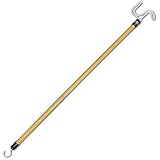
- Mostly recommended by health professionals and therapists. The Deluxe Dressing Stick makes putting on and taking off clothing easier.
- Extra Large Vinyl coated Push/Pull Hook has a unique bend to assist with putting on shirts, pulling up pants, skirts, or helping put on shoes or removing socks
- Vinyl coated "C" shaped Cup Hook on opposite end for pulling zippers and shoelace loops
Educational Overview: What Are Sock Aids Used For?
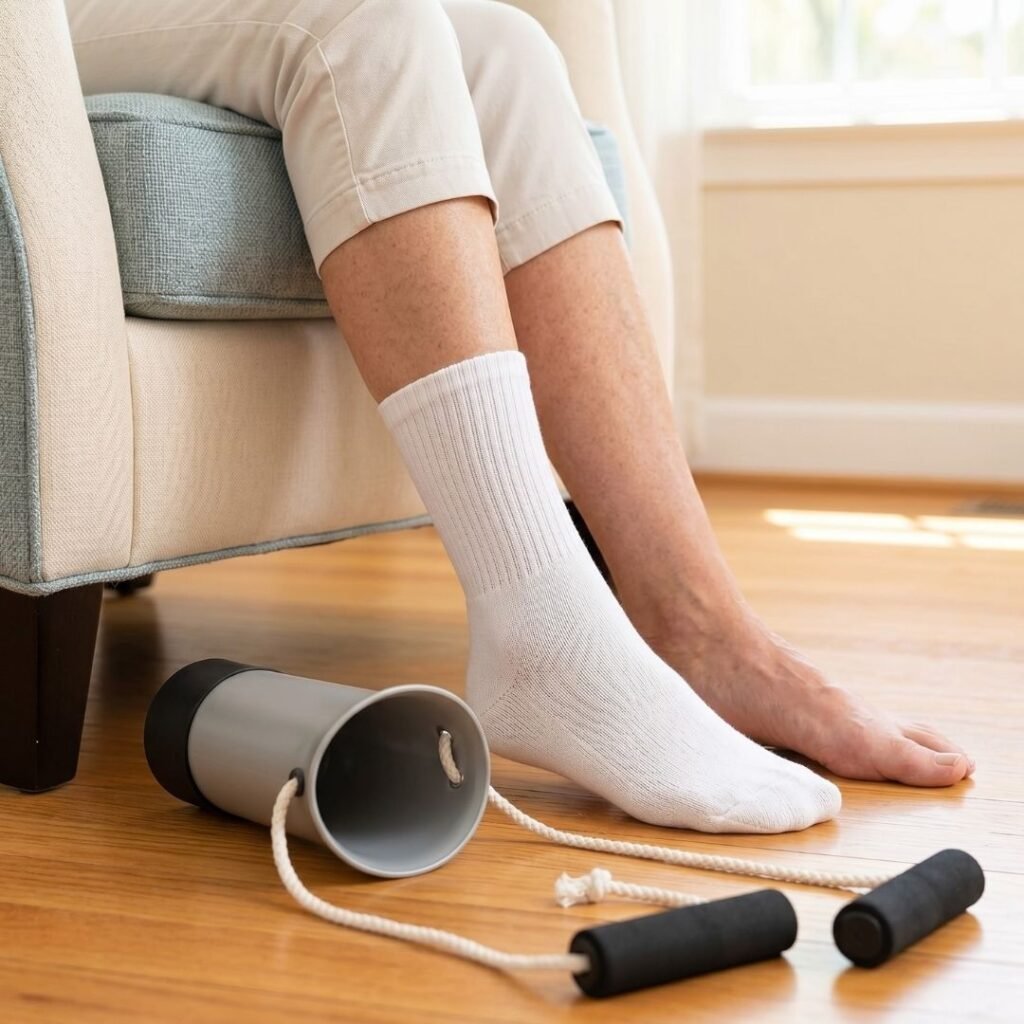
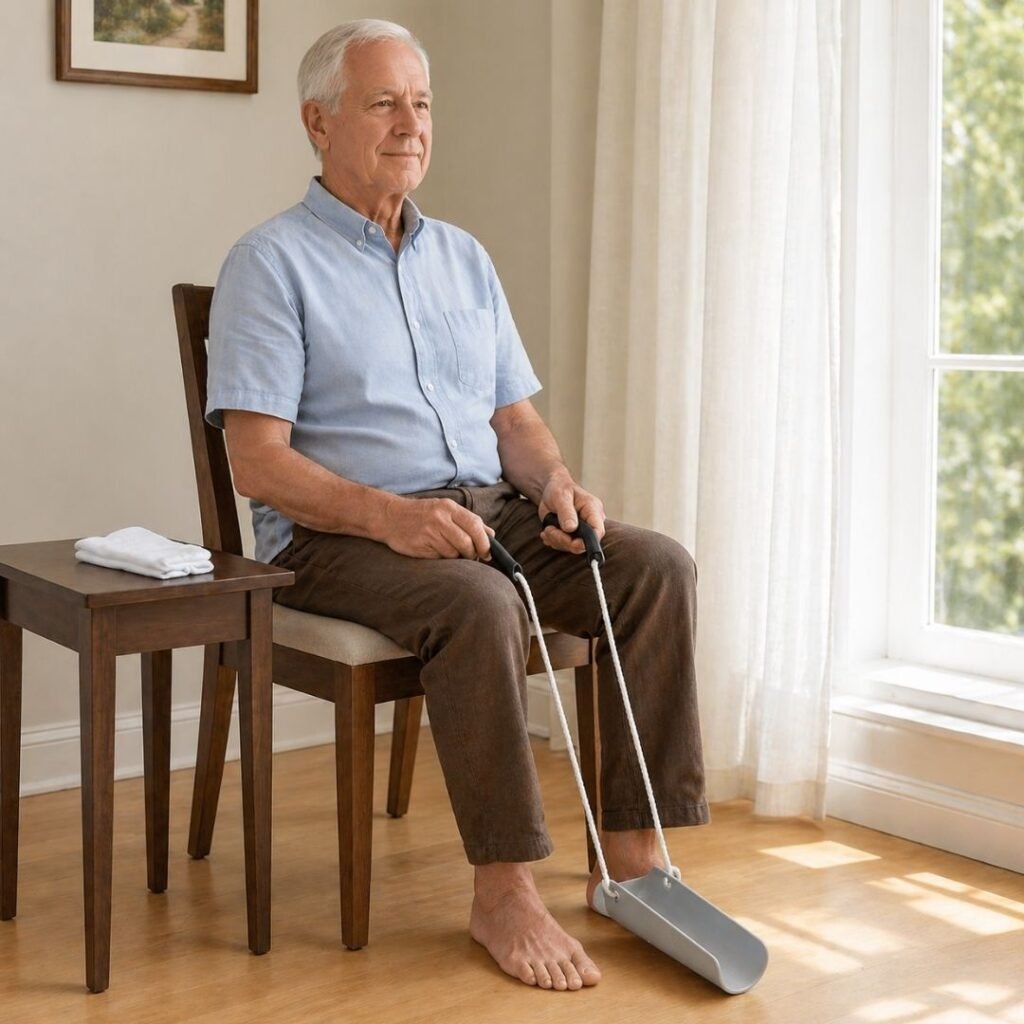
Sock aids for seniors are simple assistive devices, and a typical sock aid that holds a sock open in a rigid or semi-rigid cradle so that the user can slip their foot into it without bending forward. Once the foot is in, the user pulls on two long fabric straps attached to the cradle, which guides the sock up over the heel and onto the calf. The cradle then slides out the top of the sock, leaving the sock in place. The whole motion takes about ten seconds per foot, and it can be performed entirely from a seated position.
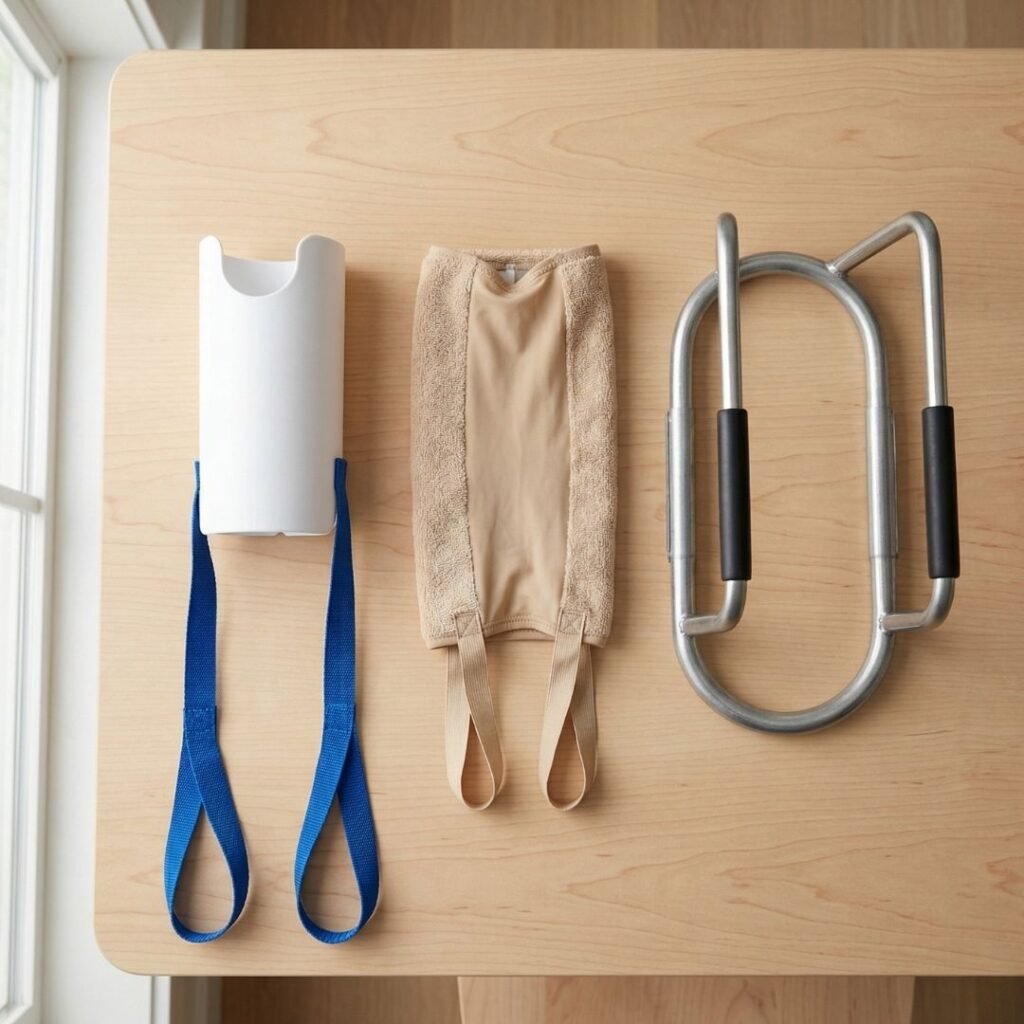
Sock aids for seniors fall into three general categories. Flexible terrycloth-and-nylon sock aids are the most common and the most affordable. They work best with regular cotton or athletic socks. Rigid plastic sock aids hold their shape better and are easier for users with weak grip strength, but they can crack if dropped. Stocking donners are the third category, designed specifically for medical-grade compression stockings. These use a rigid metal frame to hold the stocking under tension as the foot slides in. Choosing the right type depends entirely on what kind of sock the user wears every day.
Sock aids are most often recommended for seniors with arthritis, hip or knee replacement recovery, lower back pain, obesity that limits forward bending, balance disorders, Parkinson’s disease, and post-stroke weakness. They are also routinely prescribed for patients with diabetic neuropathy, who must wear special diabetic socks but cannot safely bend over to put them on. Outside the senior population, sock aids are used by pregnant women in the third trimester and by anyone recovering from spinal surgery. Occupational therapists frequently introduce sock aids during pre-surgery education sessions, so that patients can practice using the tool before they actually need it for recovery. They pair well with other adjustments around the home, especially those covered in our guide on creating a senior-friendly bathroom, where similar bending and balance considerations apply.
How to Use Sock Aids Safely
Even the best sock aids for seniors only deliver their full benefit when used the right way. Follow these steps every time.
Choose the right chair. The single most important safety rule is to always use a sock aid while seated in a sturdy, stable chair with both feet flat on the floor. A dining chair or a firm armchair works well. The edge of a bed, a low couch, or a wheeled office chair is unsafe because none of them provide the secure base needed to keep the user upright while reaching forward to drop the sock aid to the floor.
Stretch the sock fully over the cradle. Slide the sock all the way down the cradle until the heel of the sock lines up with the back of the cradle. A poorly loaded sock will slip off mid-use or twist as it goes onto the foot. Take a moment to make sure the sock is smooth and untwisted before lowering the cradle to the floor.
Lower the cradle gently. Hold both straps firmly and lower the cradle down to the floor in front of you. Keep your back straight and your shoulders relaxed. The straps should reach you while you remain upright in the chair. If you find yourself leaning forward to keep hold of the straps, the cord is too short for your height and you need a longer-corded model.
Slide the foot in slowly. Place your toes into the open top of the cradle and slide your foot forward until the heel is fully inside the sock. Then pull both straps upward in one steady motion. The sock will roll up over the heel and onto the ankle as the cradle slides out the top.
Check the sock placement. Once the sock is on, glance down to make sure it is not bunched, twisted, or partially off the heel. A poorly seated sock can cause blisters or pressure points throughout the day, especially for diabetic seniors who may not feel the discomfort right away.
Repeat for the other foot. When it comes to using sock aids for seniors safely, always finish one foot completely before starting the next. Trying to rush both feet at once leads to twisted socks and dropped sock aids, both of which create new problems.
Lifestyle Synergy: Making Dressing Tools Work Better at Home
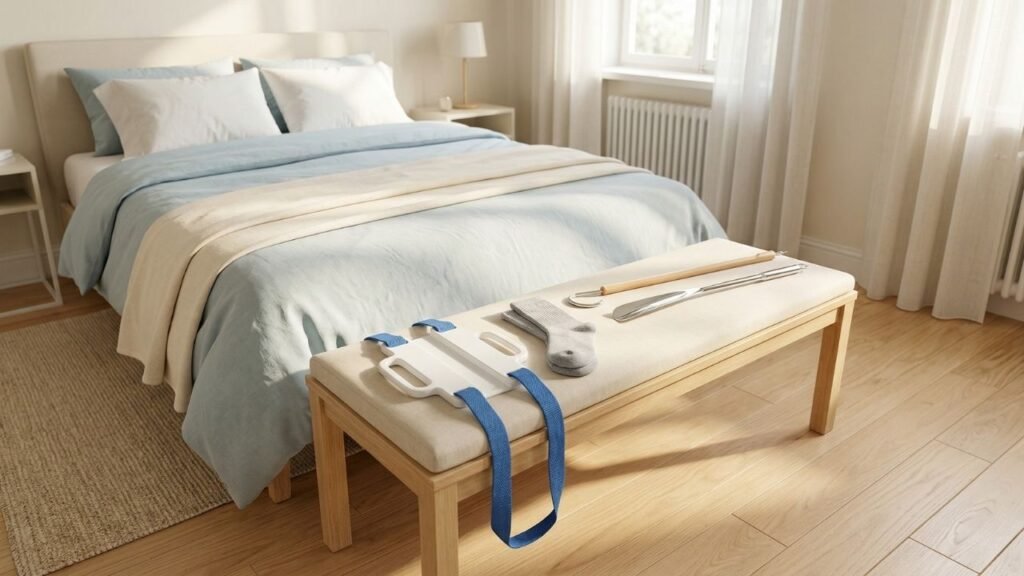
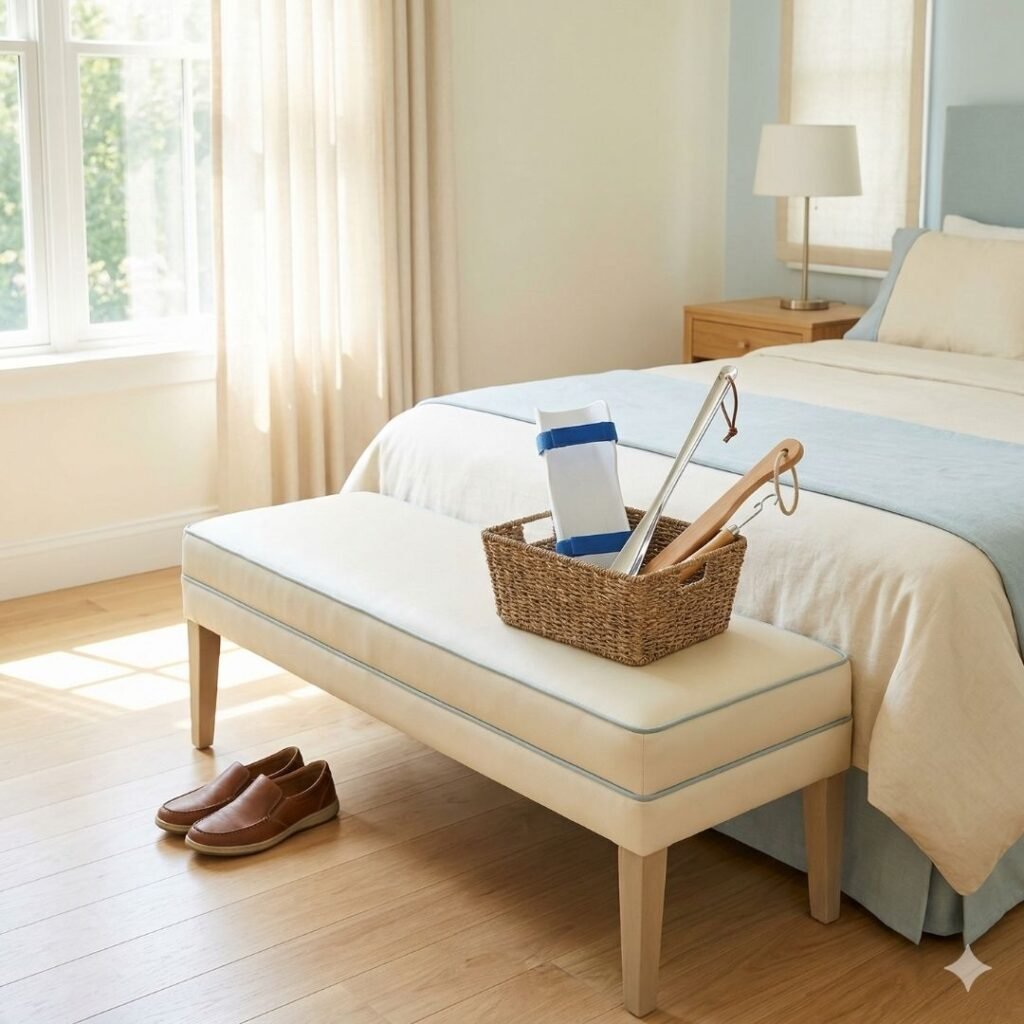
Sock aids for seniors work best when they are part of a thoughtful daily routine rather than a scattered collection of items hidden in a drawer. The most successful seniors I have worked with create a dedicated dressing station, usually a low padded bench at the foot of the bed or a sturdy chair beside a closet, with all of their dressing tools stored in a small basket within arm’s reach. The sock aid, the long-handled shoe horn, the dressing stick, and a reacher all live in the same place, every day, so that getting dressed becomes a smooth predictable sequence rather than a frustrating treasure hunt.
The room itself matters too. Good lighting, a clear path between the bed and the dressing area, and a non-slip rug under the chair all reduce the risk of falls during what is otherwise a vulnerable moment. Many of the same principles that apply to fall safety throughout the house apply here as well — the broader environment matters as much as the dressing tools themselves. A senior who uses a sock aid in a cluttered or dimly lit room is still at risk, so the room setup matters as much as the tools.
Clothing choices also matter. Pairing dressing tools with adaptive clothing and shoes for seniors — slip-on shoes, elastic-waist pants, magnetic-button shirts, and front-closing bras — multiplies the benefit. The goal is not just to make hard tasks easier, but to remove as many hard tasks from the routine as possible. A senior who wears slip-on shoes does not need to fight with shoelaces, and one who wears magnetic shirts does not need to wrestle with tiny buttons.
Physician’s Tips for Long-Term Use
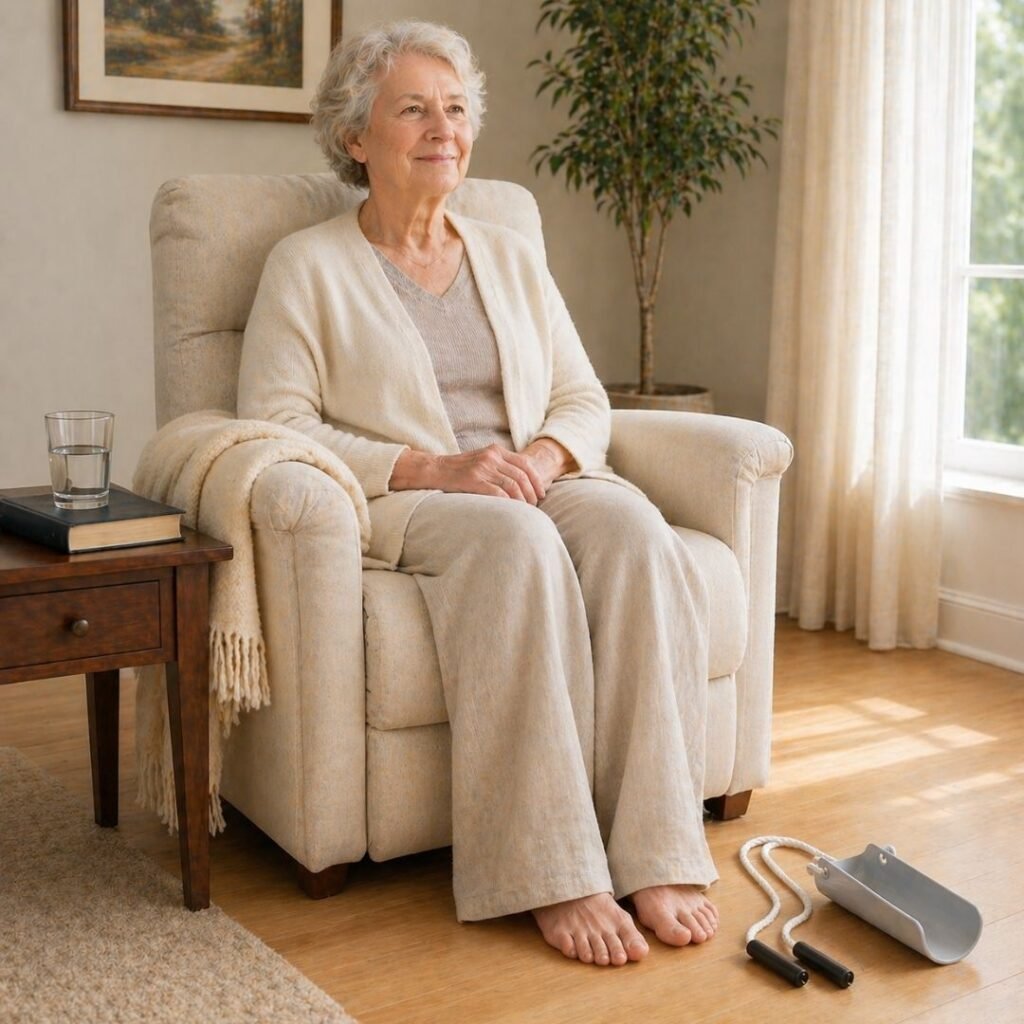
Sock aids for seniors are durable, but they do wear out. The fabric straps on a flexible sock aid will fray after a year or two of daily use, and a frayed strap can snap under tension and cause the user to lurch forward — exactly the motion the tool was meant to prevent. I tell my patients to inspect their sock aid straps every few months and replace the entire device at the first sign of wear. At under fifteen dollars per replacement, there is no reason to wait.
For patients recovering from hip replacement surgery, a sock aid is not optional — it is a medical necessity. The American Academy of Orthopaedic Surgeons identifies forward bending past 90 degrees as one of the primary risk movements for hip dislocation in the first three months after surgery, as outlined in the AAOS recovery guidelines. Every patient I see for post-surgical follow-up has a sock aid in their recovery kit, along with a reacher, a long-handled shoe horn, and a raised toilet seat. Families preparing a home for surgical recovery should make sure all four tools are in place before the patient is discharged.
I also encourage patients to keep a backup sock aid in any second location they spend regular time, such as a vacation home, a child’s house, or an assisted living suite. The cost is minimal, and having the tool available wherever the senior is means the routine never breaks. Consistency is the foundation of independent dressing, and a sock aid that lives in only one location undermines that consistency the moment travel happens. Long-term, the seniors who get the most benefit from these dressing tools are the ones who treat them as permanent parts of the daily routine rather than temporary aids.
Sock Aids and Dressing Tools Comparison for Seniors
Frequently Asked Questions
1. What is the best sock aid for seniors with arthritis?
The best sock aid for seniors with arthritis is one with thick foam-padded handles and a flexible cradle that does not require squeezing. Models like the RMS Sock Aid Kit and the Vive Sock Aid & Shoe Horn Combo are designed to minimize hand strain, since arthritic fingers struggle with thin nylon straps and tight grip requirements. A long pull cord also helps, because it lets the user keep their elbows close to their body and avoid the painful overhead pulling motion that thinner sock aids force.
2. How do you use a sock aid for seniors?
To use a sock aid, sit in a sturdy chair with both feet flat on the floor. Slide a sock all the way over the cradle until the heel of the sock lines up with the back of the cradle. Lower the cradle to the floor by holding both pull straps. Place your toes into the opening, slide your foot forward until your heel is inside the sock, and then pull both straps upward in one smooth motion. The sock will roll over the heel and the cradle will slide out the top. Repeat for the other foot.
3. Are sock aids covered by Medicare?
Standard Medicare Part B does not typically cover sock aids or dressing tools, because they are classified as convenience items rather than durable medical equipment. Some Medicare Advantage plans include over-the-counter benefit allowances that can be used to purchase sock aids and similar daily living tools. Veterans may also be able to obtain dressing aids through the VA. Always check with your specific plan, since coverage can vary widely.
4. What dressing tools help seniors after hip replacement surgery?
After hip replacement surgery, the essential dressing tools include a sock aid, a long-handled shoe horn, a dressing stick, and a reacher. These four tools allow the patient to dress completely without bending past 90 degrees at the hip, which is the critical safety rule during the first three months of recovery. Most surgeons require these tools to be in place before the patient is discharged from the hospital, and many physical therapists train patients on their use during pre-surgery appointments.
5. Can sock aids be used with compression stockings?
Standard flexible sock aids generally do not work well with medical-grade compression stockings, because the rigid elastic resists the cradle’s shape. Seniors who wear compression stockings should look for a stocking donner specifically designed for compression hosiery. These devices use a rigid metal frame to hold the stocking under tension while the foot slides in. Light support socks, however, work fine with standard sock aids.
Final Thoughts on Sock Aids and Dressing Tools for Seniors
The best sock aids for seniors are not glamorous tools, and they will never make the cover of a healthcare magazine. But for the millions of older adults who struggle every morning with the simple act of getting dressed, they represent something far more important than convenience — they represent the daily restoration of independence, dignity, and pain-free mornings. A fifteen-dollar sock aid can replace months of frustration, ease the burden on a caregiving spouse, and prevent the kind of forward-bending falls that lead to hospital stays and long recoveries.
If you are buying sock aids for seniors — whether for a parent, a partner, or yourself, start with a complete dressing kit rather than a single tool. A sock aid, a long-handled shoe horn, a dressing stick, and a reacher together cost under fifty dollars and cover virtually every dressing challenge a senior is likely to face. Add a comfortable seated dressing area at home, build the routine into each morning, and the entire experience of getting dressed becomes safer and easier. That is what the right dressing tools really offer: a quieter, calmer, more independent start to every day.
Medical Disclaimer: This guide is for general educational purposes only and is not intended to serve as personalized medical advice. Always consult a qualified healthcare professional before making changes to medical equipment or care plans.
Last update on 2026-09-15 / Affiliate links / Images from Amazon Product Advertising API
