
Affiliate Disclaimer: This article contains affiliate links. As an Amazon Associate, Mobility With Ease may earn a small commission from qualifying purchases at no additional cost to you.
Introduction
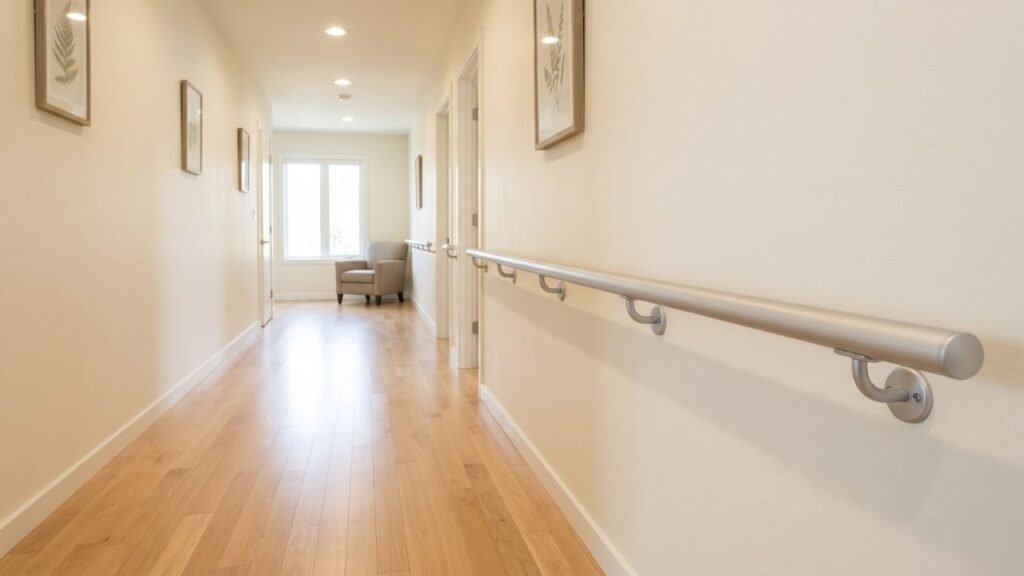
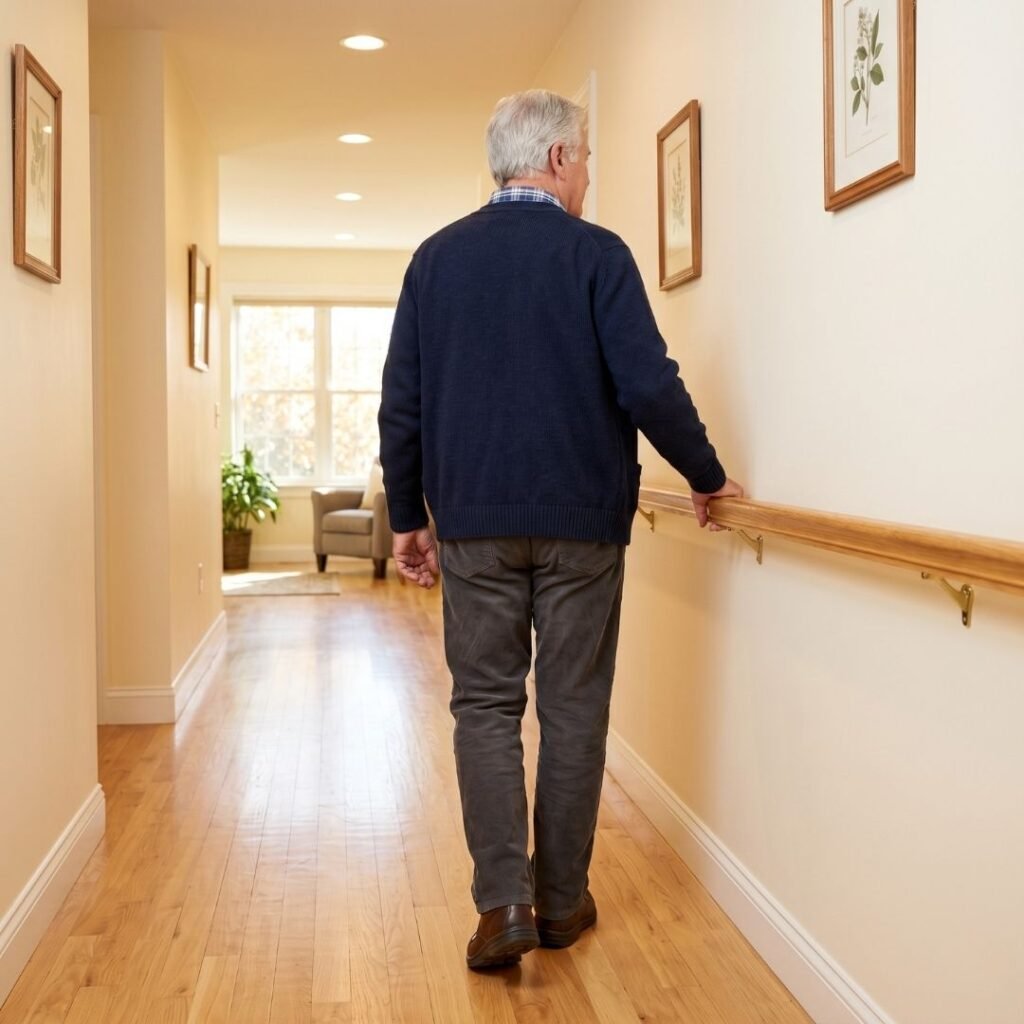
Long indoor hallways are some of the most overlooked fall zones in a senior’s home. There is nothing to grab onto, the lighting is often dim at night, and even a confident walker can drift sideways or lose balance halfway across. Handrails for indoor hallways solve this problem by giving seniors a continuous, predictable point of contact along the entire length of a corridor. Whether the hallway connects bedrooms to a bathroom, runs from a living room to a kitchen, or stretches between an entry and a back room, a wall-mounted handrail turns a high-risk passage into a steady, supported walk.
In this guide, we compare the best handrails for indoor hallways available in 2026. Each pick has been evaluated for grip comfort, mounting strength, length options, and finish quality so you can match the right rail to your wall, your hallway length, and the mobility needs of the person using it. We cover aluminum, stainless steel, wood, and lighted options across six categories to help you choose with confidence.
If you already know what you need and want to see all six picks side by side, use the button below to jump straight to the comparison table.
Why Hallway Handrails Matter for Seniors
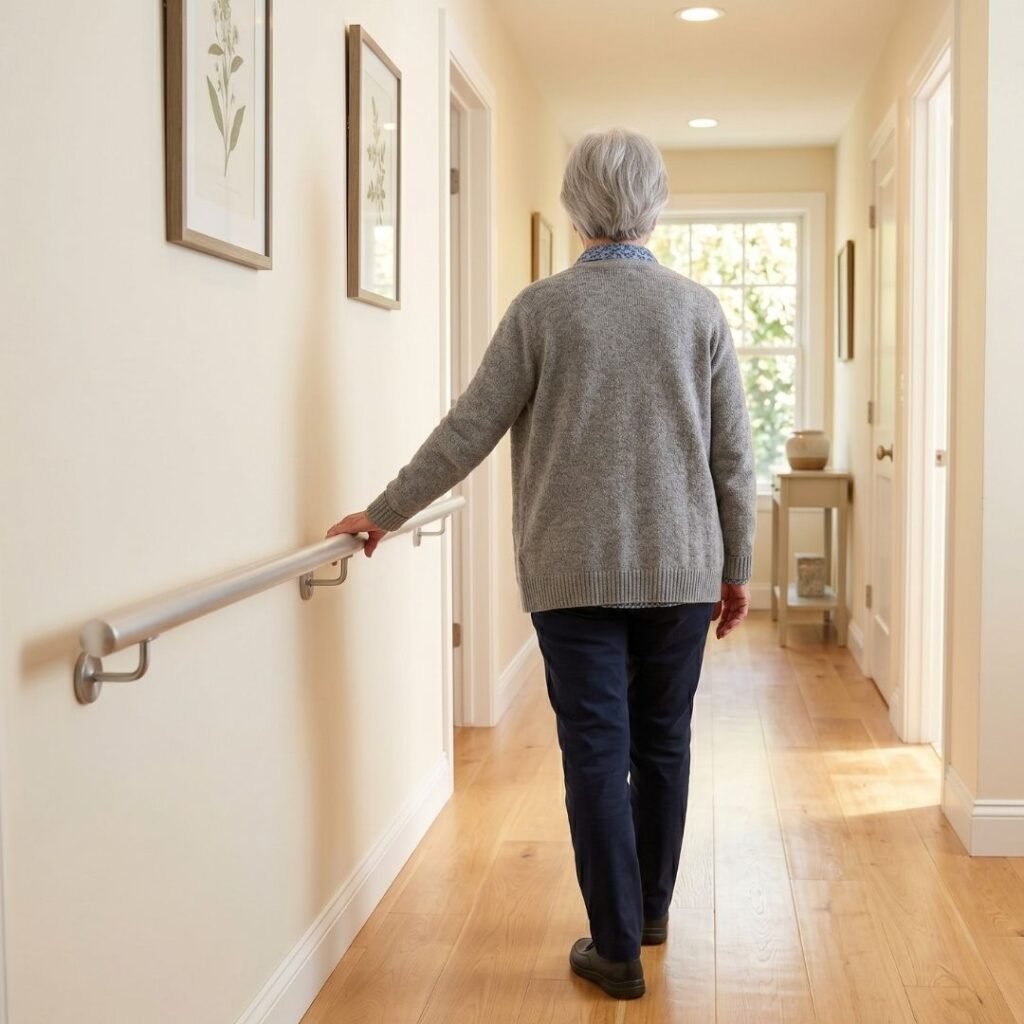
Falls are the leading cause of injury-related death among adults age 65 and older in the United States, and the CDC reports that more than one in four older adults falls at least once every year. While bathrooms get most of the safety attention, the majority of in-home falls actually happen on flat surfaces — and a long hallway is one of the most common settings. Hallways are typically narrow, often poorly lit, and almost always wall-to-wall empty of anything a person can grab if their balance suddenly slips. That combination is what makes handrails for indoor hallways such a high-impact intervention for seniors.
A continuous handrail running the length of a hallway gives a senior a third point of contact at all times, which is the same biomechanical principle physical therapists use when teaching gait stability. With a hand on the rail, the body can recover from a small stumble before it becomes a fall. The rail also encourages the senior to walk with better posture and a more deliberate stride, since the brain knows support is constantly available. For seniors recovering from hip surgery, stroke, or a recent fall, a handrail in the hallway is often the single piece of equipment that lets them move freely between rooms again without waiting for a caregiver.
Beyond fall prevention, hallway handrails also play a practical role in making your home safer for seniors as part of a broader aging-in-place strategy. They reduce the physical and emotional load on family caregivers, who no longer need to hover at the senior’s elbow during every trip down the hall. They also extend the practical life of the home — many families install handrails for indoor hallways years before they are needed full-time, so the support is already in place when mobility starts to change. The cost is modest, the installation is straightforward, and the safety return is immediate.
Doctor’s Note: Choosing the Right Hallway Handrail
I see patients every week who have fallen inside their own homes, and a surprising number of those falls happen mid-hallway, not at a doorway or on a stair. The senior is walking from the bedroom to the bathroom at night, the lighting is poor, the bladder is full, and there is nothing to reach for when balance starts to drift. Handrails for indoor hallways address this exact scenario. They give a steady, predictable point of contact from one room to the next, and they cost a fraction of what a single emergency room visit would cost a family.
When I help families choose a hallway handrail, the first thing I look at is the length of the corridor and where the rail can be continuously anchored. A short rail with a long gap before the next support is almost worse than no rail at all, because it teaches the senior to expect support that suddenly disappears. Whenever possible, I recommend a continuous rail that runs the full length of the hallway with no breaks longer than a forearm’s reach. For patients who are at elevated fall risks in seniors, that continuity matters even more — every gap is a moment without support.
I also pay close attention to grip diameter and surface texture. A rail that is too thick is hard to grip for arthritic hands, and a rail that is too thin offers no real holding power. The sweet spot for most seniors is a 1.25 to 1.6-inch round profile, which is also what the ADA specifies for accessible handrails. Surface texture matters too — a rail that gets slick from skin oils or hand sanitizer over time is a quiet hazard. The best handrails for indoor hallways have either a textured anti-slip coating or a natural grip material like wood that holds friction well across years of daily use.
Best Handrails for Indoor Hallways (Top Picks)
Best Overall
Promenaid Silver 8ft ADA Handrail Kit
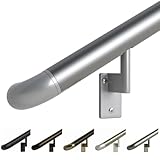
The Promenaid Silver 8ft ADA Handrail Kit is one of the most professionally designed handrails for indoor hallways available on the consumer market. The kit ships complete with a 1.6-inch round satin-anodized aluminum rail, four pivoting wall brackets, and ADA-compliant wall returns at each end so the rail finishes cleanly without a snag-prone open tip. The patented bracket channel lets installers slide each bracket along the rail to line up with wall studs at any angle, which is what makes the system genuinely easy to install on a real residential wall — no perfect stud spacing required. The aluminum is corrosion-proof and finished in a soft satin silver that works with most modern interior color palettes. For most homeowners building a senior-safe corridor, this is the rail to start with.
Pros
- Complete kit — rail, brackets, and ADA returns included
- Pivoting brackets align to studs at any angle, simplifying install
- 1.6-inch round profile meets ADA grip standards
- Indoor and outdoor rated; will not rust or corrode
Cons
- Higher price point than basic single-bar rails
- 8 feet may be longer than needed for short hallways
- MODERN DESIGN THAT ELEVATES YOUR SPACE - Sleek contemporary aluminum handrail with clean lines and ADA-compliant wall returns, elegant architectural aesthetic for residential and commercial settings...
- TRUSTED BY BUILDERS, ARCHITECTS & DIY HOMEOWNERS - Our professional-grade completely continuous system is adaptable to any project scale. Our patented clip-in brackets twist-lock into place anywhere...
- ADA-COMPLIANT WITH WALL RETURNS INCLUDED - Meets all Americans with Disabilities Act (ADA) guidelines and residential/commercial building codes across North America. Our professional-grade, completely...
Best Stainless Steel
Muzata 8Ft Pre-drilled Brushed Stainless Steel Wall Mounted Handrail
The Muzata 8-foot pre-drilled stainless steel handrail is built around a 2-inch outside-diameter round T304 stainless steel tube with a brushed satin finish that resists fingerprints and won’t rust. The rail ships with pre-drilled mounting holes and adjustable-angle wall brackets, so it can run cleanly along a level hallway wall or follow a slight pitch where a hallway transitions to a step or landing. T304 is the same grade used in commercial kitchens and medical environments, which makes the rail easy to wipe down and a strong fit for households where hygiene matters — caregivers in and out, frequent hand washing, or a senior recovering from illness. At 8 feet, it covers most residential hallways in a single rail, and Muzata offers matching 3, 5, and 10-foot versions if your wall calls for a different length. For homes that want the durability and easy-clean profile of stainless steel along a long corridor, this is one of the most practical handrails for indoor hallways on Amazon.
Pros
- T304 brushed stainless steel — rust-resistant and easy to clean
- Pre-drilled rail with adjustable-angle wall brackets
- 2-inch round profile gives a confident full-hand grip
- Multiple length options in the same product line (3, 5, 8, 10 ft)
Cons
- 2-inch diameter is on the larger side for very small senior hands
- Brushed finish shows water spots if not wiped after cleaning

- Enhanced safety :This heavy-duty stair handrail ensures safety for your family, especially for pregnant women, children, and elderly individuals. With a maximum load-bearing capacity of 200lbs, it...
- Easy installation :Pre-drilled holes and an adjustable connector make installation easy. Please ensure that you accurately measure the required length before installation and follow the instructions...
- Weather protection :Made of premium T304 stainless steel, this handrail is rust-resistant and durable, ideal for indoor and outdoor use. It's suitable for any angle stairs and landings and can be...
Best Wood
SELEWARE 52″ Beech Wood Hallway Handrail
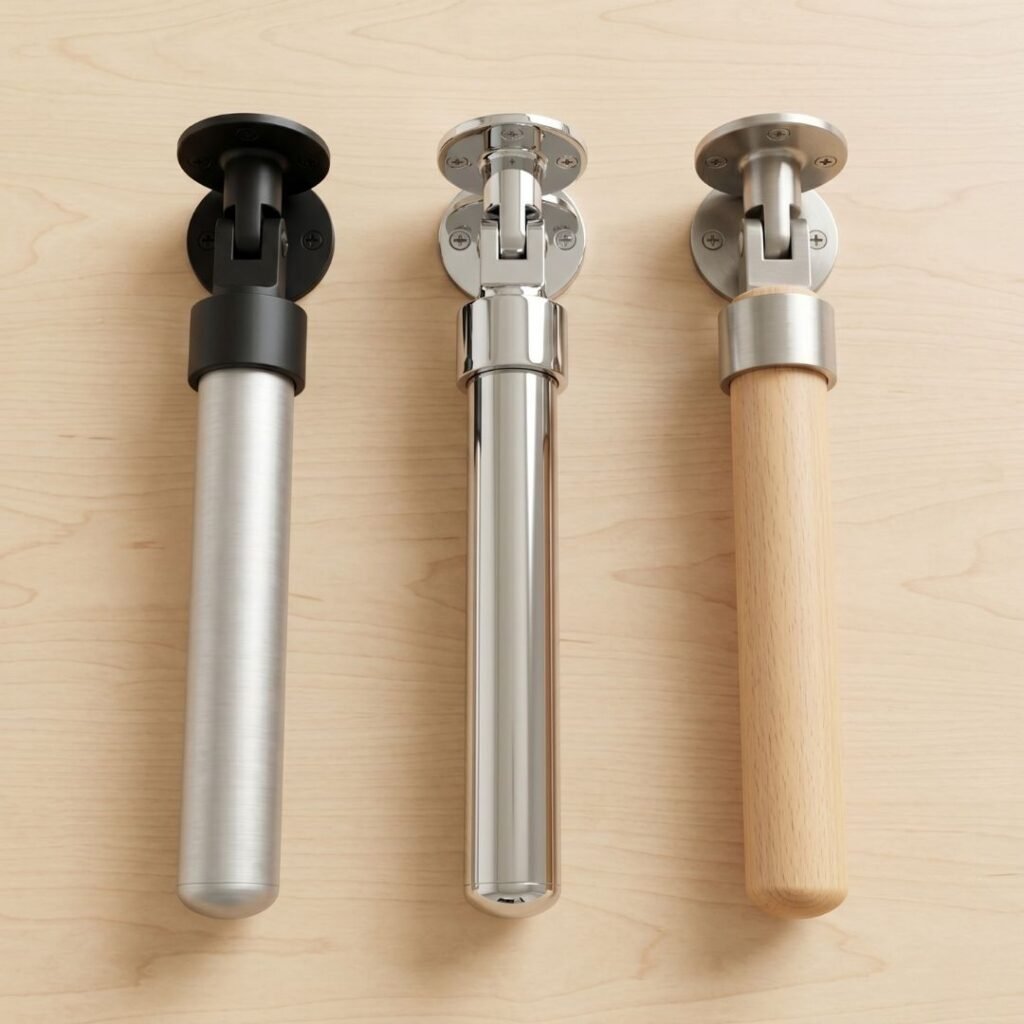
The SELEWARE 52-inch beech wood handrail is the warmest-feeling option in this guide, both literally and visually. Real beech wood does not get cold to the touch in winter the way a metal rail does, which is a real comfort difference for seniors with arthritic or circulation-sensitive hands. The 1.3-inch round profile is sized correctly for an ADA-compatible grip, and the included sturdy metal wall brackets each support up to 300 pounds of pull-down load. At 52 inches the rail covers a meaningful stretch of hallway, and longer SELEWARE rails are available if you need to chain two together. The natural wood finish blends easily with traditional decor, oak or maple flooring, and warm-toned wall paint, so it doesn’t read as a piece of medical equipment in a residential hallway.
Pros
- Real beech wood — warm grip year-round
- 1.3-inch round ADA-compatible profile
- Brackets rated to 300 pounds each
- Blends into traditional residential decor
Cons
- Wood can show wear over years of heavy daily use
- Not rated for outdoor or in-shower use

- Real wood handrail with metal brackets (already mounted on the handrail), you can tell by feeling it that it's a forever handrail made to last, each bracket supports 300 lbs.
- Stylish sturdy stairs handrail with round edge design at each end, which become more safety while little kids running everywhere at home.
- It's very good craftsmanship, you can feel the smooth when you slide your fingers from the wood to metal.
Best with LED Lighting
Motion-Sensor LED Aluminum Wall Mount Handrail
This motion-sensor LED handrail is purpose-built for one of the most dangerous fall scenarios seniors face: walking down a hallway in the middle of the night. The modern aluminum rail has an integrated strip of ultra-bright LEDs along its underside, controlled by a built-in motion sensor that activates the lights as soon as someone enters the hallway and shuts them off automatically a few seconds after the person passes. The result is a clearly lit path without ever needing to fumble for a wall switch, and without disturbing other sleepers in the home. The rail mounts to the wall like any standard handrail and is offered in left- or right-hand orientations to suit the wall layout. For seniors who get up for the bathroom multiple times a night, this is one of the most useful handrails for indoor hallways available.
Pros
- Built-in motion-activated LED lighting — no wall switch needed
- Automatic shut-off conserves battery and avoids glare
- Modern aluminum profile suits contemporary decor
- Left- and right-hand mounting orientations available
Cons
- Higher price than non-lit rails
- LED batteries or wiring need periodic checking

- Family safety: The LED strips are hidden inside the handrails and come with a diffuser cover, light transmission rate of 92% or more, soft light, clear vision. These can keep them away from little...
- Unique Design: this LED illuminated handrail is an innovative product that combines a handrail with an LED channel. A slot is cut from underneath in which the LED strip can be installed. When you get...
- Motion Sensor Light: This LED light has built-in motion detector, it will turn on immediately when it detects motion 10ft/3m away. That way, you don't have to fumble for wall switches in the dark for...
Best Budget
Purife 2FT Black Wall Mount Hand Rail
The Purife 2-foot black wall mount hand rail is the most affordable pick in this guide and a smart choice when full-length handrails for indoor hallways aren’t needed — only a short stretch of support at a specific transition point. The 24-inch rail is sized to fit short hallway segments, doorway transitions, the top of a small step, or the wall beside a bathroom entry. The black powder-coated metal finish is understated and pairs well with both modern and traditional interiors. The rail mounts with two wall brackets, giving a stable two-point install that handles steady leaning loads. While it won’t replace a continuous corridor rail, it is an excellent way to add support exactly where a senior tends to stumble without committing to a full-length system.
Pros
- Most affordable pick in this guide
- Compact 24-inch length fits short transition points
- Powder-coated black finish is understated and easy to clean
- Indoor or short outdoor use
Cons
- Too short to serve as a full hallway rail on its own
- Two-bracket install — load capacity lower than longer rails
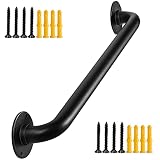
- STRONG & SECURITY HANDRAIL: These Pipe handrail, made of 1.3'' diameter iron pipe with 1.5mm wall thickness and galvanized metal, not plastic or aluminum parts, strong and solid enough to support an...
- MULTI-PURPOSE FOR WIDE USE: Perfect wood or wall mounted indoor stair railing or exterior hand rails for outdoor steps. Indoor staircase handrail for loft, apartment or basement; Outdoor patio garden...
- WHOLE ONE PART DESIGN: Instead of the assemble parts, our hand rails were full welded together in one part, really simplifly the installation and increased the stability and durability. also very nice...
Best Decorative Finish
Promenaid Architectural Bronze 9ft ADA Handrail Kit
For homeowners who want senior-safe handrails for indoor hallways without the rail looking like medical equipment, the Promenaid Architectural Bronze 9ft Kit is the right answer. It uses the same patented modular bracket system and ADA-compliant 1.6-inch round profile as the Best Overall pick, but finished in a warm architectural bronze powder coat that disappears against traditional walnut, mahogany, or oak interiors. The kit includes the rail, five pivoting bronze-painted brackets, and ADA wall returns at each end, so the install is clean and finished. At 9 feet long, it covers a meaningful stretch of hallway in a single rail without needing to splice. For families restoring a craftsman, traditional, or transitional home and adding accessibility along the way, this rail integrates instead of intruding.
Pros
- Architectural bronze finish blends with traditional decor
- 9-foot length covers most residential hallways in one rail
- Same ADA-compliant grip and bracket system as the Best Overall pick
- Indoor and outdoor rated
Cons
- Premium price point reflects the finish quality
- Bronze finish may clash with cool gray or white modern interiors
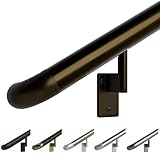
- MODERN DESIGN THAT ELEVATES YOUR SPACE - Sleek contemporary aluminum handrail with clean lines and ADA-compliant wall returns, elegant architectural aesthetic for residential and commercial settings...
- TRUSTED BY BUILDERS, ARCHITECTS & DIY HOMEOWNERS - Our professional-grade completely continuous system is adaptable to any project scale. Our patented clip-in brackets twist-lock into place anywhere...
- ADA-COMPLIANT WITH WALL RETURNS INCLUDED - Meets all Americans with Disabilities Act (ADA) guidelines and residential/commercial building codes across North America. Our professional-grade, completely...
Educational Overview: What Are Hallway Handrails Used For?
Handrails for indoor hallways are wall-mounted support rails designed to give a person a continuous handhold while walking down a corridor inside the home. Unlike short bathroom grab bars or stair handrails, hallway rails are intended to run a long, uninterrupted length so the user never loses contact with support between two rooms. They are used most often by seniors with balance loss, arthritis, recent surgery, stroke recovery, or general age-related gait changes — but they are also installed proactively in homes where a senior plans to age in place and wants the support already mounted before it becomes urgent.
The three most common materials are aluminum, stainless steel, and wood. Aluminum rails are lightweight, corrosion-proof, and available in modern powder-coated finishes that fit any decor — they are the most common choice for newer homes and ADA-compliant installs. Stainless steel rails are the most hygienic and the easiest to wipe clean, which is why they dominate nursing-home and assisted-living settings. Wood rails are the warmest to the touch and the most visually traditional, making them a favorite for older homes and craftsman interiors. Each material has trade-offs in weight, price, grip feel, and install difficulty, which is why matching the rail to the home and the user matters as much as picking a brand.
It’s also worth understanding what hallway handrails are not. They are not stair handrails, which have their own ADA slope and continuity requirements. They are not bathroom grab bars, which need to be water-resistant and rated for sudden full-body weight transfers, and they are not decorative wall trim that happens to look like a rail. A hallway handrail’s only job is to give a steady, predictable handhold along an otherwise empty wall, and it must be rated for the sudden recovery loads that come with a near-fall — not just for a senior’s hand resting on it during a calm walk. The best handrails for indoor hallways do exactly that, nothing more and nothing less.
How to Install and Use Hallway Handrails Safely
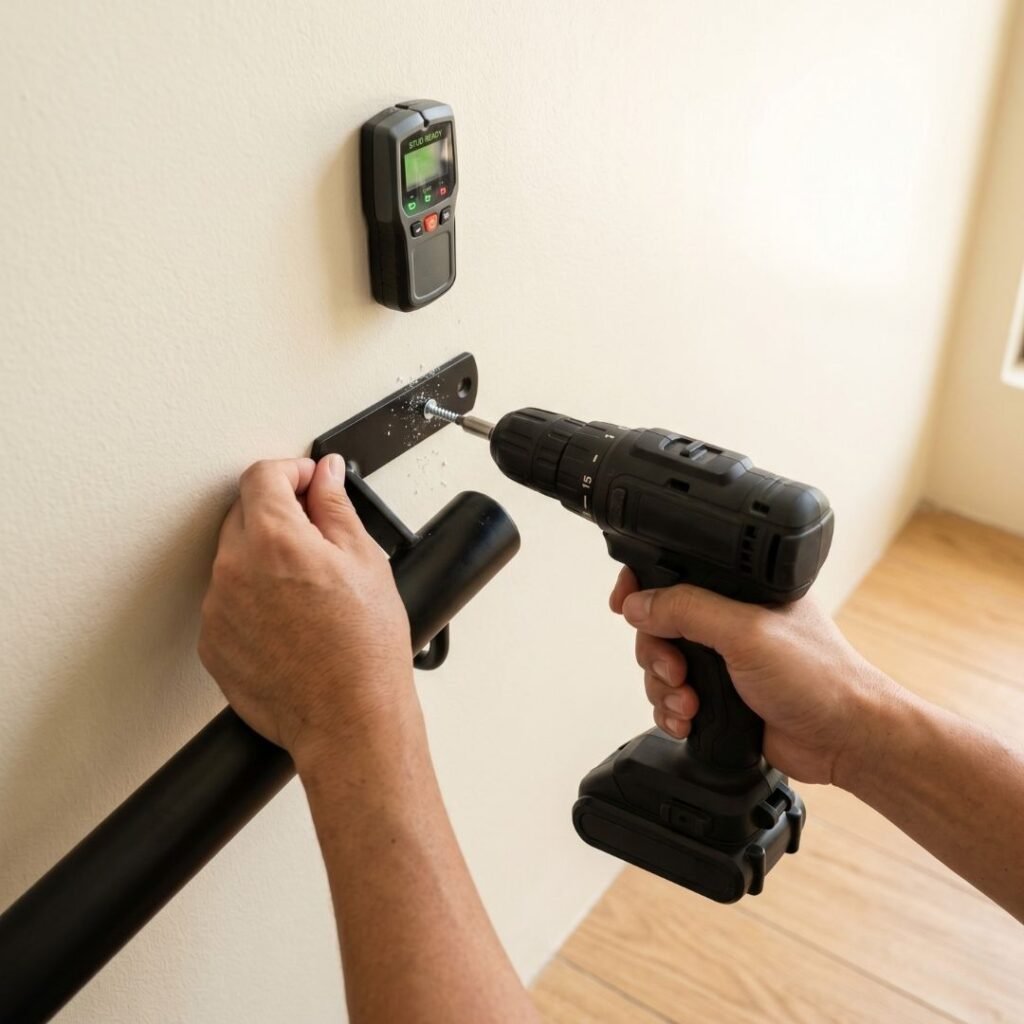
Anchor every bracket into a wall stud, not just drywall. The single most important rule for installing handrails for indoor hallways is that every wall bracket must be screwed into a structural stud behind the drywall. Drywall anchors alone — even heavy-duty toggle bolts — are not rated to take the sudden, sideways jerking load of a person catching themselves from a fall. Use an electronic stud finder to map every stud along the planned rail path before drilling a single hole, and choose a rail system with pivoting brackets so the bracket positions can shift to align with the studs you actually have. If a stretch of wall has no stud where one is needed, mount a backer board behind the drywall first or move the rail to a wall that does.
Install the rail at the right height for the user. The 2010 ADA Standards specify a handrail height of 34 to 38 inches measured from the finished floor to the top of the rail. For most adults, the upper end of that range — about 36 to 38 inches — gives the best leverage and the least stooping. For a noticeably shorter senior or a wheelchair user who occasionally rises to walk, drop the rail closer to 34 inches. Whatever height you choose, keep it consistent along the entire run. A rail that rises or dips mid-hallway forces the user to constantly adjust their grip, which defeats the point of having a continuous rail in the first place.
Leave a finger gap between the rail and the wall. A handrail mounted too tight to the wall is unsafe because the user’s knuckles can scrape or get pinched against the wall surface during a quick recovery. The ADA specifies a minimum 1.5-inch gap between the rail and the wall, and most quality wall brackets — including those used by the rails in this guide — are designed to hit that spacing automatically. Before final tightening, slide a closed fist between the rail and the wall to confirm the gap is generous enough for a full hand wrap.
Inspect the rail and brackets every few months. Even a well-installed handrail loosens over time as the wood frame of the home expands and contracts seasonally. Once every three to four months, walk the length of the rail and gently push down and outward on each bracket. Any bracket that wobbles, clicks, or shifts under hand pressure should be retightened or, if the screw hole has stripped, relocated to a fresh stud position. A rail the senior trusts but that quietly fails under load is one of the worst possible safety failures, so the inspection step is not optional.
Lifestyle Synergy: Making Hallway Handrails Work Better at Home
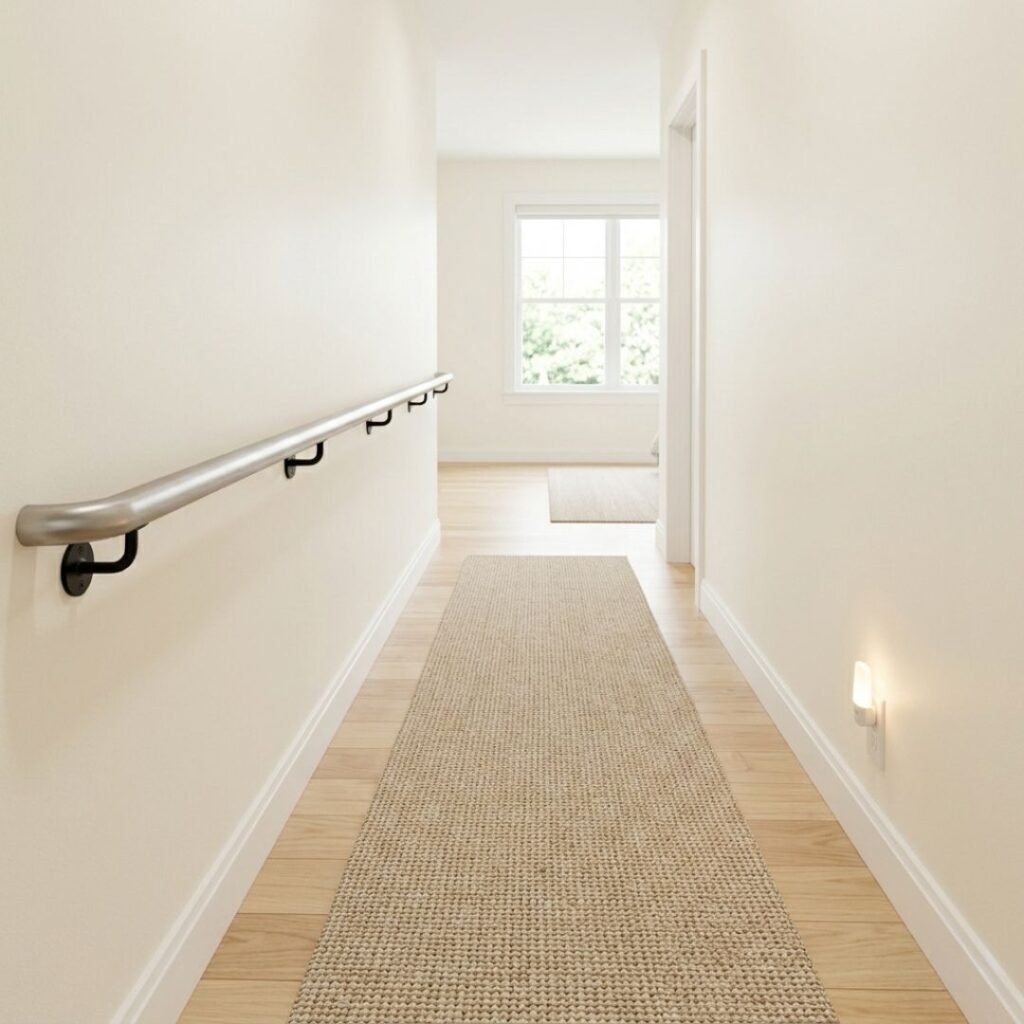
Handrails for indoor hallways do their best work when they are part of a coordinated safety setup along the entire corridor, not an isolated rail on a single wall. The first pairing to consider is flooring. A handrail combined with a slick hardwood floor still leaves the feet vulnerable to slipping, especially if the senior wears socks or slippers. Adding non-slip rugs and mats or a textured runner along the length of the hallway gives the floor surface the traction it needs to match the handrail’s stability. The runner should be wide enough to cover the full walking path and secured at both ends so it cannot bunch up under foot.
The second pairing is lighting. A rail the senior cannot see at night is a rail they will reach for clumsily, and missed grabs are how falls happen. Installing motion-sensor night lights at the baseboard along the hallway — or choosing a handrail with built-in LED lighting like the lighted pick in this guide — eliminates the dark-walk problem entirely. The rail is visible the moment the senior steps into the hallway, and the light follows them from end to end without anyone needing to hit a switch.
The third pairing is wall layout. Long hallways often have closet doors, framed photos, and light switches mounted along them, and any of those can interfere with a continuous handrail run. Plan the rail path before installing so it routes above or below switches, doesn’t block frequently used closet doors, and accounts for any furniture pushed against the hallway walls. If a closet door swings into the planned rail path, consider rerouting the rail to the opposite wall — a senior should never have to choose between using the rail and opening a door they need every day.
Physician’s Tips for Long-Term Use
When I recommend handrails for indoor hallways to my patients, I always frame them as a long-term piece of the home, not a temporary fix. Mobility needs tend to progress gradually — a senior who walks confidently today may need light support within a year and steady support within three. Installing the rail before it is needed every day costs nothing extra in materials and saves the family from having to organize a rushed install during a recovery period after a fall or a hospitalization. The home is simply ready when the senior is.
I also remind families to choose a rail rated for more weight than the senior currently demands. A rail that comfortably supports a 200-pound user with a hand on it for balance must also be able to absorb the full body weight of that same user catching themselves from a near-fall — a much larger sudden load. The handrails in this guide are all rated for full-body recovery loads when properly anchored to studs, but generic decorative wall rails and curtain rods are not. If a rail looks like it might double as a closet bar, it is not a safety device and should never be used as one.
Finally, I encourage my patients to actually use the rail every time they walk the hallway, not just when they feel unsteady. Building the habit of resting a hand on the rail every trip down the hallway means the hand is already in position if balance suddenly slips. Seniors who only reach for the rail when they feel a stumble starting often miss the grab — by the time the body realizes balance is gone, the hand is too far away to catch the rail in time. A handrail used every trip becomes muscle memory; a handrail used only in emergencies is just decoration on a wall.
Hallway Handrail Comparison for Seniors (Features & Stability)
Frequently Asked Questions
1. What height should handrails for indoor hallways be installed at?
The ADA standard for handrail height is 34 to 38 inches measured from the finished floor to the top of the rail, and that range works well for most senior hallway installations too. For an average-height adult, mounting the rail toward the upper end of that range — 36 to 38 inches — gives the best leverage and the least stooping. For a shorter senior or someone who uses a wheelchair part-time, drop the rail closer to 34 inches. Whatever height you pick, keep it consistent along the entire length of the hallway so the user does not have to constantly readjust their grip mid-walk.
2. Do hallway handrails need to be screwed into wall studs?
Yes. Every wall bracket on a hallway handrail must be anchored directly into a structural wall stud behind the drywall. Drywall anchors alone — even heavy-duty toggle bolts — are not rated to absorb the sudden, sideways jerking load that happens when a person catches themselves from a fall. Use an electronic stud finder to map every stud along the planned rail path before drilling, and choose a rail system with pivoting brackets so the bracket spacing can flex to match your real stud layout. Where studs are not available in the right spot, mount a wood backer board across multiple studs first and then mount the bracket into the backer board.
3. What is the best material for indoor hallway handrails?
Each common material has its strengths. Aluminum is the most popular for new installations because it is lightweight, corrosion-proof, ADA-compliant in profile, and available in many decor-friendly finishes. Stainless steel is the most hygienic and easiest to clean, which is why it is the standard in nursing homes and assisted-living facilities. Wood is the warmest to the touch and the most visually traditional, making it ideal for older homes and craftsman interiors. For most seniors choosing handrails for indoor hallways in a residential setting, an aluminum rail with a satin finish offers the best balance of grip, durability, install ease, and appearance.
4. Are handrails for indoor hallways covered by Medicare or insurance?
Hallway handrails are generally not covered by standard Medicare under durable medical equipment (DME) benefits, because Medicare classifies them as home modifications rather than medical devices. However, some Medicaid waiver programs, Veterans Affairs (VA) home modification grants, and private long-term care insurance policies may cover part or all of the cost. If you or a family member is a veteran, the VA’s Home Improvements and Structural Alterations (HISA) grant can fund accessibility modifications including hallway handrails. It is worth contacting your state Medicaid office or insurance provider to confirm coverage before purchasing.
5. How long should an indoor hallway handrail be?
The ideal length for handrails for indoor hallways is the full length of the hallway with no breaks longer than a forearm’s reach. A rail that stops short of either end of the corridor leaves the user without support exactly where they are most likely to lose balance — at the transition into a new room or at the end of a long unsupported walk. For a 10-foot hallway, plan on a 9- to 10-foot rail. For longer hallways, choose a rail system that allows splicing and add brackets every 32 to 48 inches to keep the rail rigid. If full coverage is not possible, prioritize the section of the hallway closest to the bathroom or the bedroom, which is where most night-time falls occur.
Final Thoughts on Handrails for Indoor Hallways
Handrails for indoor hallways are one of the highest-impact, lowest-cost senior safety upgrades a household can make. They prevent the kind of mid-corridor falls that fill emergency rooms every winter, they restore independent movement between rooms, and they age right alongside the senior using them. The key is choosing a rail that fits the hallway length, the wall layout, and the user’s grip needs — and then installing it correctly with bracket screws driven into real wall studs.
Every product in this guide has been selected for its build quality, grip performance, and suitability for seniors and caregivers. Whether you need a continuous ADA-compliant aluminum kit for a long corridor, a warm wood rail for a traditional home, or a lighted rail for safer night-time trips to the bathroom, the right handrail is a small investment that pays back daily in safety, confidence, and independence.
Medical Disclaimer: This guide is for general educational purposes only and is not intended to serve as personalized medical advice. Always consult a qualified healthcare professional before making changes to medical equipment or care plans.
Last update on 2026-09-15 / Affiliate links / Images from Amazon Product Advertising API
