

Introduction
When mobility starts to change, the decision between a walker vs rollator vs wheelchair can feel surprisingly heavy. Each device looks similar at first glance, but they solve very different problems, fit different stages of physical ability, and carry different trade-offs in stability, energy, and independence. Picking the right one — and recognizing when it is time to move on to the next — is one of the most consequential decisions a senior or caregiver will make as needs evolve over the years.
Most families do not pick a single mobility aid and use it forever. Strength, balance, and endurance shift over time, sometimes gradually and sometimes after a sudden event like a fall or a hospitalization. A device that fit two years ago may now feel awkward or unsafe. The opposite is also true: a senior who needed a wheelchair temporarily after surgery may regain enough strength to return to a walker.
This guide is built around the idea that mobility care is a moving target. We will walk through what each device does, who it suits best, what to watch for as needs change, and how to transition from one to the next without losing independence. The goal is not to crown a single winner. It is to give you a framework that holds up over time.
Why Mobility Changes With Age
The walker vs rollator vs wheelchair conversation is rarely a one-time decision because the underlying body is constantly changing. After about age 50, adults gradually lose muscle mass at a rate of roughly one to two percent per year, and the rate accelerates after 65. As that strength slips away, the right equipment can bridge the gap, which is why we put together a roundup of the best transition mobility aids for seniors losing strength. Balance systems, joint health, vision, and cardiovascular endurance also decline, often unevenly and with sudden setbacks after illness or surgery. The result is that the same person may need different levels of support at different points in time.
According to the American Academy of Family Physicians, more than one in four adults over 65 currently uses an assistive mobility device, and that number grows steeply with each decade. Family physicians and physical therapists routinely re-evaluate patients to make sure the device still fits the body they have today. The right tool for a 70-year-old recovering from a knee replacement is rarely the right tool for the same person at 82 with worsening arthritis.
Thinking in terms of mobility aid progression for seniors helps families plan instead of react. Rather than treating each new device as a defeat, it can be reframed as a tool change to match the work. The goal of every mobility aid is the same: keep the person moving safely, with as much independence as possible, for as long as possible. Sometimes that means a cane is enough. Sometimes it means a walker. And sometimes it means accepting that a wheelchair is the device that finally restores freedom rather than removes it.
The Three Mobility Aids Compared: Walker, Rollator, and Wheelchair
When families compare walker vs rollator vs wheelchair, they are really weighing three things: how much weight the device can take off the legs, how much energy it requires to use, and how much independent walking it preserves. Each device sits in a different spot on those three scales.
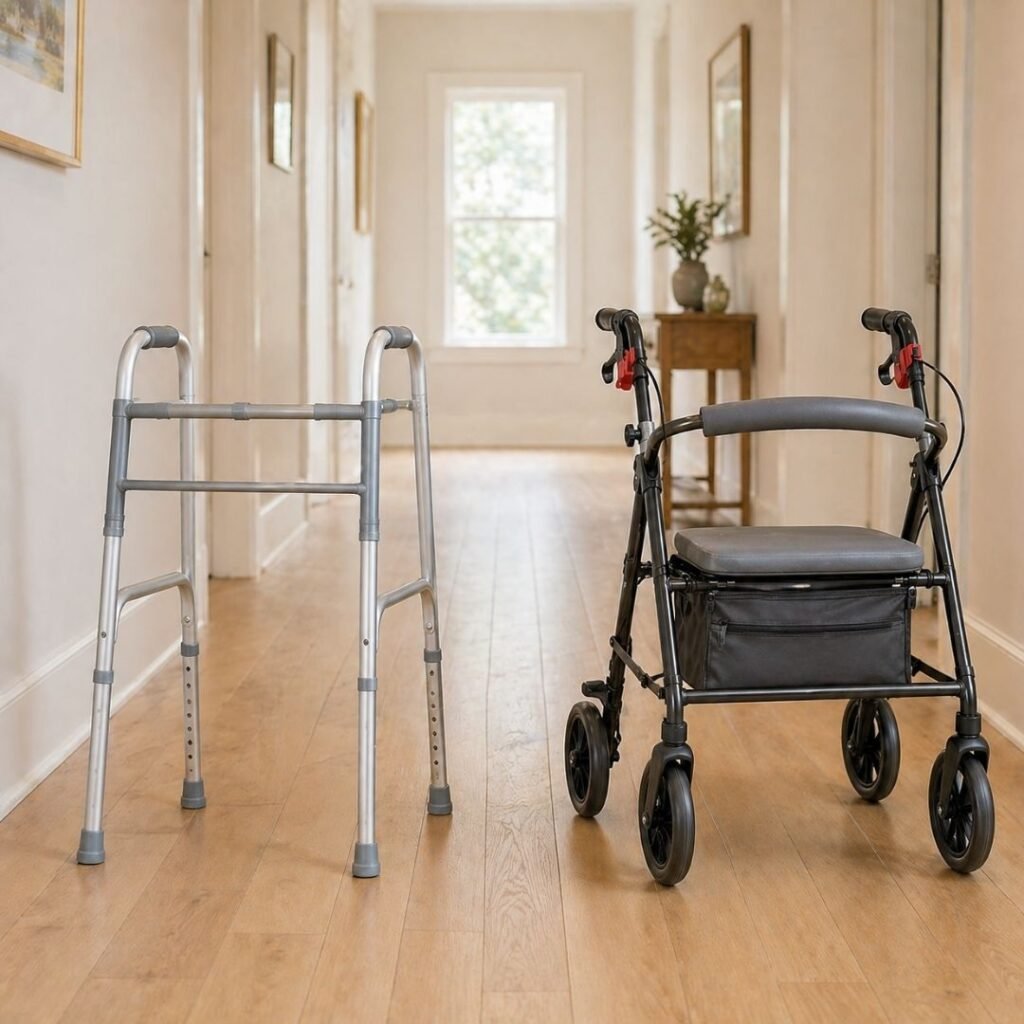
A standard walker is a four-legged aluminum frame, sometimes with two small front wheels. It is the most stable of the three because all four legs make contact with the ground at the same time. A walker is designed for someone who needs to bear meaningful weight through their arms while taking a step, often after a fall, surgery, or a long period of illness. It is slow, requires good upper-body strength, and works best on flat indoor surfaces.
A rollator is a four-wheeled walker with hand brakes, larger wheels, and a built-in seat. It is designed for someone who can walk reasonably well but tires quickly, has occasional balance problems, or wants the option to stop and rest. A rollator moves smoothly across more surface types — including pavement, carpet, and many outdoor settings — and it gives the user a place to sit during longer outings. Comparing rollator vs walker for elderly users, the rollator preserves more natural walking but provides less weight-bearing support.
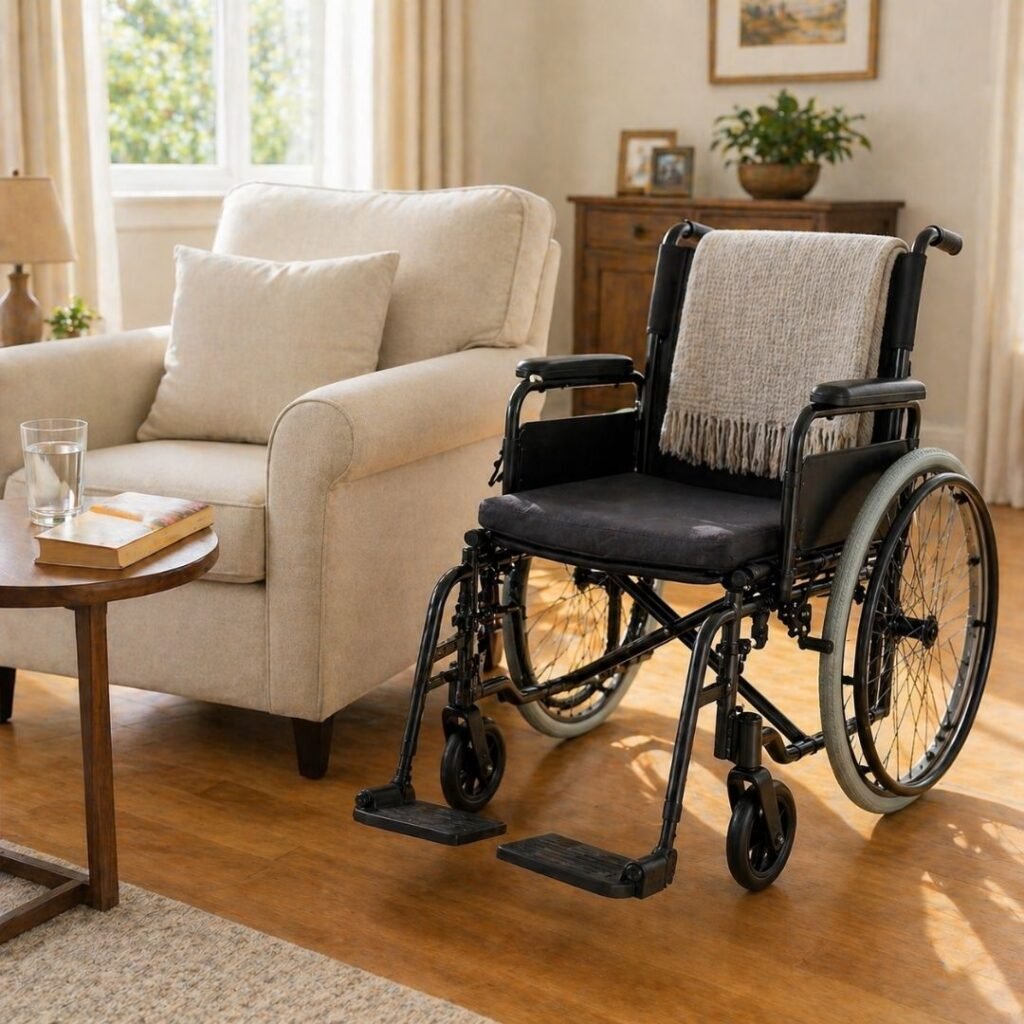
A wheelchair removes the need to walk altogether for the distance covered. Manual chairs are propelled by the user or pushed by a caregiver. Power chairs are driven with a joystick. Wheelchairs are the right choice when balance, endurance, or pain make safe walking impossible — even for short distances — or when long outings would exhaust the senior to the point of collapse. Many seniors who use a wheelchair part of the time still walk with a rollator at home. For deeper product detail, our guide on the best walkers and rollators for seniors breaks down current options.
What Mobility Decline Actually Looks Like at Home
The differences between walkers, rollators, and wheelchairs become much clearer when you watch how mobility decline actually shows up in daily life. Most families do not see a single dramatic event. They see small signals stack up over weeks or months until one day the current device is no longer enough.
A senior using a cane may start to lean heavily on furniture as they walk through the house. These everyday moments are often the first clues, and our guide to the signs a senior needs more support than a cane can help you tell when it is time to move up to a walker. They steady themselves on the kitchen counter, the back of the couch, and the bathroom doorframe. They take longer routes to avoid open spaces. This is often the first sign that a walker or rollator would be safer. The same pattern repeats one level up: a senior with a walker who has to sit down in a chair before reaching the bathroom may be telling you their endurance has dropped below what the walker can support.
Falls or near-falls are the loudest signal. The Centers for Disease Control and Prevention (CDC) reports that more than one in four adults over 65 falls each year, and the risk is higher when a mobility aid no longer matches the user’s physical ability. A senior who falls while using a walker is not necessarily failing the walker — they may be telling you the walker is no longer the right tool.
Quieter signs include withdrawing from outings the senior used to enjoy, refusing to leave the house because walking from the car to the restaurant feels like too much, or cutting visits short. Mobility devices exist to keep seniors connected to their lives, not just to keep them upright. When a device starts shrinking the person’s world instead of expanding it, the device may need to change.
Choosing Your First Mobility Aid
The first time a senior needs a mobility device is often the hardest. There is emotional weight behind the choice and a learning curve nobody prepares for. The best way to navigate that first decision is to focus on function rather than feelings. The walker vs rollator vs wheelchair question, at the entry point, usually comes down to two simpler ones: how much weight can the legs safely carry, and how reliable is the balance system?
If the senior can walk on flat ground without leaning on furniture but tires quickly or feels unsteady on longer routes, a rollator is usually the right starting point. The four wheels and built-in seat let them keep moving and rest as needed. If the senior cannot bear full weight through the legs — for instance, after hip or knee surgery, a stroke, or a serious fall — a standard walker is safer because all four legs grip the floor when weight is pushed through the arms. If the senior cannot stand or walk safely even with arm support, a wheelchair becomes the appropriate first device, often paired with physical therapy aimed at returning to a walker if possible.
An evaluation by a physical therapist is the single best investment a family can make at this stage. A therapist can size the device to the user, watch how they walk, identify weaknesses to strengthen, and recommend a model that fits both the body and the home. Medicare often covers part of this evaluation when ordered by a physician. Our overview on how to choose the right mobility aid goes into more detail on what a proper fitting looks like.
Avoid choosing on price alone or on what a friend uses. The wrong device can make a senior more likely to fall; the right one, even a basic model, can extend independent living by years.
Knowing When It Is Time to Step Up
Reframing walker vs rollator vs wheelchair as a progression rather than a competition makes the next decision much less emotional. A device change is not a sign that the senior is getting worse. It is a sign that the family is paying attention. Most transitions happen at one of two moments: a sudden event like a fall or hospital stay that forces a change, or a slow drift where the current device is doing less and less of the work it was meant to do.
Signs it may be time to step up from a cane to a walker include leaning heavily on furniture, any unexplained fall in the past year, or feeling unsteady on uneven surfaces. Stepping up from a walker to a rollator usually makes sense when the senior is steady enough to keep moving smoothly but is held back by endurance — they want to walk longer distances or join family outings but cannot keep up.
Knowing when to switch from walker to wheelchair is more delicate. The most reliable triggers are a clear pattern of falls while using the walker, severe pain with walking, deconditioning to the point that even a few steps cause exhaustion, or a medical condition that has made walking unrealistic. A 2-in-1 rollator-transport chair is often a useful bridge: the senior walks behind it for short distances and is pushed in it for longer ones. Our roundup of the best lightweight wheelchairs for seniors covers what to consider.
Whatever the trigger, do not delay the conversation. Families who wait until after a serious fall to switch devices have already paid the cost they were trying to avoid. Talk with the physician and physical therapist as soon as the signs appear.
Daily Life with a Mobility Aid
The walker vs rollator vs wheelchair you choose today will shape almost every part of daily life — from how the home is arranged to how outings are planned. Setting the home up to match the device, instead of fighting it, makes the difference between a tool that helps and a tool that gets resented.
Start with pathways. The main routes from bedroom to bathroom and from the front door to the kitchen should be wide enough for the device and clear of area rugs, extension cords, shoes, and pet bowls. A standard walker needs about 24 to 30 inches of clearance, a rollator roughly the same, and a manual wheelchair about 32 to 36 inches through doorways. If a doorway is too narrow, a swing-clear hinge is an inexpensive fix that gains an extra inch and a half.
Furniture should be firm and at the right height for sit-to-stand transfers. Soft, deep couches make standing up dangerous. A dining chair or recliner with armrests can replace one tricky seat without remodeling the room. In the bathroom, grab bars near the toilet and inside the shower or tub are essential at every stage. A raised toilet seat and a shower chair often follow.
Outings need a different kind of planning. A senior using a rollator may be confident at the grocery store but exhausted by an art museum. A senior who walks at home with a walker may need a wheelchair at the airport. Many families do well with a primary device for the home and a secondary device for distance, kept folded in the car. The right tool for the moment is whichever one keeps the senior safe, present, and not too tired to enjoy where they are.
Special Considerations: Surgery, Cognition, and Mixed Use
Some situations make the walker vs rollator vs wheelchair decision more nuanced than the usual progression. Knowing how to handle these situations ahead of time prevents costly mistakes and uncomfortable conversations later.
For seniors recovering from hip, knee, or spine surgery, the surgeon usually prescribes a specific device for the recovery period, regardless of what the senior used before. This is often a standard walker for the first few weeks because of the weight-bearing support it provides. Following the surgeon’s instructions exactly matters more than personal preference. Once early recovery ends, the senior often returns to the previous device — or steps up if surgery revealed deeper limitations.
For seniors with dementia or cognitive decline, the choice is shaped as much by judgment as by physical ability. A senior who forgets to lock the brakes on a rollator can fall when they sit on the seat. In these cases, simpler is often safer: a standard walker with no moving parts, or a wheelchair pushed by a caregiver, may suit better than a rollator that demands the user remember brakes. Close supervision and predictable routines help.
Mixed use is more common than most families realize. A senior may walk around the house with a cane, use a rollator for short walks outside, and rely on a wheelchair for full-day outings or travel. Owning more than one device is often the most practical setup for an active senior with limited endurance. Insurance coverage varies for second devices, but many families find the out-of-pocket cost worthwhile for the freedom it provides.
Frequently Asked Questions
1. What is the difference between a walker, a rollator, and a wheelchair?
A standard walker is a four-legged frame, sometimes with two front wheels, designed to bear weight through the arms with each step. A rollator is a four-wheeled walker with hand brakes and a built-in seat, made for someone who walks reasonably well but tires quickly. A wheelchair replaces walking and is used when balance, strength, or endurance make safe walking impossible. The simplest way to remember the walker vs rollator vs wheelchair distinction: walkers support weight, rollators support endurance, wheelchairs replace walking when neither is enough.
2. When should a senior switch from a standard walker to a rollator?
The switch usually makes sense when the senior is steady enough to walk smoothly but is limited by endurance rather than weight-bearing. If they tire quickly, get winded on routine outings, or want a place to sit during longer walks, a rollator is often a better fit. A physical therapist can confirm whether the senior has the balance and judgment to use the brakes safely.
3. How do you know it is time to move from a walker to a wheelchair?
The most reliable signs are repeated falls while using the walker, severe pain that will not improve, deconditioning so significant that even short walks cause exhaustion, or a new diagnosis that affects mobility. Doctors generally err on the side of preserving walking, so when a physician suggests a wheelchair, the recommendation usually reflects a real safety concern. A 2-in-1 rollator-transport chair can serve as a bridge.
4. Can a senior use a rollator and a wheelchair at the same time?
Yes, and many do. It is common for a senior to walk with a rollator at home and use a wheelchair for longer outings, doctor appointments, and travel. Owning two devices is not a sign of decline. It is often the most practical way to balance daily independence with the energy reality of a longer outing.
5. Which mobility aid is best for seniors with poor balance?
For seniors with significant balance problems, a standard walker is usually safer than a rollator because all four legs stay in contact with the floor when weight is applied. A rollator’s wheels can roll out from under the user if not braked properly. If balance is so impaired that walking is no longer safe even with a walker, a wheelchair is the appropriate choice. A physical therapist evaluation is strongly recommended before settling on any device.
Final Thoughts
Walker vs rollator vs wheelchair is not a single decision made once and filed away. It is a series of small, honest evaluations that happen as the body changes. Done well, each new device shows up at the right moment, the home adapts around it, and the senior keeps moving through life with little disruption. Done poorly, the family ends up reacting to falls and emergencies that better timing could have prevented.
The most useful mindset is to treat mobility aids the way you might treat eyeglasses. The prescription changes over time. Switching to a stronger one is not a failure — it is simply a way to keep doing what you love. A walker does not mean the end of independence. A rollator does not mean defeat. A wheelchair, perhaps most of all, can be the device that finally lets a tired senior attend a grandchild’s wedding or sit through a full family dinner without exhaustion.
If you are unsure which device fits today, schedule a physical therapy evaluation. If you sense the current device is not enough, do not wait for a fall to confirm it. The goal of every mobility aid is the same: more life, more safely, for as long as possible.
Medical Disclaimer: The information provided on this website is for educational purposes only and should not replace professional medical advice. Always consult your physician or qualified healthcare provider regarding any medical condition or treatment decisions.
