
Affiliate Disclaimer: This article contains affiliate links. As an Amazon Associate, Mobility With Ease may earn a small commission from qualifying purchases at no additional cost to you.
Introduction
Seating solutions for seniors with arthritis solve a problem that the rest of the home cannot. Grab bars help with transfers, walkers help with steps, and bed rails help with getting in and out at night — but the chair is where an arthritic senior actually spends most of their waking day. A dining seat that pinches the hips, a couch that swallows them whole, or a desk chair that grinds the lower back can turn three meals, a card game, and a TV show into eight hours of unrelieved joint pain. The right chair quietly removes that load.
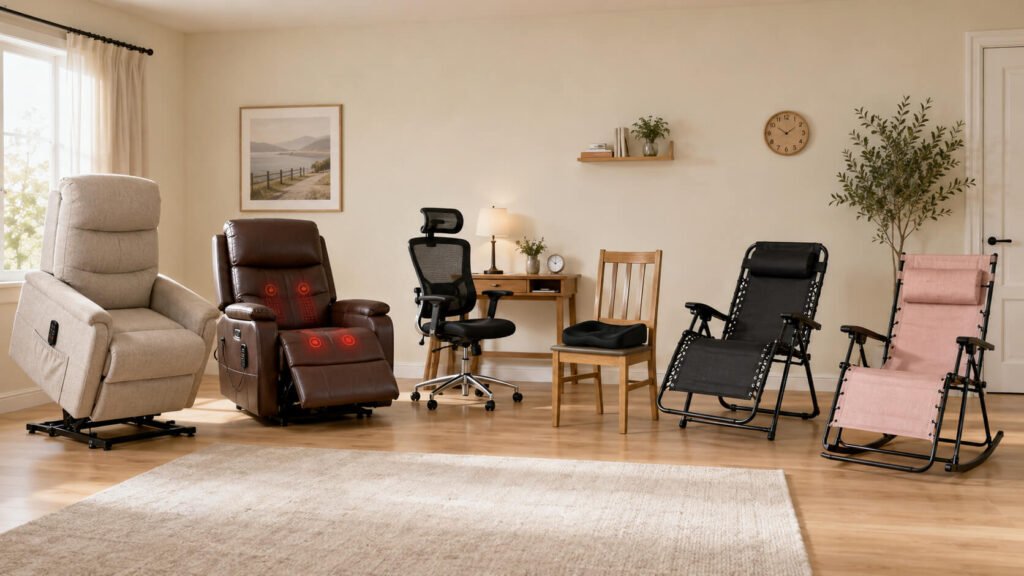
The picks in this guide are six of the best seating solutions for seniors with arthritis sold on Amazon in 2026. Each one fits a specific room and a specific routine: the living-room recliner that lifts the senior nearly to standing, the heat-and-massage chair that warms a stiff lumbar, the desk seat that holds the spine upright through a long morning, the cushion that rescues an existing dining chair, the zero-gravity recliner that decompresses arthritic hips, and the portable rocker that keeps the senior moving outside the house. The diagnosis matters less than whether the chair fits the senior’s daily movement needs.
If you already know which room is the problem, use the button below to jump straight to the comparison table.
Why Seating Solutions for Seniors with Arthritis Matter
The clinical case is short. The CDC reports that more than fifty-three million U.S. adults have doctor-diagnosed arthritis, and the prevalence climbs sharply after age sixty-five. Osteoarthritis — the wear-and-tear form — is the most common joint condition in seniors, and it most often hits the knees, hips, hands, and lower spine. Every one of those joints loads when a senior sits down, sits still, and stands back up. A chair that fights the joints multiplies the disease; a chair that supports them subtracts from it.
The math gets worse the longer a senior sits in the wrong chair. Cartilage that is already thin compresses faster under poor posture. Hip and knee joints stiffen within thirty minutes of immobility, so a deep couch that traps the senior for two hours of television guarantees a painful sit-to-stand at the end of it. A low dining chair forces a deeper knee flexion than an arthritic knee can comfortably hold, and the next morning’s flare is the direct result. Seating solutions for seniors with arthritis address the geometry of the chair itself rather than the senior’s pain medication schedule.
The other half of the equation is movement. Arthritic joints feel best when they are gently and frequently moved, not when they are held still and not when they are pushed hard. A recliner that allows infinite small position changes, a desk chair that lets the senior shift posture every few minutes, and a rocking chair that delivers continuous gentle motion all work with the disease instead of against it. For families pairing the right chair with the rest of the daily routine, our guide on simple daily habits to improve senior mobility covers the small movement patterns that protect arthritic joints between sitting sessions.
Doctor’s Note: Choosing the Right Seating Solutions for Seniors with Arthritis
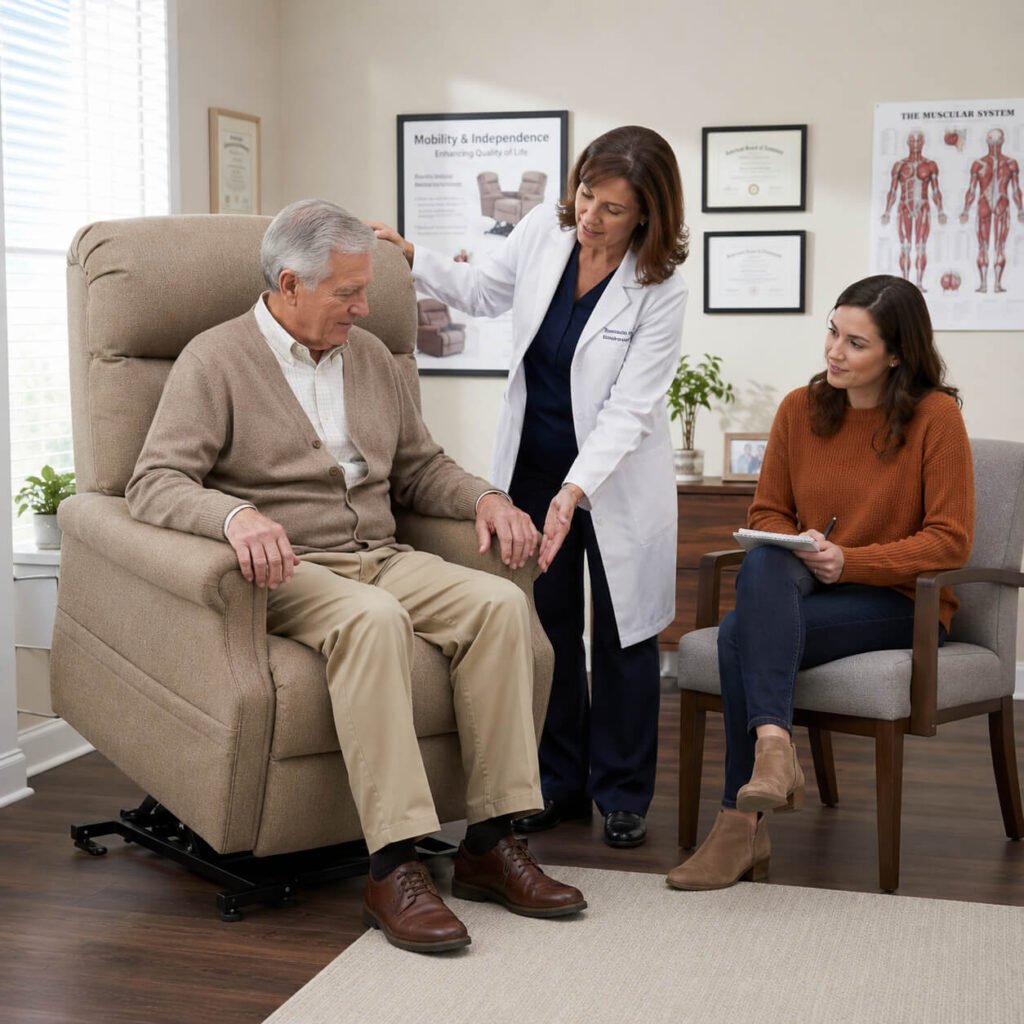
I see three failure modes in the chairs my arthritic patients sit in at home. The first is the recliner that is too deep and too soft — the senior sinks into it, the hips drop below the knees, and the sit-to-stand becomes a thirty-second wrestling match against gravity. The second is the dining chair that is too low and has no armrests, so the senior cannot push down through the hands to stand. The third is the desk chair from twenty years ago with collapsed foam, no lumbar support, and a backrest that tilts the spine forward. Each one of these chairs quietly makes the arthritis worse one sitting at a time.
The first thing I ask families to consider is the height of the seat. A chair that is too low forces the knee past ninety degrees of flexion, which is the angle arthritic knees hate the most. A chair that is too high lets the feet dangle and pulls the senior forward at the hips. The seat should land just under the knee crease with both feet flat on the floor. For a senior who already struggles with sit-to-stand transfers, a power lift recliner solves the problem mechanically — our guide to the best lift chairs for seniors walks through how the lift mechanism removes the knee load that arthritis cannot.
The second question is what the chair will be used for. A senior who reads for two hours after dinner needs a different chair than one who works at a computer in the morning, who needs a different chair than one who sits down at the dining table three times a day. No single chair solves all three rooms, and trying to make one chair do all three is the most common reason the seating solutions for seniors with arthritis end up failing. Plan the home room by room rather than buying one chair and hoping it covers everything. The picks in this guide map to those rooms directly.
Best Seating Solutions for Seniors with Arthritis (Top Picks)
Best Overall
CANMOV Power Lift Recliner Chair for Elderly
The CANMOV power lift recliner is the default recommendation for most seniors with arthritis because it solves the single hardest moment of the day — standing up out of a deep chair. The single-motor mechanism gently tilts the seat forward to lift the user nearly to standing, removing the knee and hip load that arthritic joints cannot absorb. The reclining position is smooth and supports the lower back through the full range. The overstuffed cushioning and antiskid fabric strike the right balance between comfort and firmness, so the senior does not sink. This is the chair to buy when the living room is the primary problem and one trusted recliner needs to cover reading, television, and afternoon naps. The single motor keeps the price reasonable compared with the dual-motor options.
Pros
- Power lift mechanism tilts the seat forward to lift the user nearly to standing
- Heavy-duty safety motion reclining covers reading, TV, and naps
- Overstuffed cushioning gives comfort without losing support
- Antiskid fabric grips clothing and prevents sliding forward
- Simple two-button remote — easy for arthritic hands
Cons
- Single motor — back and footrest move together, not independently
- No heat or massage features at this price point
No products found.
Best for Joint Pain Relief (Heat & Massage)
Couchus Large Dual Motor Power Lift Recliner Chair with Massage and Heat
The Couchus is the upgrade when arthritis pain itself is the main complaint and the senior wants the chair to actively treat it. The dual-motor system moves the back and footrest independently, which means the senior can find the exact position that relieves their lumbar without forcing the legs to follow. Built-in lumbar heat delivers targeted warmth that loosens stiff joints within minutes, and the vibration massage runs across the back and legs to improve circulation in the morning or after a long day on the feet. The infinite-position recline includes a near-flat lay-flat angle that is genuinely useful for an afternoon nap. The breathable leather upholstery wipes clean, which matters for a chair that is going to be used every day for years.
Pros
- Lumbar heat and full-body vibration massage actively treat arthritis pain
- Dual motor — back and footrest adjust independently
- Infinite positions including lay-flat for naps
- USB charging ports keep a phone within reach
- Breathable leather upholstery is easy to wipe clean
Cons
- Larger footprint — needs a wider living-room corner
- More expensive than single-motor lift recliners

- [Dual-Power Customization for Personalized Comfort] - Unlike conventional lift chairs, our dual-motor system allows independent backrest and footrest adjustments (from a 27" back support to a 75" full...
- [Ergonomic Design for Optimal Support] - The thoughtfully designed 27" backrest cradles your body's natural curves, while the 23" deep seat provides a comfortable sitting experience. Premium...
- [Adjustable 360° Relaxation Modes] - Seamlessly transition from upright reading (100°) to flat lounging (180°) with infinite lock positions. Enjoy comfortable angles designed for full-body...
Best Ergonomic Desk Chair
SIHOO M18 Ergonomic Office Chair with Adjustable Lumbar Support
The SIHOO M18 is the right chair for the senior who still does paperwork, reads at a desk, manages bills on a computer, or runs a small business from home. The high-back mesh design keeps the back cool through long sitting sessions, and the adjustable lumbar support presses into the lower spine exactly where arthritic discs need the most help. The 330-pound capacity covers most users comfortably, and the 2D armrests adjust to land where the elbows actually want to rest rather than where the factory set them. The tilt-lock lets the senior shift posture every few minutes without standing up, which is the single best protection against arthritic stiffness during a long task. This is the chair that turns a punishing morning at the desk into a comfortable one.
Pros
- Adjustable lumbar support targets arthritic lower back directly
- Breathable mesh keeps the back cool through long sitting sessions
- Tilt-lock allows posture shifts without standing up
- 2D armrests adjust to the user’s actual elbow height
- 330-lb capacity covers most seniors comfortably
Cons
- Assembly required out of the box
- Headrest may need adjustment for shorter seniors

- 【ERGONOMICE OFFICE CHAIR】- The ergonomic chair provides 4 support points (head/back/hip/hands) and proper lumbar support. SIHOO designs ergonomic chairs to meet different needs, with seat height...
- 【For Home and Work】 SIHOO chairs can be applied in different scenarios according to the needs of different consumers in needs. Can be used as student office chairs, computer chairs, ergonomic...
- 【Breathable Mesh】 Mesh Office Chair Premium Backrest features flexible non-pattern mesh fabric while keeping your back cool and comfortable, allowing you to sit focused and relaxed at the same...
Best Orthopedic Seat Cushion
SnugPad Upgraded Memory Foam Seat Cushion
The SnugPad cushion is the lowest-cost arthritis fix in this guide and one of the most useful, because it turns the chair the senior already owns into an orthopedic chair. The firm memory foam contours to the tailbone and offloads pressure from the coccyx, sciatic nerve, and the back of the hip socket. The non-slip base keeps the cushion in place on wood, vinyl, or fabric seats, and the breathable cover unzips for washing. The same cushion travels easily — clip it to a dining chair at home in the morning, drop it onto the car seat for an appointment, and bring it along to a restaurant where the booth would otherwise be miserable. For seniors with knee or hip arthritis who do not yet need a full lift recliner, the cushion is the right place to start.
Pros
- Firm memory foam offloads pressure from coccyx, hips, and sciatic nerve
- Non-slip base grips dining chairs, car seats, and office chairs
- Breathable washable cover for daily use
- Travels easily between home, car, and restaurant
- Lowest-cost arthritis seating fix in this guide
Cons
- Adds about three inches of seat height — may not fit under low tables
- Not a substitute for a true ergonomic chair on long workdays

- ✅ INSTANT BACK PAIN AND SCIATICA RELIEF – GetComfort Coccyx Seat Cushion is specially designed to suspends the tailbone provide ultimate support and comfort, while reducing pressure on the...
- ✅ VERSATILE & PORTABLE BACK PAIN CUSHION (comes with a grip handle) Ideal for travel, long commute, office chairs and wheelchairs. Has a non-slip bottom making it ideal for any surface.
- ✅ 100% PREMIUM MEMORY FOAM CUSHION with orthopedic support and absolutely NO additives, machine washable, black velour cover with non slip bottom. The dimesions of the cushion is 18 x 14 x 3 inches.
Best Zero-Gravity Recliner
Best Choice Products Oversized Zero Gravity Chair
The Best Choice Products oversized zero-gravity recliner is the pick when the goal is genuine pressure relief for arthritic hips, knees, and the lumbar spine. Zero-gravity positioning lifts the legs above the heart, decompresses the discs, and lets the body weight distribute evenly across the chair rather than pile onto the joints. The oversized frame fits larger users comfortably, the textilene mesh stays cool in summer, and the lockable recline holds the position for as long as the senior wants. The folding design means it can move from the patio to the living room and back without permanent furniture commitment. This is also the chair to buy when the senior wants a midafternoon nap that does not require climbing into bed and back out again, which is its own arthritic ordeal.
Pros
- Zero-gravity position decompresses the lumbar spine and arthritic hips
- Oversized frame fits larger users comfortably
- Lockable recline holds position for naps or reading
- Folds flat for storage between seasons
- Cup holder and pillow included — ready to use out of the box
Cons
- Lower to the ground — harder sit-to-stand than a lift recliner
- Not powered — the recline lever requires hand strength to adjust

- EXTRA-WIDE SEATING: Enjoy plenty of space to relax with an extra-wide 24-inch seat, a set of armrests, and a headrest for added comfort
- LOCKABLE RECLINING SYSTEM: Smoothly glide into an ergonomic zero-gravity position with a system of locks and elastic bands for extra support
- WEATHER-RESISTANT MATERIALS: UV- and weather-resistant textilene fabric combined with a steel frame and replaceable elastic bands provide years of superior seating
Best Portable Rocking Chair
GCI Outdoor Comfort Pro Rocker Camping Chair
The GCI Comfort Pro Rocker is the chair to buy when the senior wants to leave the house and still sit comfortably. Patented spring-action rocking delivers continuous gentle movement that arthritic joints actually crave — the same therapeutic motion as a porch rocker, in a chair that folds flat and travels in a car trunk. Durable padded armrests support the sit-to-stand transition, the drink holder lives in the armrest where the user can reach it without leaning, and the easy push-apart setup means the senior or a family member can deploy it in seconds. Take it to a grandchild’s ballgame, a summer outdoor concert, the back deck after dinner, or the campsite the family rents every August. Sitting comfortably in places other than the living room is part of the freedom the chair is buying.
Pros
- Spring-action rocking gives continuous gentle joint motion
- Padded armrests assist sit-to-stand
- Folds flat and travels in a car trunk
- Drink holder in the armrest — no leaning required
- Easy push-apart setup in seconds
Cons
- 250-lb weight capacity — lighter duty than indoor recliners
- Seat is firm rather than plush — bring a cushion for long sits

- OUTDOOR LIVING. Relax by the campfire in the Comfort Pro Rocker, an adult rocking chair from GCI Outdoor. With an easy to carry shoulder strap, grab this chair and head off on new adventures, or into...
- A FRONT ROW SEAT. Perfect for sports games or backyard lawn BBQ, the Comfort Pro Rocker is ready to go. With a beverage holder built into the armrest, a secure phone pocket and great back support, you...
- CUTTING-EDGE DESIGN. Shock absorbers with patented Spring-Action Rocking Technology let you gently rock on flat, hard or soft terrain. A sturdy steel frame holds up to 250 lbs, while a durable mesh...

Educational Overview: What Are Arthritis-Friendly Chairs Used For?
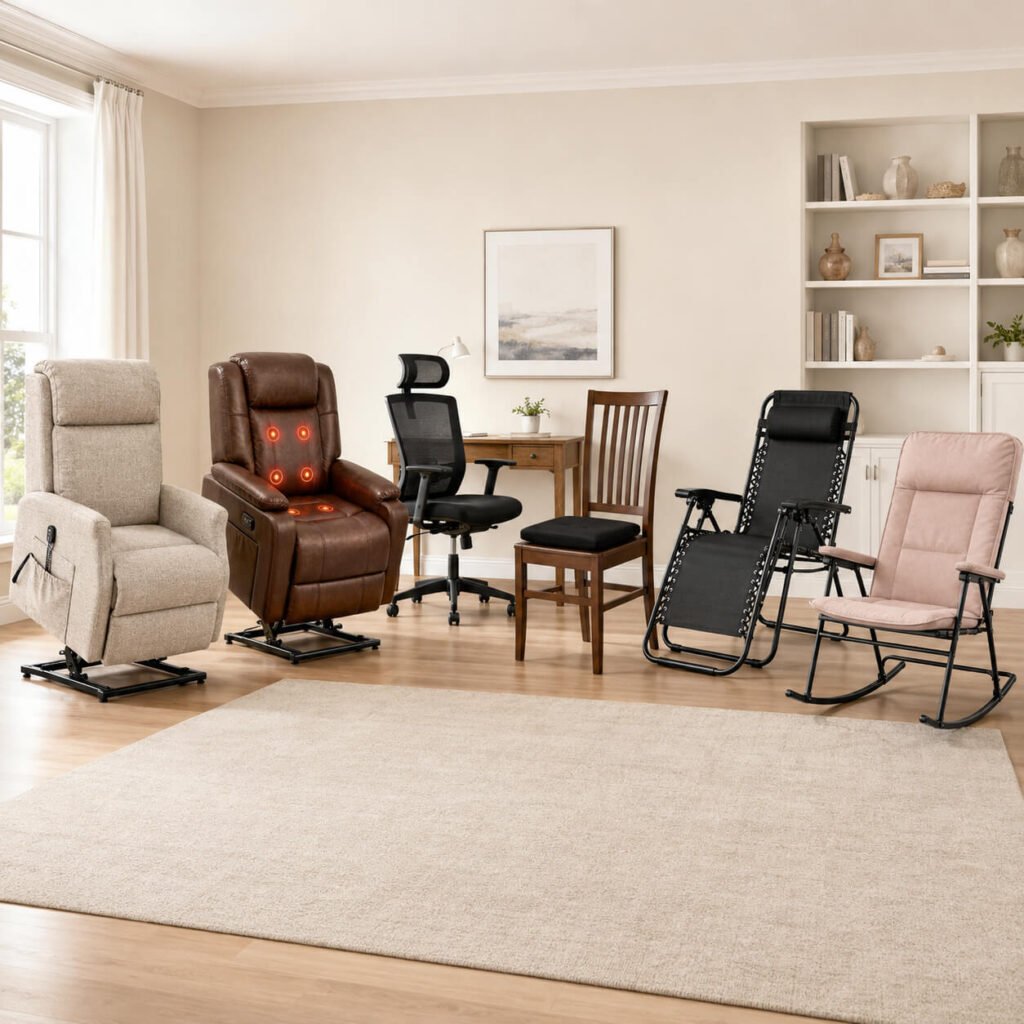
Seating solutions for seniors with arthritis solve a layered set of problems. The first is sit-to-stand — the moment when arthritic knees and hips have to load the body’s full weight against gravity. The second is sustained posture — the thirty minutes to two hours when the senior is seated and the joints are slowly stiffening. The third is pressure distribution — how the weight spreads across the hips, tailbone, and lumbar spine while the senior is in the chair. A good chair quietly handles all three; a bad chair quietly fights all three. The six picks in this guide cover the specific room or activity where each problem shows up most.
According to the National Institute on Aging, osteoarthritis most often affects the knees, hips, hands, and lower spine in older adults — the exact joints that load every time a senior sits down or stands up. The NIA also notes that gentle movement and proper joint positioning are central to symptom management, which is the clinical reason a recliner with infinite positions, a desk chair with tilt-lock, or a rocking chair with continuous motion outperforms a fixed-position chair. The chair is part of the treatment plan, not an accessory to it.
What matters most in the choice is the daily routine of the user. A senior who is recovering from a recent fall or surgery needs a chair that prioritizes the sit-to-stand mechanics; our guide to the best recovery chairs and recliners after surgery covers that specific recovery window. A senior with chronic arthritis and no recent surgical event needs a chair that prioritizes long-term pain management — heat, massage, lumbar support, and the ability to shift position without standing. The picks in this guide map to both situations, but the conversation should always start with the routine the chair has to support.
How to Set Up Arthritis-Friendly Seating Safely
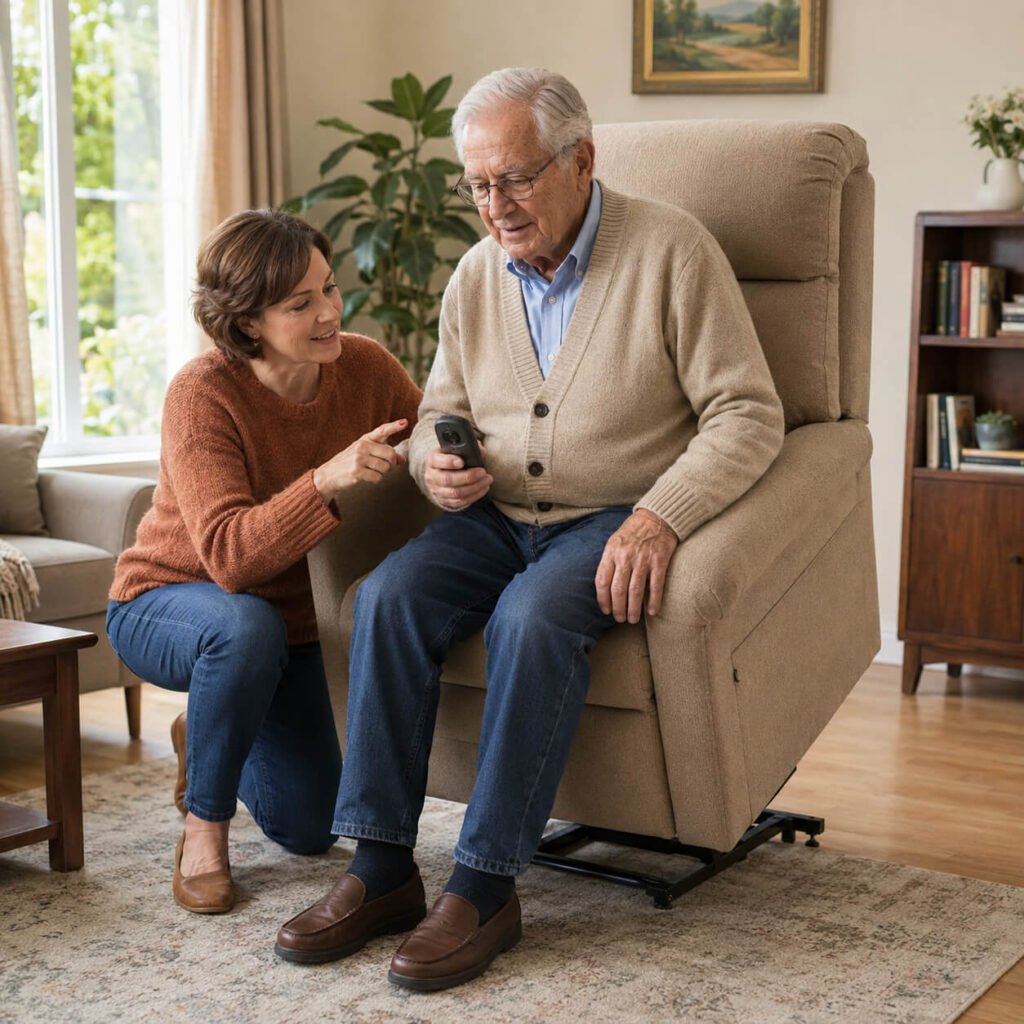
Most seating solutions for seniors with arthritis fail at setup rather than at the product level. Walking through every adjustment on the day the chair arrives is the difference between a chair the senior actually uses and a chair that sits unused in the corner because it never felt right. The rules are short, and none of them are optional.
Measure seat height before unboxing. The seat of the chair should sit just under the senior’s knee crease when their feet are flat on the floor. Too low and the knees flex past ninety degrees, which is where arthritic knees hurt most. Too high and the feet dangle, which strains the hips and the lower back. Measure the senior’s lower leg from the floor to the knee crease before the chair arrives, and compare it to the seat height in the product specs. For chairs that are slightly too low, a firm orthopedic cushion adds two to three inches of effective height without sacrificing support.
Adjust lumbar support on the first sitting. Every ergonomic desk chair ships with the lumbar support in a neutral position that almost never fits an actual user. Have the senior sit in the chair with the back fully against the backrest, then slide the lumbar support up or down until it presses gently into the natural inward curve of the lower spine. The right position should feel like a small steady push, not pressure. The same rule applies to the headrest on an ergonomic chair — adjust it so the back of the senior’s head touches naturally without forcing the neck forward.
Practice the lift cycle with a power recliner. Power lift recliners have a slow tilt-forward speed that surprises first-time users. Schedule a practice session in a calm moment, with the senior seated and a family member nearby. Walk through pressing the up button, riding the chair forward to near-standing, stepping off, and returning to the chair the same way. The first three or four cycles feel foreign; by the tenth the mechanism feels natural. Skipping this practice is the most common reason a senior turns the lift feature off and uses the chair like a regular recliner.
Position the chair so the dominant side reaches the armrest. Most seniors have a stronger side they push down with to stand. The chair should be positioned in the room so the armrest under the dominant hand has a clear, unobstructed pushing surface. A side table, a lamp cord, or a footstool in the wrong spot turns a smooth sit-to-stand into a fight. Walk the room from the door to the chair and back, and remove anything between the senior’s dominant hand and the armrest they push down through.
Set a recurring rest-and-shift schedule. Arthritis flares less when joints are moved gently every twenty to thirty minutes. For desk work, set a phone timer that prompts a posture shift twice an hour. For long television sessions in a recliner, schedule a stand-and-stretch every commercial break or every thirty minutes. For zero-gravity recliners, change positions slightly every fifteen minutes rather than holding the same flat angle for an hour. The chair makes the movement easier; the schedule makes the movement happen.
Lifestyle Synergy: Making Arthritis Seating Work Day to Day
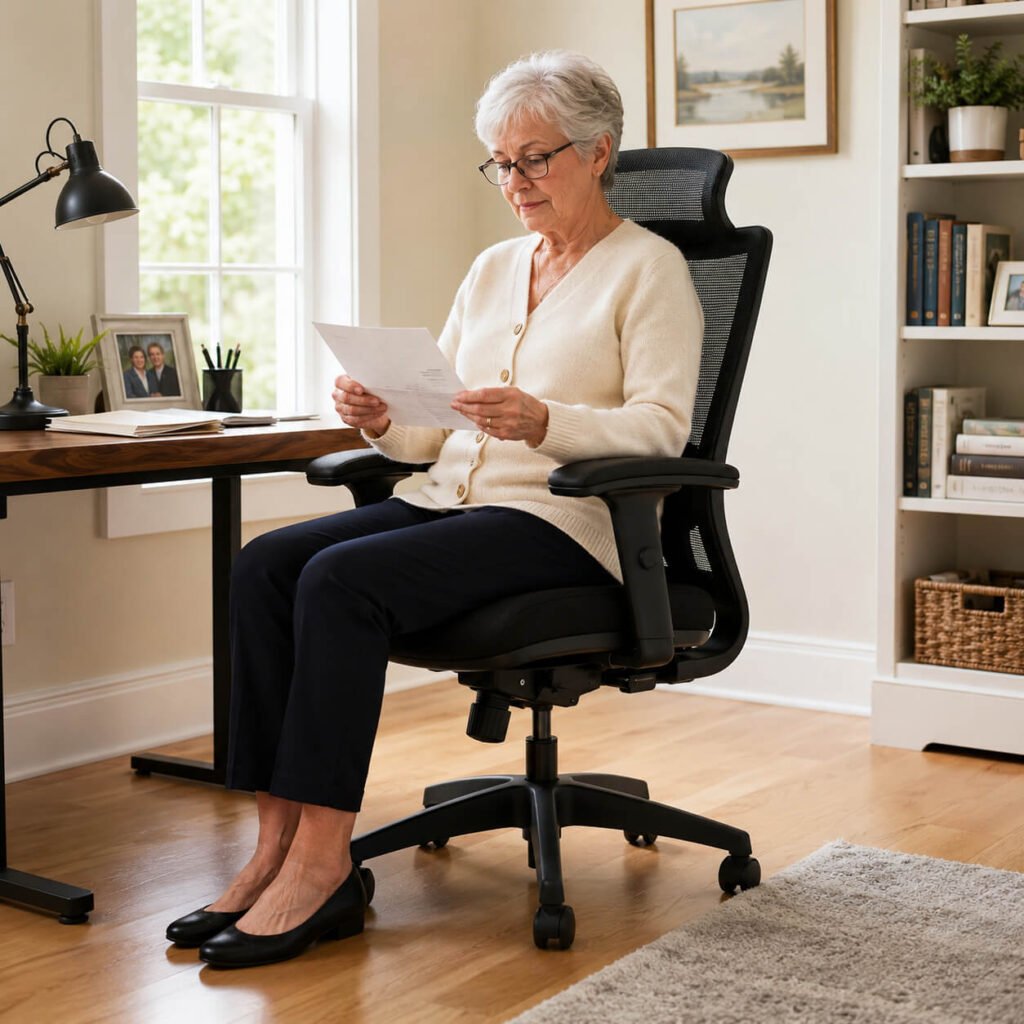
Seating solutions for seniors with arthritis only work if they cover the whole day, not just the prime two-hour window in front of the television. A senior with osteoarthritis sits down to eat three times a day, sits at a desk to handle mail, sits in the car for appointments, sits at church or at a social gathering, and sits outside when the weather is good. A chair that only solves one of those moments leaves the other six unaddressed. Treat the home and the daily routine as a connected seating system, not as a single-chair decision.
The living room is where most families start, and the lift recliner with heat and massage usually earns its spot. The dining table is the next priority, and an orthopedic seat cushion on the existing chair usually solves it without replacing furniture. The desk or the kitchen counter where the senior reads the mail, balances the checkbook, or video-calls the grandkids is the third room, and an ergonomic desk chair is the right answer there. For seniors who also spend significant time in a wheelchair or a transport chair, our guide to the best wheelchair cushions for seniors covers the cushion that protects the hips and tailbone during longer rides.
Outside the house is where most arthritis seating plans collapse. A senior who has a perfect living-room setup but cannot sit comfortably at a grandchild’s baseball game ends up staying home, which costs more than any chair. The portable rocker covers the ballgame and the back porch, the orthopedic cushion travels easily for restaurant booths and long car trips, and the zero-gravity recliner folds for the patio and the weekend cabin. The portable picks are not luxury items — they are the difference between a senior who keeps showing up and a senior who quietly stops accepting invitations.
Resistance to using arthritis-specific furniture is common, especially with the lift recliner. Many seniors read the chair as a medical device and avoid it the same way they avoid the cane in the closet. The framing that overcomes resistance fastest is independence: the lift recliner is the reason the senior can stand up without calling for help, the orthopedic cushion is the reason they can stay for the whole dinner, and the rocker is the reason they can come to the cabin for the weekend instead of staying home. Family members who lead with the independence framing see far higher consistent-use rates within the first month.
Physician’s Tips for Long-Term Use of Arthritis-Friendly Seating
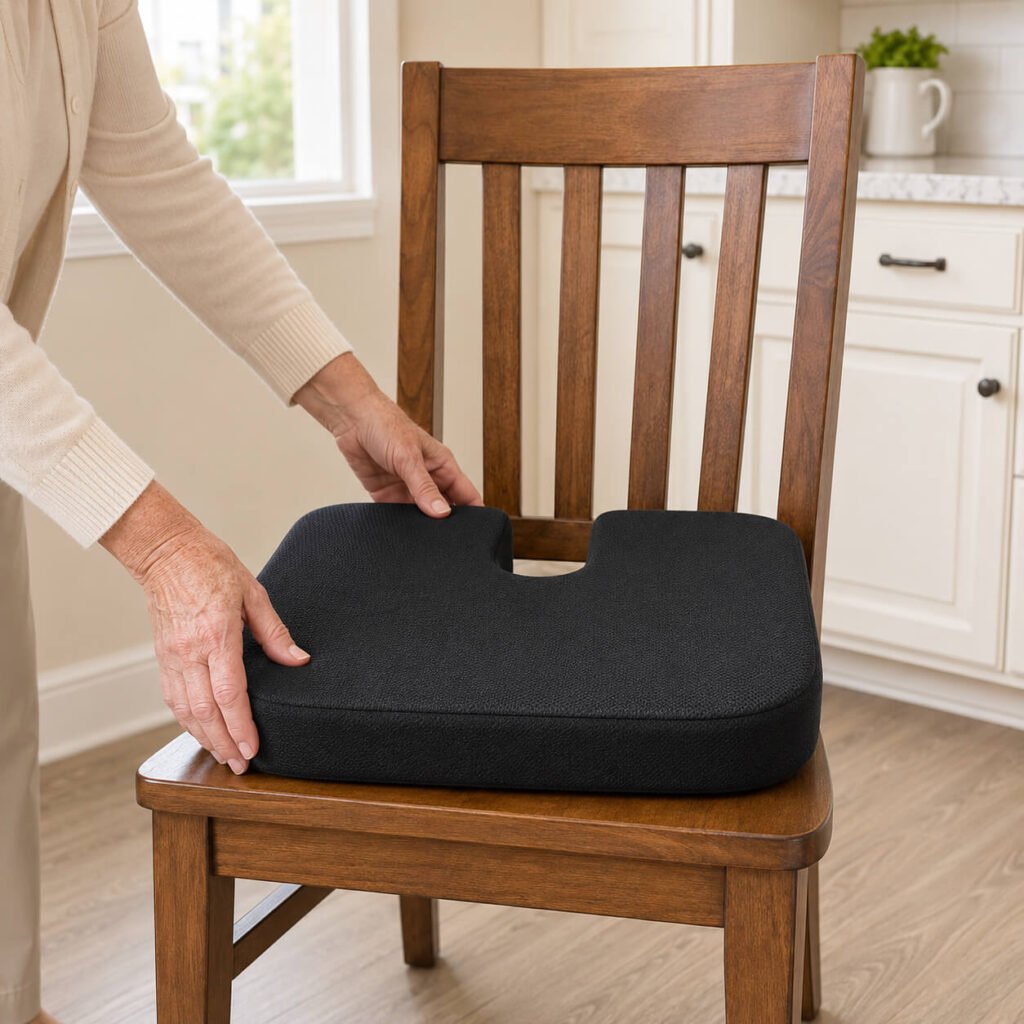
The single best physician’s tip on long-term seating for arthritis is to rotate between chairs rather than depending on one. Even the best ergonomic desk chair becomes a stiffness machine after three straight hours. The senior who moves from the desk chair to the recliner to the rocker on the porch and back through the day keeps the joints loaded in different angles, which is the exact opposite of the static-posture pattern that drives arthritic flares. Rotation is the cheapest joint protection available and the easiest to implement once the home has the right pieces in place.
For long-term use, plan the seating around the senior’s worst joint rather than the average. A senior whose hips are the dominant problem benefits most from the zero-gravity recliner and a high-seat dining chair. A senior whose knees are the dominant problem benefits most from the power lift recliner and a tall office chair that does not force a deep knee bend. A senior whose lower back is the dominant problem benefits most from the heat-and-massage recliner and the ergonomic desk chair with the lumbar support correctly set. For families coordinating a fuller home setup to support a loved one with limited mobility, the chair decision sits inside the broader plan, not next to it.
Finally, expect to revisit the seating plan every twelve to eighteen months. Arthritis is progressive, and a chair that fit perfectly in 2024 may need to be replaced or supplemented by 2026. Watch for the early warning signs: the senior leaning forward to stand from the recliner instead of using the lift, the dining-chair cushion compressing flat, the senior choosing the couch instead of the desk chair because the desk chair has started to hurt. Each of those is a quiet signal that the chair has aged out of the routine. Replace the piece rather than waiting for a fall or a flare that forces the replacement on a worse timeline.
Seating Solutions for Seniors with Arthritis Comparison (Features & Coverage)
Frequently Asked Questions
1. What are the best seating solutions for seniors with arthritis?
The best seating solutions for seniors with arthritis are the ones that match the room and the routine of the user. A power lift recliner is the default answer for the living room because it removes the sit-to-stand load that arthritic knees and hips cannot absorb. An ergonomic desk chair with adjustable lumbar support is the answer for any room where the senior reads, writes, or works on a computer. An orthopedic seat cushion is the answer for the dining chair the senior already owns. A zero-gravity recliner is the answer for pressure relief and naps. A portable rocking chair is the answer for outside the house. There is no single best chair for every senior — the right pick is the one that matches the room where the pain is happening.
2. Which type of chair is best for arthritis sufferers?
For most seniors, the power lift recliner is the single most useful chair to buy first. It addresses the hardest moment of the day — the moment of standing up out of a deep seated position — and it does so mechanically rather than asking the joints to absorb the load. A lift recliner with heat and massage adds active pain treatment on top of the lift mechanism, which is worth the upgrade for seniors with daily flare-ups. For active seniors who do not yet need a lift chair, an ergonomic chair with adjustable lumbar support and a firm orthopedic cushion together cover most of the day at a fraction of the cost. The right answer depends on whether sit-to-stand is the main complaint or whether sustained sitting comfort is the main complaint.
3. Are zero-gravity recliners good for arthritis pain relief?
Yes. The zero-gravity position raises the legs above the heart, which decompresses the lumbar spine and offloads pressure from arthritic hips and knees. The position also evenly distributes body weight across the chair rather than concentrating it on the tailbone and the back of the hips, which is the source of much of the pressure pain seniors with arthritis feel after sitting in a flat chair. The trade-off is that zero-gravity recliners sit lower to the ground than traditional recliners, so the sit-to-stand transition is harder. The best pattern is to use the zero-gravity chair for naps and pressure relief during the day and to keep a power lift recliner as the primary living-room chair for moments when getting up matters more.
4. Do orthopedic seat cushions actually help with arthritis pain?
Yes, when matched to the right problem. A firm memory-foam coccyx cushion offloads pressure from the tailbone, the sciatic nerve, and the back of the hip socket, which addresses the most common pressure pain in seniors with hip or low-back arthritis. The same cushion adds two to three inches of effective seat height, which reduces the knee flexion angle and helps seniors with knee arthritis stand more easily. The cushion does not replace an ergonomic chair on long workdays, and it does not address shoulder or neck arthritis. For dining chairs, car seats, and restaurant booths, the cushion is the highest-impact and lowest-cost addition to the arthritis seating plan.
5. Should a senior with arthritis use a power lift chair or a regular recliner?
The honest answer is power lift if the senior struggles to stand up out of a deep chair, regular recliner if they do not. The lift mechanism is the single most expensive feature in a recliner, and it is only worth paying for if the sit-to-stand load is a daily problem. For active seniors with mild arthritis who can still stand independently from a normal chair, a regular recliner with proper firmness and a non-deep seat is usually enough. For seniors who already brace on the armrests, rock forward repeatedly, or call for help to stand, the lift is non-negotiable and worth the cost. A useful test is to time how long the senior takes to go from seated to standing in their current chair. If the answer is more than five seconds, plan for a lift recliner.
Final Thoughts on Seating Solutions for Seniors with Arthritis
Seating solutions for seniors with arthritis are not a single purchase. They are a room-by-room plan that covers the living room, the dining table, the desk, the outdoor spaces, and the moments away from home that matter most. The chair quietly does work the medication cannot — it changes the geometry the joints have to fight, removes the sit-to-stand load that flares the disease, and gives the senior somewhere comfortable to land between bouts of activity. The right chairs do not cure arthritis. They make the day with arthritis livable.
The right plan fits the senior’s actual routine and the family’s actual budget. A perfect lift recliner does not solve the dining-room pain, and a perfect orthopedic cushion does not solve the sit-to-stand problem in the living room. The picks in this guide cover the full range — lift recliner, heat-and-massage recliner, ergonomic desk chair, orthopedic cushion, zero-gravity recliner, and portable rocking chair — and most homes need three or four of them to cover the full day. Build the plan piece by piece, and let the chairs do quietly what arthritis would otherwise do loudly.
Medical Disclaimer: This guide is for general educational purposes only and is not intended to serve as personalized medical advice. Always consult a qualified healthcare professional before making changes to medical equipment or care plans.
Last update on 2026-10-24 / Affiliate links / Images from Amazon Product Advertising API
