

Affiliate Disclaimer: This article contains affiliate links. As an Amazon Associate, Mobility With Ease may earn a small commission from qualifying purchases at no additional cost to you.
Introduction
An overbed table may seem like a simple piece of furniture, but for many seniors, it becomes a daily support tool that directly affects comfort, safety, and independence. When mobility is limited—whether temporarily during recovery or long term due to chronic conditions—having a stable surface within reach can reduce physical strain and make everyday tasks more manageable.
For seniors who spend extended periods in bed, small design differences matter. Table height that cannot be adjusted properly can force awkward shoulder or neck positions. Unstable bases or poorly designed wheels can cause the table to shift unexpectedly during use. Even tabletop size and surface material can influence whether meals, medications, or personal items remain secure or become fall hazards.
Many overbed tables sold online are designed to meet basic hospital requirements but are not optimized for daily use in a home environment. Some prioritize compactness over stability, while others are heavy and difficult to reposition without assistance. Caregivers may also find that certain designs interfere with transfers, bedside equipment, or room layout. These limitations often only become obvious after the table is already in use.
Choosing the best overbed table for seniors requires more than comparing prices or product photos. It involves understanding how the table will be used day to day, how it interacts with the bed and surrounding furniture, and how easily it can be adjusted as needs change. A well-chosen overbed table can support safer eating, reduce unnecessary movement, and improve access to essential items without increasing fall risk or caregiver burden.
This guide reviews the best overbed tables for seniors in 2026, focusing on models that perform well in real-world home settings. Each recommendation is evaluated for stability, adjustability, ease of movement, and practical usability for both seniors and caregivers—helping you choose an option that supports comfort and safety over time.
Why Overbed Tables Matter for Seniors
For seniors who spend extended time in bed, even routine activities can place unexpected physical demands on the body. Simple movements—such as reaching for a glass of water, adjusting a book, or taking medications—often require bending, twisting, or leaning in ways that increase strain on the shoulders, neck, and lower back. Over time, these repeated movements can contribute to discomfort, fatigue, and a higher risk of imbalance or falls.
A properly designed overbed table creates a stable, accessible surface that moves with the senior rather than forcing the senior to adapt to the environment. By positioning essential items at a comfortable height and distance, overbed tables reduce the need for awkward reaching or frequent repositioning. This can be especially important for seniors recovering from surgery, managing joint pain, or living with reduced core strength or balance.
When used correctly, an overbed table supports common daily activities—such as eating, medication management, and reading—without forcing awkward or unsafe movement.
Overbed tables also play an important role in caregiving efficiency. For caregivers, having a stable surface that can be positioned precisely where needed reduces repeated lifting, bending, and room rearrangement. It allows care tasks—such as assisting with meals, organizing medications, or providing bedside activities—to be performed more smoothly and with less physical stress.
In both home and assisted-living environments, the right overbed table supports safer routines, better posture, and more predictable daily care. While it may seem like a minor piece of equipment, its impact on comfort, independence, and workload can be significant when chosen thoughtfully.
Doctor’s Note: Choosing the Right Overbed Table

As a physician working with seniors across home care, rehabilitation, and long-term care settings, I see overbed tables used every day—and used incorrectly just as often. Many issues are not caused by the table itself, but by poor fit or inappropriate design for the individual using it. Tables that are set too low, roll unexpectedly, or lack adequate base stability can quietly increase strain and safety risks over time.
One of the most common problems is treating an overbed table as a fixed surface rather than an adjustable support tool. Seniors’ needs change throughout the day depending on posture, fatigue, pain levels, and activity. A table that adjusts smoothly and predictably allows for these changes without forcing awkward reaching or sustained forward leaning. When adjustment mechanisms are stiff or imprecise, seniors tend to compensate with poor posture rather than reposition the table.
Stability is another critical consideration. Overbed tables are not designed to support full body weight, but they should feel secure when leaned on lightly during daily tasks. Tables with narrow bases, poorly designed wheels, or uneven weight distribution may shift when pressure is applied, which can startle a senior and increase fall risk. Secure wheel locks and a well-balanced base are not optional features—they are essential for safe daily use.
From a medical standpoint, the best overbed table for seniors is one that supports neutral posture, minimizes unnecessary movement, and remains predictable during use. A table that glides easily when unlocked and stays firmly in place when locked reduces both physical strain and anxiety for the user. While comfort and appearance matter, safety and functional reliability should always take priority when selecting an overbed table.
Best Overbed Tables for Seniors (Top Picks)
Best Overall Overbed Table for Seniors
Drive Medical Overbed Table with Wheels
This medical-grade overbed table is designed for dependable daily use, offering a stable, non-tilt surface and smooth height adjustment that works well in both home and clinical settings. Its solid construction and neutral woodgrain top make it a practical long-term solution for most seniors.
Pros
- Stable, non-tilt tabletop provides a secure surface for meals, medications, and daily activities without shifting or flexing
- Smooth height adjustment allows proper positioning for different bed heights and seated postures throughout the day
- Locking wheels help keep the table firmly in place during use, reducing unexpected movement
- Durable construction commonly used in hospitals and rehab facilities, indicating long-term reliability
Cons
- Heavier than some lightweight models, which can make frequent repositioning more difficult
- Larger base requires adequate floor clearance and may not fit well in very tight spaces

Best Budget / Lightweight Overbed Table
Vaunn Medical Adjustable Overbed Bedside Table
This lightweight overbed table focuses on simplicity and ease of movement, making it a good option for short-term recovery or seniors who need a basic, no-frills surface. While prices may fluctuate, its design emphasizes portability and straightforward daily use.
Pros
- Lightweight frame makes it easier to move and reposition without caregiver assistance
- Simple design with minimal components allows quick assembly and straightforward adjustment
- Suitable for short-term recovery, temporary use, or light daily tasks
- Takes up less visual and physical space than heavier medical-grade tables
Cons
- Less stable than heavier tables, particularly when leaned on or used for prolonged tasks
- Not ideal for seniors who rely on the table for frequent support or heavier items

Best Overbed Table With Wheels (Mobility Focused)
Carex Rolling Overbed Table
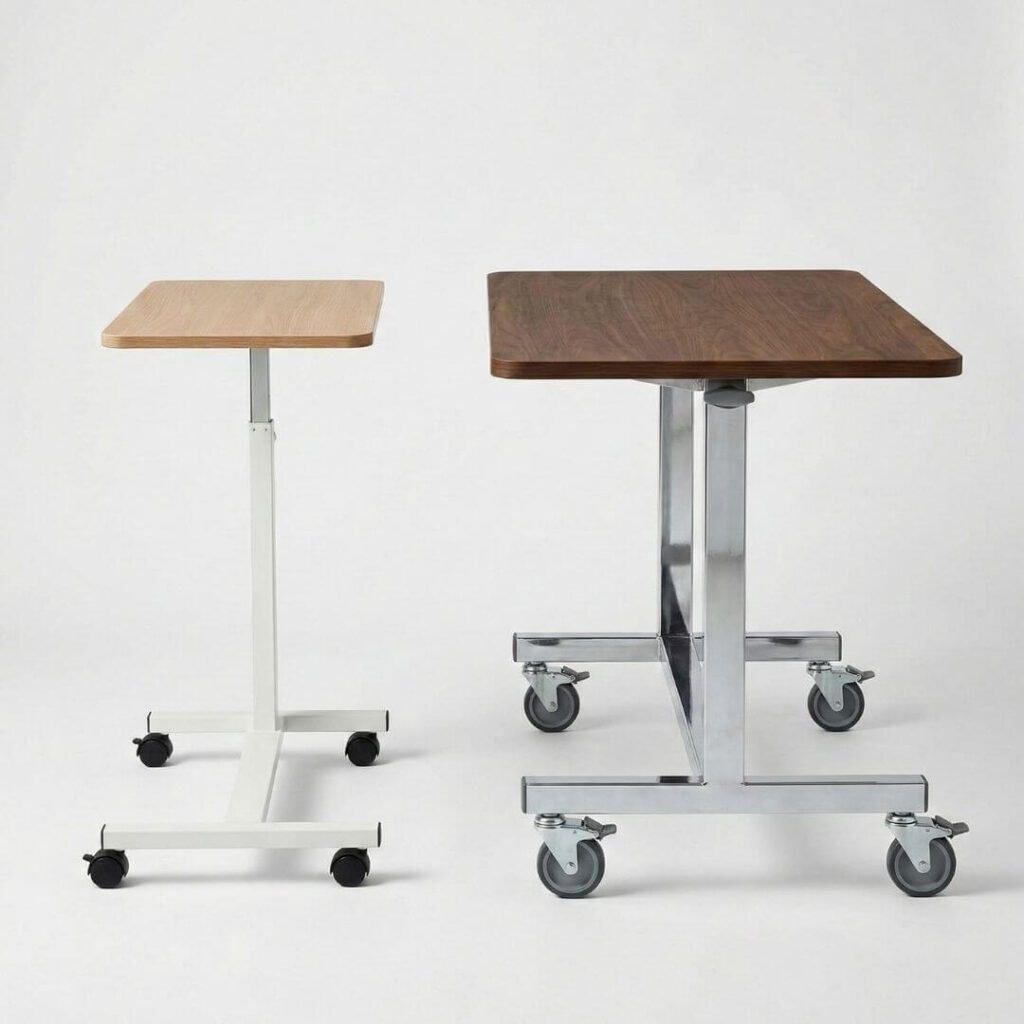
This rolling overbed table is designed for seniors who need frequent repositioning throughout the day, whether moving between bed, recliner, or sofa. Smooth-rolling casters and reliable locking mechanisms make it easy to adjust while maintaining stability when in use.
Pros
- Smooth-rolling wheels allow easy repositioning across different surfaces without lifting
- Secure wheel locks help prevent unwanted movement once the table is in place
- Works well with beds, recliners, and sofas, increasing versatility throughout the home
- Balanced design supports daily activities without feeling unstable during normal use
Cons
- Slightly larger footprint than compact models, requiring more floor space
- Requires consistent attention to wheel locking to maintain safe positioning

Best Heavy-Duty Overbed Table (Stability & Capacity)
Invacare Bed Table with L-Shaped Steel Base
Built for long-term durability, this heavy-duty overbed table offers increased stability and weight capacity for seniors who require a sturdier surface. Its steel base provides confidence during use, especially for those who rely more heavily on bedside support.
Pros
- Heavy-duty steel base enhances overall stability and reduces wobble
- Higher weight capacity than lightweight models, suitable for heavier items or equipment
- Designed for long-term and frequent daily use in medical and home settings
- Provides confidence for seniors who apply light pressure during activities
Cons
- Heavier and less portable, making frequent repositioning more difficult
- Bulkier base may be challenging to fit in small bedrooms or narrow spaces

Best Overbed Table With Tilt-Top (Reading / Tablet Use)
Drive Medical Tilt-Top Overbed Table
This tilt-top overbed table is best suited for reading, writing, or tablet use, allowing the surface angle to be adjusted for comfort. A raised edge helps keep items from sliding when the top is angled, though it is less appropriate for meals.
Pros
- Adjustable tilt feature supports reading, writing, and tablet use at comfortable angles
- Raised lip edge helps prevent books or devices from slipping when tilted
- Height adjustable to accommodate different bed heights and seating positions
- Durable construction from a trusted medical equipment brand
Cons
- Tilted surface is not well suited for meals, drinks, or medications
- Slightly more setup and adjustment required compared to flat-top tables

Best Compact Overbed Table for Small Spaces
Medline Economy Overbed Table
Designed with a smaller footprint, this compact overbed table fits well in tight bedrooms or assisted-living spaces. It offers essential adjustability while remaining easier to position under low-clearance beds.
Pros
- Compact base fits well in smaller rooms or limited floor space
- Adjustable height supports different bed setups and seating positions
- Trusted Medline construction offers consistent quality
- Easier to maneuver around tight spaces compared to full-size tables
Cons
- Smaller tabletop limits the amount of usable surface area
- Less stable than heavier, full-size overbed tables

Educational Overview: What Is an Overbed Table Used For?
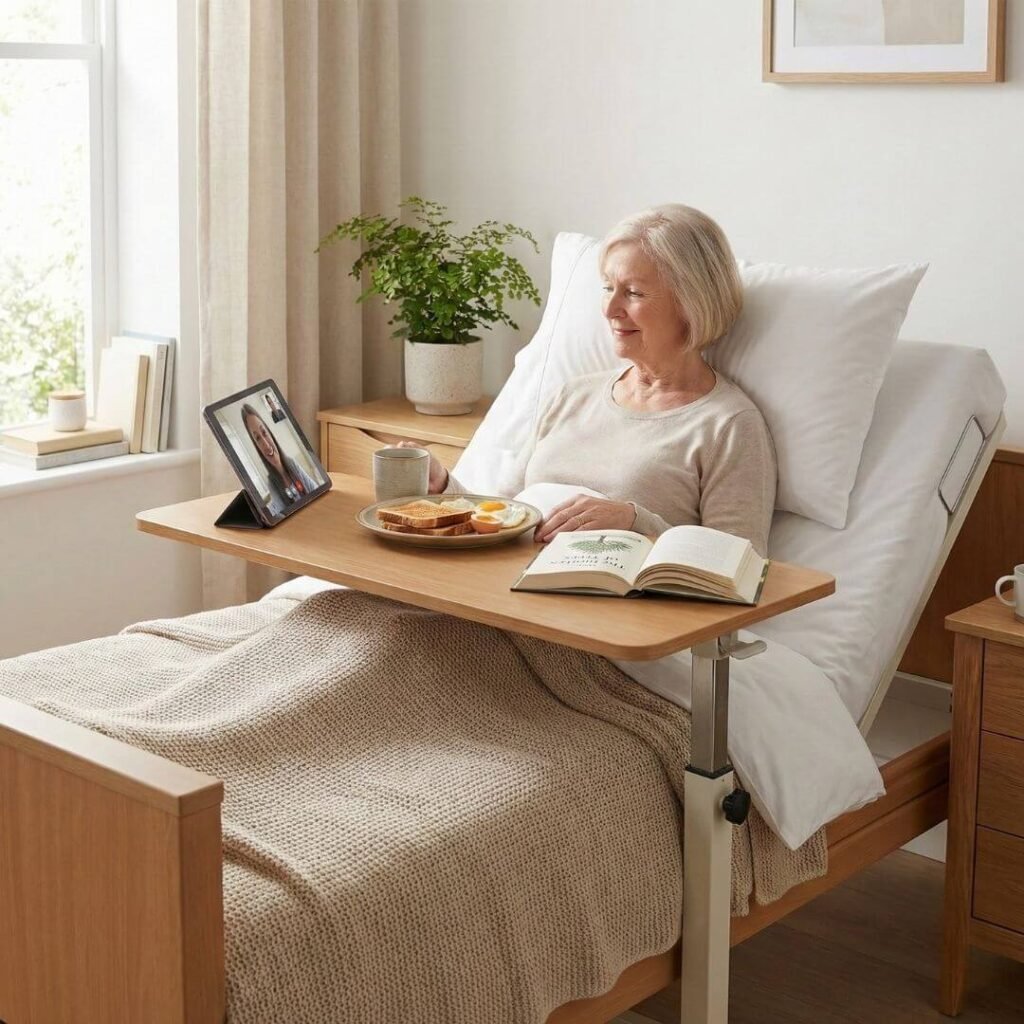
An overbed table is a piece of adaptive furniture designed to slide over or alongside a bed, providing a stable surface that remains within easy reach while a senior is seated or lying down. Unlike fixed bedside furniture, overbed tables are intentionally adjustable and mobile, allowing them to accommodate different positions and activities throughout the day.
In senior care, overbed tables are commonly used to support routine tasks that become more difficult when mobility or endurance is limited. These include eating meals in bed, organizing medications and water, reading or writing, and using personal electronics such as phones or tablets. By bringing these activities closer to the user, overbed tables help reduce the need for repeated reaching, twisting, or getting in and out of bed.
Overbed tables are especially useful for seniors whose daily needs change based on fatigue, pain levels, or recovery status. A senior may rely on the table heavily during illness or rehabilitation and use it more intermittently as strength improves. The ability to raise, lower, and reposition the table allows it to remain useful across different stages of care without requiring multiple furniture solutions.
Compared to nightstands or simple bedside trays, overbed tables are better suited for seniors who spend significant time in bed or need flexibility throughout the day. Nightstands are fixed in place and often sit too low or too far away, while trays typically lack stability and adjustability. Overbed tables fill this gap by offering a purpose-built surface that adapts to both the bed and the user.
If you’re unsure whether an overbed table is the right solution versus another type of support, this guide on how to choose the right mobility aid for your needs can help clarify when adaptive furniture is appropriate and when mobility equipment may be more beneficial.
How to Use an Overbed Table Safely
The tabletop should be positioned so it sits just below elbow height when the senior is seated upright in bed. This allows comfortable use without lifting the shoulders, leaning forward, or placing strain on the neck and upper back. Tables that are set too low or too high often lead to poor posture and discomfort over time.
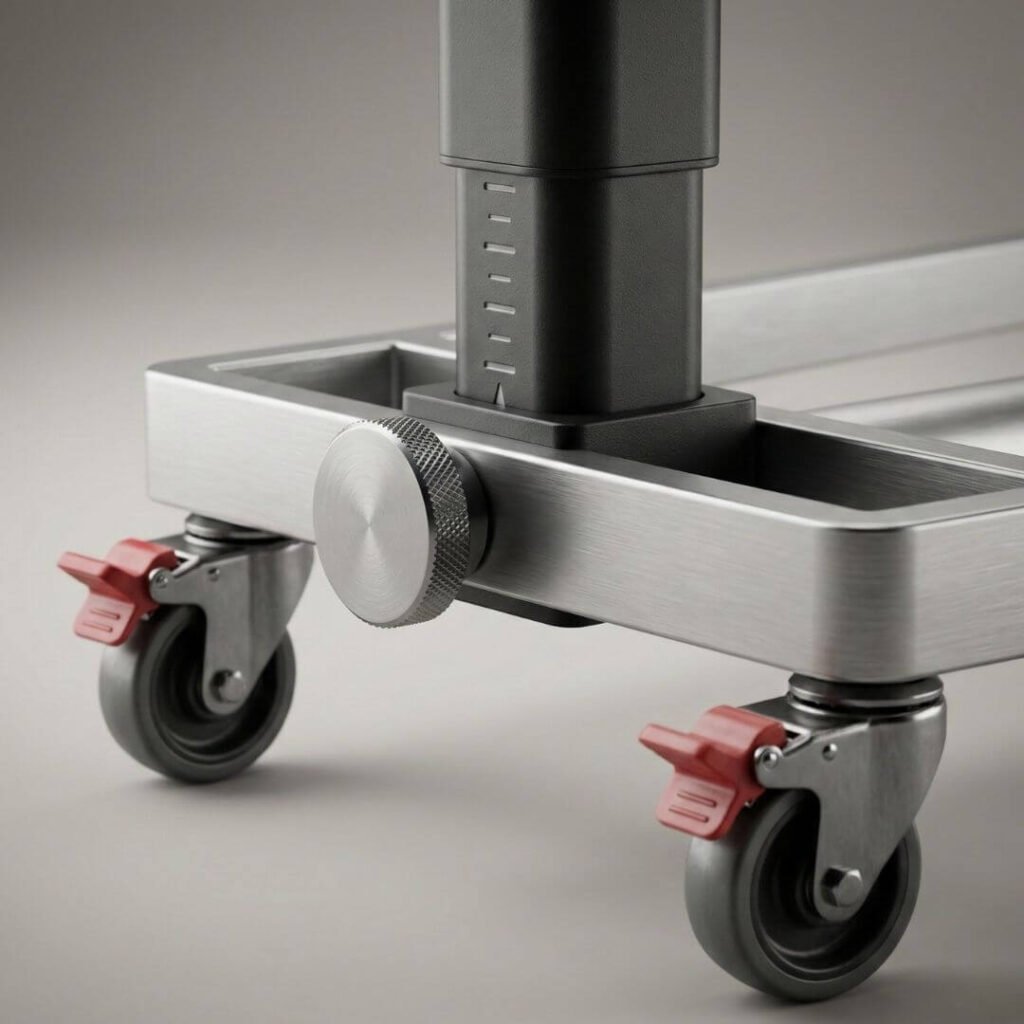
Wheel management is another critical safety factor. Overbed tables should roll easily when being repositioned, but they must remain fully stationary during use. Wheels should always be locked before placing weight on the table or setting items such as dishes, medications, or electronics on the surface. Even slight movement can be startling and increase the risk of spills or loss of balance.
Item placement also matters. Heavier or frequently used items should be placed toward the center of the tabletop to maintain balance and reduce tipping risk. Overloading one side of the table or placing items near the edge can make the surface feel unstable, especially for seniors with reduced strength or coordination.
It’s also important to remember what overbed tables are not designed to do. They are not meant to support full body weight or act as a substitute for mobility aids during transfers. If a senior begins relying on the table for balance when standing or shifting position, this may indicate that additional support or equipment is needed.
Regularly reassessing setup helps maintain safety over time. As bed height, mobility, or daily routines change, small adjustments to table height or positioning can prevent discomfort and reduce risk. For broader context on home safety and supportive environments, Cleveland Clinic offers practical guidance on aging in place and reducing everyday risks within the home.
Lifestyle Synergy: Making Overbed Tables Work Better at Home
Overbed tables are most effective when they are part of a thoughtfully arranged living space rather than treated as a standalone piece of equipment. The surrounding environment—lighting, floor layout, and nearby furniture—plays a significant role in how comfortably and safely the table can be used day to day.
Adequate lighting is essential, particularly for meals, medications, and reading. Poor lighting can force seniors to lean forward or reposition the table awkwardly to see clearly. Clear floor space around the bed is equally important, allowing the table to roll smoothly into position without catching on rugs, cords, or clutter. Even minor obstructions can make repositioning frustrating or unsafe over time.
Complementary furniture can further enhance how an overbed table functions within the home. Many seniors benefit from pairing an overbed table with supportive seating options such as lift chairs, which reduce strain during transfers between bed and chair and allow the table to be used in multiple positions throughout the day. When furniture works together, seniors can transition between resting, eating, and seated activities with less effort.
Small, practical adjustments can also improve usability. A non-slip mat can help keep dishes or devices stable, especially for seniors with tremors or reduced grip strength. Thoughtful cord management for lamps, chargers, or medical devices prevents tangling and reduces trip hazards. Keeping commonly used items organized and consistently placed on the table helps seniors build predictable routines that support independence.
When integrated into a supportive home setup, an overbed table becomes more than a convenience—it becomes a flexible tool that adapts to daily life, reduces physical strain, and supports safer, more comfortable routines.
Physician’s Tips for Long-Term Use
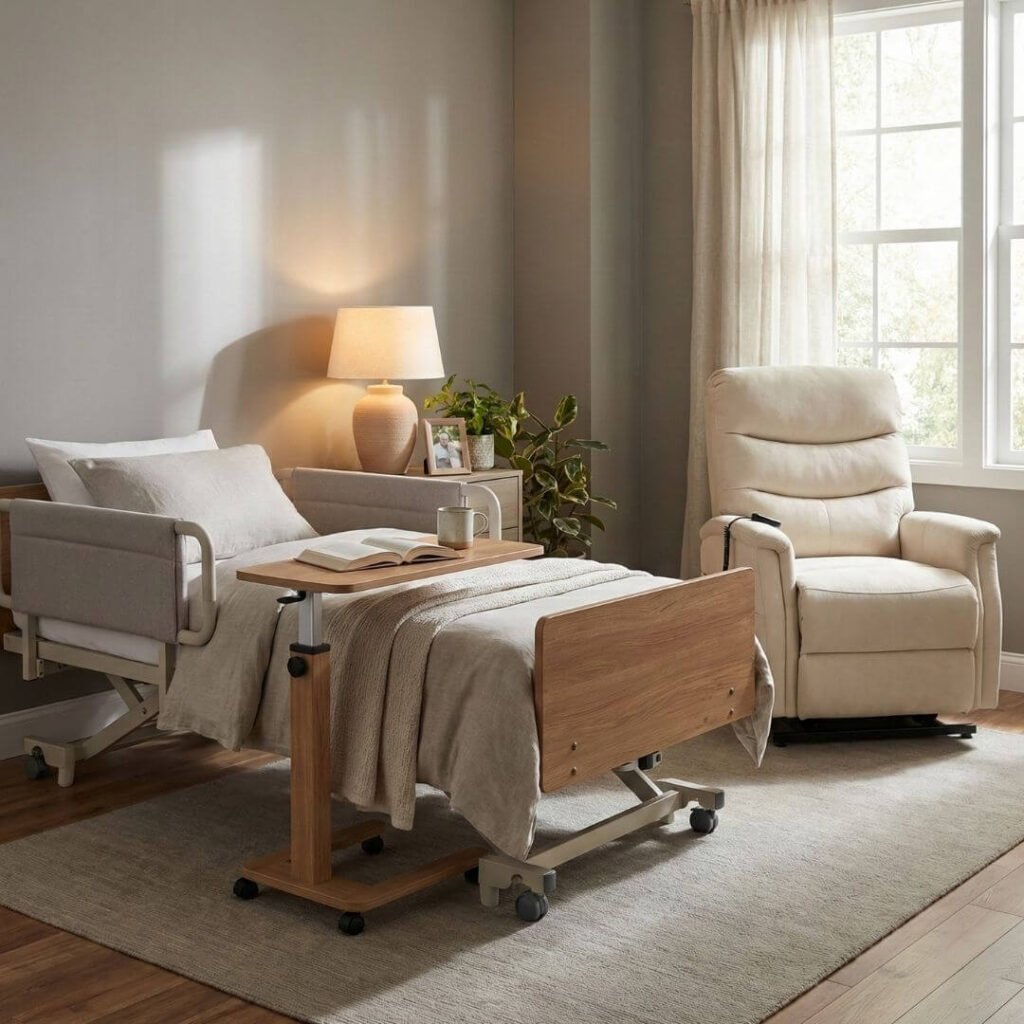
For seniors who rely on an overbed table daily, it’s important to view the table as part of an evolving care setup rather than a one-time purchase. Physical abilities often change gradually, not suddenly. Reassessing the table’s height, position, and stability every few months helps ensure it continues to support comfort and safety as strength, posture, vision, or balance shift over time.
A common issue I see in long-term use is what might be called gradual mismatch. A table that worked well during early recovery may become awkward if a senior begins leaning more heavily on it, spends longer periods in bed, or transitions between bed and chair more frequently. On the other hand, as mobility improves, a table that once felt bulky or restrictive may need to be repositioned to better fit daily routines. These changes are subtle, which is why they’re often overlooked.
Small, thoughtful adjustments can make a meaningful difference. Raising or lowering the tabletop slightly, repositioning frequently used items, or being more intentional about when wheels are locked can improve usability without changing equipment. Even minor changes in room layout or lighting can affect how naturally a senior interacts with the table throughout the day.
Caregivers should also pay attention to behavioral cues that suggest the setup may no longer be ideal. Increased frustration, repeated attempts to reposition the table, or using the table for balance rather than light support are often early signs that needs have changed. Addressing these signals early can help prevent discomfort and reduce unnecessary strain.
For additional medical context on assistive devices used in the home, MedlinePlus provides clear, evidence-based guidance that can help caregivers recognize when it may be appropriate to modify, supplement, or upgrade home equipment as part of a broader care plan.
Overbed Table Comparison for Seniors (Features, Stability & Use Cases)
Frequently Asked Questions
1. What is an overbed table used for in senior care?
An overbed table provides a stable, adjustable surface that allows seniors to eat, take medications, read, or use personal items while remaining safely positioned in bed. It reduces the need for repeated reaching or repositioning, which can increase strain or imbalance. In both short-term recovery and long-term care, overbed tables help keep essential items consistently within reach throughout the day.
2. Are overbed tables safe for elderly adults living alone?
Overbed tables can be safe for seniors living alone when they are properly adjusted and used correctly. Locking wheels, stable bases, and appropriate height settings help prevent unwanted movement during use. Keeping frequently used items within easy reach can also reduce unnecessary bending or transfers that increase fall risk.
3. What features matter most in an overbed table for seniors?
Stability is the most important feature, followed closely by smooth and reliable height adjustment. Locking wheels help ensure the table stays in place during use, while an appropriately sized tabletop prevents crowding or tipping. A well-designed base that fits under the bed without interference also improves usability.
4. Are overbed tables covered by Medicare or insurance?
Coverage varies depending on the specific policy and whether the table is classified as durable medical equipment. Some medical-grade overbed tables may qualify with proper documentation, but many home-use models are considered out-of-pocket purchases. It’s best to check with the insurer directly to understand coverage requirements.
5. What is the difference between medical and home-use overbed tables?
Medical overbed tables are typically heavier, more rigid, and designed for frequent use in clinical settings. Home-use models often prioritize lighter weight, appearance, and ease of movement. Both can be appropriate for seniors, depending on stability needs and how often the table will be used.
6. Do seniors need an overbed table with wheels?
Wheels make it easier to position and reposition the table without lifting, which benefits both seniors and caregivers. However, wheels must lock securely to prevent the table from shifting during use. For seniors who remain in one position most of the day, mobility is helpful but stability remains the priority.
7. How high should an overbed table be?
An overbed table should generally be set just below elbow height when the senior is seated upright in bed. This position allows comfortable use without raising the shoulders or leaning forward. Proper height reduces strain on the neck, shoulders, and lower back during meals or activities.
8. Can overbed tables help prevent strain or falls?
Yes, when positioned correctly, overbed tables can reduce the need for reaching, twisting, or standing up to access essential items. By keeping daily necessities within a safe range, they help limit movements that commonly contribute to loss of balance. While not a fall-prevention device on their own, they can support safer routines as part of a broader home setup.
Final Thoughts
Choosing the best overbed table for seniors is about more than convenience. The right table can support independence, reduce physical strain, and make everyday routines safer and more comfortable. By focusing on stability, adjustability, and real-world usability, seniors and caregivers can find an option that fits both medical needs and home life.
Medical Disclaimer: This guide is for general educational purposes only and is not intended to serve as personalized medical advice, diagnosis, or treatment. Always consult a licensed healthcare professional for recommendations tailored to your specific medical condition, mobility needs, or safety concerns.
Last update on 2026-03-21 / Affiliate links / Images from Amazon Product Advertising API