
Affiliate Disclaimer: This article contains affiliate links. As an Amazon Associate, Mobility With Ease may earn a small commission from qualifying purchases at no additional cost to you.
Introduction
Stepping over the side of a bathtub is one of the most dangerous daily movements for older adults. The combination of a raised tub wall, wet surfaces, and limited leg strength creates a moment of instability that leads to thousands of bathroom falls every year. For seniors who want to continue bathing at home safely, a shower transfer bench eliminates the need to step over that wall entirely. Instead of lifting a leg over a slippery edge, the user sits down on the bench outside the tub and slides across into the bathing area while staying seated the entire time.
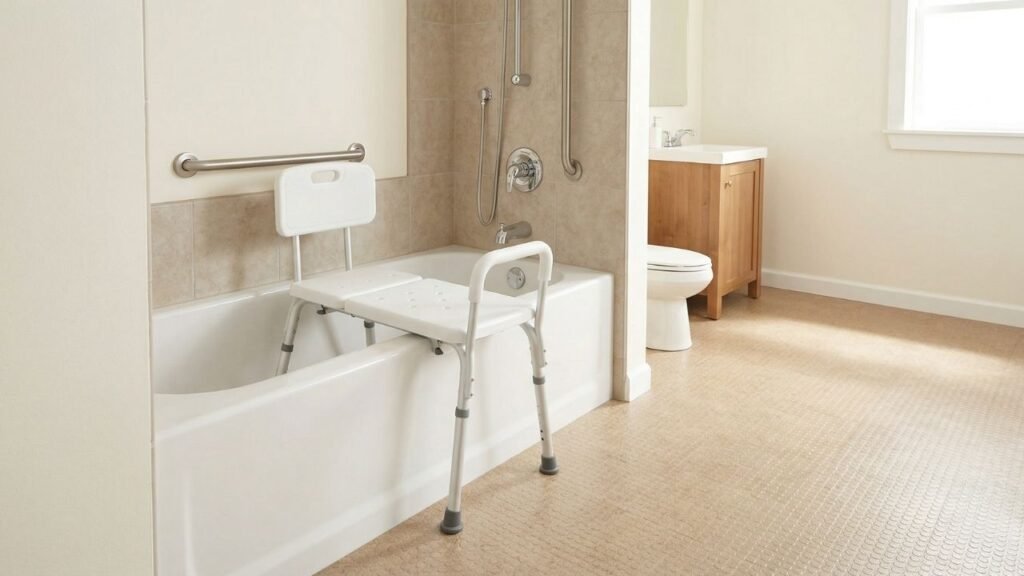
A shower transfer bench for seniors bridges the gap between the bathroom floor and the inside of the tub, creating a stable seated surface that spans the tub wall. Two legs rest on the bathroom floor and two legs rest inside the tub, giving the bench a wide, secure base. For many families, a transfer bench is the first piece of adaptive equipment that makes independent bathing possible again after a fall, surgery, or decline in balance. If you are assisting a loved one with bathing, our guide on how to help a senior shower safely covers the full caregiver process from preparation to technique.
In this 2026 guide, we review the best shower transfer benches for seniors across six categories: best overall, best padded, best sliding, best budget, best heavy-duty, and best compact. Each recommendation is evaluated based on stability, weight capacity, comfort, ease of setup, and suitability for real-world home use. We also cover how transfer benches work, how to use them safely, and what to look for before buying one.
Why Shower Transfer Benches Matter for Seniors
According to the CDC, falls are the leading cause of injury among adults 65 and older, and bathrooms are among the highest-risk rooms in the home. The standard tub wall height of 14 to 16 inches requires a person to lift one leg high enough to clear the edge while balancing their full body weight on the opposite leg — on a hard, often wet surface with limited handholds. The injuries that result from these falls — hip fractures, head trauma, wrist breaks — often trigger a cascade of complications including hospitalization, loss of independence, and long-term fear of movement.
A shower transfer bench for seniors directly eliminates the tub step-over. By providing a seated bridge across the tub wall, the bench allows the user to enter and exit the bathing area without ever standing on one leg over a wet surface. This approach is fundamentally safer because it keeps the body’s center of gravity low and supported during the entire transition. Understanding fall risks in seniors is the first step toward choosing the right bathroom safety equipment. For seniors who still have the upper body strength to slide and reposition themselves while seated, a transfer bench can preserve bathing independence far longer than relying on caregiver assistance or avoiding baths altogether.
Doctor’s Note: Choosing the Right Shower Transfer Bench
As a physician, I frequently recommend shower transfer benches for seniors who are recovering from surgery, managing chronic balance issues, or simply experiencing the gradual strength loss that comes with aging. The bathtub step-over is one of the first daily movements I assess when evaluating fall risk, because it combines multiple physical demands at once: single-leg balance, hip flexion, weight shifting, and coordination on a wet surface. When any of these abilities begins to decline, a transfer bench becomes medically appropriate.
Choosing the right model starts with understanding the user’s specific limitations. Grip strength matters because the person needs to stabilize themselves while sliding across the bench surface. If arthritis or neuropathy limits hand function, a bench with a textured or padded seat provides better friction and reduces the need to grip an armrest tightly. Leg strength determines whether the person can push themselves across the seat or whether a sliding mechanism would be more appropriate. For patients with significant lower body weakness or post-surgical restrictions, a sliding transfer bench with a swivel seat dramatically reduces the physical effort required to enter the tub.
Weight capacity is a critical safety factor. Every transfer bench has a rated load limit, and exceeding it creates a structural failure risk that can lead to a serious fall. I always recommend selecting a bench rated at least 50 pounds above the user’s body weight to provide an adequate safety margin. For bariatric patients, heavy-duty models with reinforced frames and wider seats are available and should be used exclusively.
The bathroom environment also plays a role. Tub width, wall placement, ceiling height for shower clearance, and the distance from the tub to the nearest wall or fixture all affect which bench model will fit properly. A bench that is too narrow will not span the tub wall securely, and one that is too wide may interfere with the shower curtain or enclosure. I encourage families to measure the tub carefully — inside width, outside width, and wall height — before selecting a product. For additional vertical support near the tub, consider pairing a transfer bench with one of the best transfer poles for seniors.

Best Shower Transfer Benches for Seniors (Top Picks)
Best Overall
Drive Medical Premium Bathtub Transfer Bench
The Drive Medical Premium Transfer Bench is one of the most widely recommended and reviewed shower transfer benches on the market. Its lightweight aluminum frame resists rust in humid bathroom environments and supports up to 400 pounds. The bench features a contoured backrest for comfort during seated bathing, adjustable-height legs with suction-cup tips for secure placement on wet surfaces, and a reversible design that fits both left-hand and right-hand tub configurations. Tool-free assembly means most families can set it up in under 15 minutes without any special equipment.
Pros
- Sturdy aluminum frame rated to 400 lbs
- Reversible design fits left or right tub setups
- Adjustable leg height with non-slip suction cups
- Tool-free assembly
Cons
- Plastic seat is not padded
- No armrest on the standard model

- Enjoy the Bath with Confidence: The Drive Tub Transfer Bench supports safer, independent bathing and stability, featuring an easy slide tub bench and a supportive backrest
- Bathe Independently & Securely: This shower bench promotes a secure bathing experience for users requiring assistance, offering stability along with drainage openings and suction cup feet
- Customizable Comfort: Designed to accommodate various tubs and user needs, this bench includes height adustable legs supported by sturdy, dual column extensions for precise 0.5-inch incremental...
Best Padded / Comfort
Medline Transfer Bench for Bathtubs and Showers
The Medline Transfer Bench is a heavy-duty option built specifically for seniors and adults with limited mobility. It supports up to 400 pounds and features an adjustable seat height from 17.5 to 22.5 inches in half-inch increments, allowing a precise fit for different tub depths and user heights. The reversible backrest can be switched to either side of the seat to accommodate left-hand or right-hand tub configurations, and a standard side arm provides stability and leverage when sitting down or standing up. Wide suction cup feet inside the tub grip securely to the surface, while slip-resistant rubber feet on the outside legs prevent sliding on the bathroom floor. Tool-free assembly and built-in drainage holes in the seat and backrest make setup and maintenance straightforward.
Pros
- Heavy-duty 400 lb weight capacity
- Adjustable height in half-inch increments for precise fit
- Reversible backrest with standard side arm
- Dual non-slip system: suction cups inside tub, rubber feet outside
Cons
- Side arm is fixed, not removable
- Hard plastic seat is not padded

- HEAVY DUTY BATH AND SHOWER BENCH—For seniors and mobility-impaired individuals; use as tub transfer bench or bath seat for easy entry and exit; high-strength, rust-resistant aluminum frame; 400 lb...
- EASY ADJUSTABLE HEIGHT SETTINGS AND REVERSIBLE BACKREST – Easy push-button design for simple, custom seat height adjustment from 17.5-22”. Reversible backrest fits on either side of seat to...
- BACKREST and ARM REST – Get extra stability and support when sitting down or getting up. Reversible backrest can be positioned on either side to fit most tubs; Stationary arm rest stays on one side.
Best Sliding
Eagle Health Supplies Sliding Transfer Bench with Swivel Seat (77662)
The Eagle Health 77662 is designed for seniors who have difficulty pushing themselves across a standard flat bench surface. The seat glides along a reinforced aluminum rail and features a 360-degree swivel system that locks at 90-degree intervals, allowing the user to sit down outside the tub, rotate to face the tub interior, and slide smoothly into the bathing position without lifting their body weight. A one-touch slide button controls seat movement along the 19-inch sliding track, and the included security belt adds an extra layer of safety during transfers. The bench supports up to 400 pounds with an adjustable seat height from 18.75 to 23 inches. It is FSA/HSA eligible and sets up in under five minutes with no tools required.
Pros
- 360° swivel with 90° locking intervals for controlled positioning
- One-touch sliding mechanism reduces upper body effort
- Heavy-duty 400 lb capacity with security belt included
- FSA/HSA eligible, tool-free setup
Cons
- Wider footprint may not suit very narrow tubs
- More complex mechanism requires careful maintenance
- Higher price point than basic benches

- Ease of Transfer, Effortless Sliding: FSA/HSA Eligible. This sliding shower transfer bench for bathtub helps reduce the risk of stepping into the tub—a major cause of falls in bathroom. This shower...
- Easy, Tool-Free Assembly: This tub transfer bench for bathtub sets up in under 5 minutes—no tools needed. It’s 100% reversible for left- or right-side installation, making this bath bench a...
- Enhanced Safety & Stability: This bath chairs for seniors built with a durable reinforced aluminum rail and rust-resistant frame, supports up to 400 lbs. The textured anti-slip bath seats with...
Best Budget
Drive Medical Plastic Tub Transfer Bench
For families working within a tight budget, the Drive Medical Plastic Transfer Bench delivers reliable safety at an accessible price. The bench uses a durable blow-molded plastic seat on an aluminum frame with a weight capacity of 300 pounds. It includes adjustable-height legs with suction tips and a simple backrest for seated support. While it lacks the padding and premium features of higher-priced models, it provides the same fundamental safety benefit — eliminating the tub step-over — at a fraction of the cost. The straightforward design also makes it one of the easiest benches to clean and maintain.
Pros
- Most affordable option with reliable safety features
- Lightweight and easy to clean
- Adjustable height with non-slip suction cups
- Simple tool-free assembly
Cons
- Hard plastic seat may be uncomfortable for longer use
- Lower weight capacity than premium models (300 lbs)
- No armrests
- The Bathtub Transfer Bench is designed to assist individuals while entering and exiting the bath for renewed independence
- Blow-molded plastic bath bench and backrest ensure maximum stability and are reversible to accommodate any bathroom
- Tool-free transfer bench assembly of back, legs, and arm, including pinch-free lever for extra installation safety
Best Heavy-Duty / Bariatric
HEALTHLINE Heavy Duty Transfer Bench (500 lb Capacity)
The HEALTHLINE Heavy Duty Transfer Bench pairs a bariatric-grade 500-pound weight capacity with a surprisingly light 9.5-pound frame, making it one of the easiest high-capacity benches to move or store between uses. The A-frame aluminum construction and durable blow-molded plastic seat provide rigid, wobble-free support, while the textured non-slip seat surface and suction-cup feet grip securely on wet bathroom floors and tub basins. Leg height adjusts in half-inch increments so you can fine-tune the fit for your tub depth, and the contoured backrest is shaped to encourage an orthopedically correct seated position. Tool-free assembly means it goes together in minutes with no hardware to fumble with.
Pros
- 500 lb bariatric capacity at only 9.5 lbs — easy to move or store
- A-frame construction for extra stability
- Non-slip seat surface and suction-cup feet
- Tool-free assembly, half-inch height adjustments
Cons
- Wider frame may be tight in very small bathrooms
- Hard plastic seat is not padded
- How much weight can it hold safely? – Bench frame and seat have been weight-tested up to 500 lbs under controlled conditions. For long-term daily use, recommended for users up to 300 lbs to ensure...
- Will it last in the shower? – Constructed with an aluminum frame and molded plastic seat. Regular drying after use is advised to reduce wear, prevent water from collecting inside the seat, and...
- How secure is the assembly? – Tool-free assembly; all screws and clips are included. For best safety, check and tighten connections regularly, as parts may loosen with repeated use in wet...
Best Compact / Lightweight
Carex Tub Transfer Bench
The Carex Tub Transfer Bench is a simple, lightweight option that works well in smaller bathrooms or for households that need to move the bench in and out of the tub between uses. The aluminum frame and blow-molded plastic seat keep the weight down without sacrificing stability, and the removable backrest can be switched to either side to accommodate left- or right-hand tub entry. Leg height adjusts in half-inch increments from 18.5 to 23.5 inches, so it fits a wide range of standard tubs. With a 300-pound weight capacity, non-slip rubber feet, and completely tool-free assembly, it covers the essentials for safe seated tub entry without adding bulk or complexity.
Pros
- Lightweight aluminum frame — easy to move or store
- Convertible backrest for left- or right-hand entry
- Half-inch height adjustments for a precise fit
- Tool-free assembly, non-slip rubber feet
Cons
- 300 lb capacity — lower than heavier-duty models
- No padding on seat surface

- Adjustable Seat Height Shower Bench....Easy to level bath bench to fit your bathtub, no tools required. The bath seat (or shower seat) disassembles quickly and easily. Works as a transfer bench for...
- Easy Transfer Tub Transfer Bench.... One side of the tub bench sits outside the tub, the other inside the tub. Simply sit on the outside part of the bench and slide the legs around to the inside bath...
- Sturdy Shower Chair For Inside Shower, Holds 300lbs. This tub transfer bench shower chair is compact in size but sturdy. Carex shower benches for inside shower to sit on comes standard with...
What Is a Shower Transfer Bench?
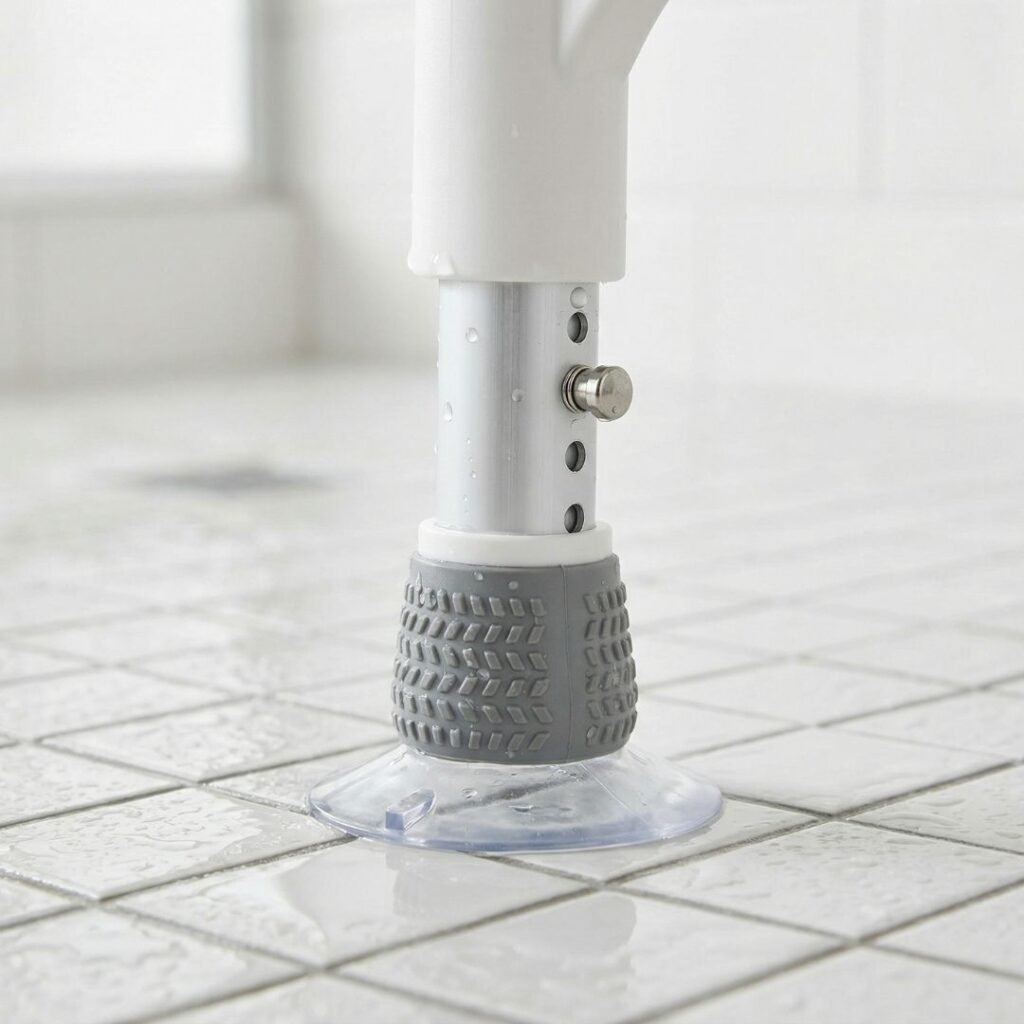
A shower transfer bench is an assistive bathing device that spans the width of the tub, with two legs on the bathroom floor and two inside the tub basin. This creates a stable, seated bridge that allows the user to sit down outside the tub, slide across, and bathe while remaining seated. Most models are constructed from lightweight aluminum or rust-resistant steel frames with molded plastic or padded seats. The legs feature adjustable height settings secured by push-button pins, and non-slip rubber tips or suction cups on the bottoms provide grip on wet surfaces.
There are several types of shower transfer benches available. Standard benches have a fixed flat seat that the user slides across manually. Sliding transfer benches feature a seat mounted on a rail system that glides smoothly with minimal effort. Swivel models add a rotating seat that allows the user to turn and face forward once inside the tub. Padded benches provide cushioned surfaces for comfort during longer bathing sessions. Bariatric models are built with reinforced frames and wider seats to support higher weight capacities.
A shower transfer bench for seniors is different from a standard shower chair or bath stool. A shower chair sits entirely inside the tub and still requires the user to step over the tub wall to reach it. A transfer bench eliminates that step entirely by bridging the wall. This distinction is critical for fall prevention because the step-over is the specific motion that creates the most instability and risk.
How to Use a Shower Transfer Bench Safely
Correct placement is the first requirement. Position the bench so that it spans the tub wall evenly, with two legs firmly on the bathroom floor and two legs firmly on the tub basin floor. All four legs must make full contact with their respective surfaces. If any leg is floating, tilting, or resting on the tub edge rather than the floor, the bench is not positioned correctly and should not be used. Adjust the leg heights so the seat surface is level. An uneven seat causes the user to slide toward the lower side, which creates instability during transfers.
Verify stability before every use. Press down firmly on the seat with both hands before sitting. Check that the suction cups or rubber tips are gripping properly and that no leg shifts or wobbles under pressure. Wet surfaces can reduce friction, so this check is especially important after the tub or floor has been rinsed. If any movement is detected, reposition the bench, clean the suction cups, or dry the contact surfaces before proceeding.
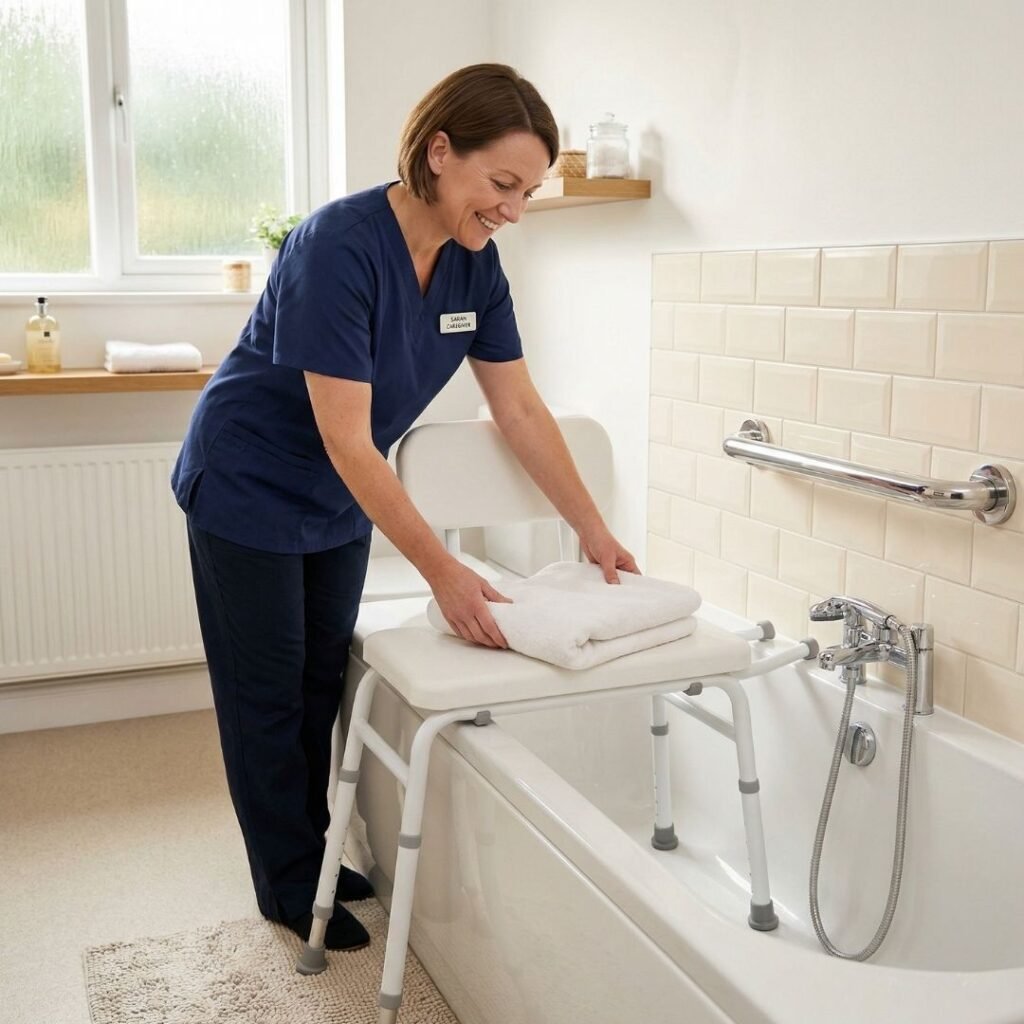
The transfer sequence should follow a consistent pattern. The user sits down on the outside portion of the bench first, keeping both feet on the bathroom floor. Once seated and stable, they lift one leg at a time over the tub wall and place each foot flat on the tub floor inside. Then the user slides their body across the bench seat toward the tub side. A grab bar mounted on the wall above the tub provides an additional handhold during the slide. Exiting the tub reverses the sequence: slide to the outside edge, swing legs over the wall one at a time, and stand up only when both feet are flat on the bathroom floor.
Never rush the transfer. Each movement should be deliberate and controlled. Hurrying increases the chance of slipping, misjudging distance, or losing balance mid-slide. If a caregiver is present, they should stand beside the bench on the bathroom floor side and provide verbal guidance or light physical support at the shoulder or hip without pulling or pushing the user. Bathroom modifications work best as part of a whole-home approach — see our tips for making your home safer for seniors.
Lifestyle Synergy: Making a Transfer Bench Work Better at Home
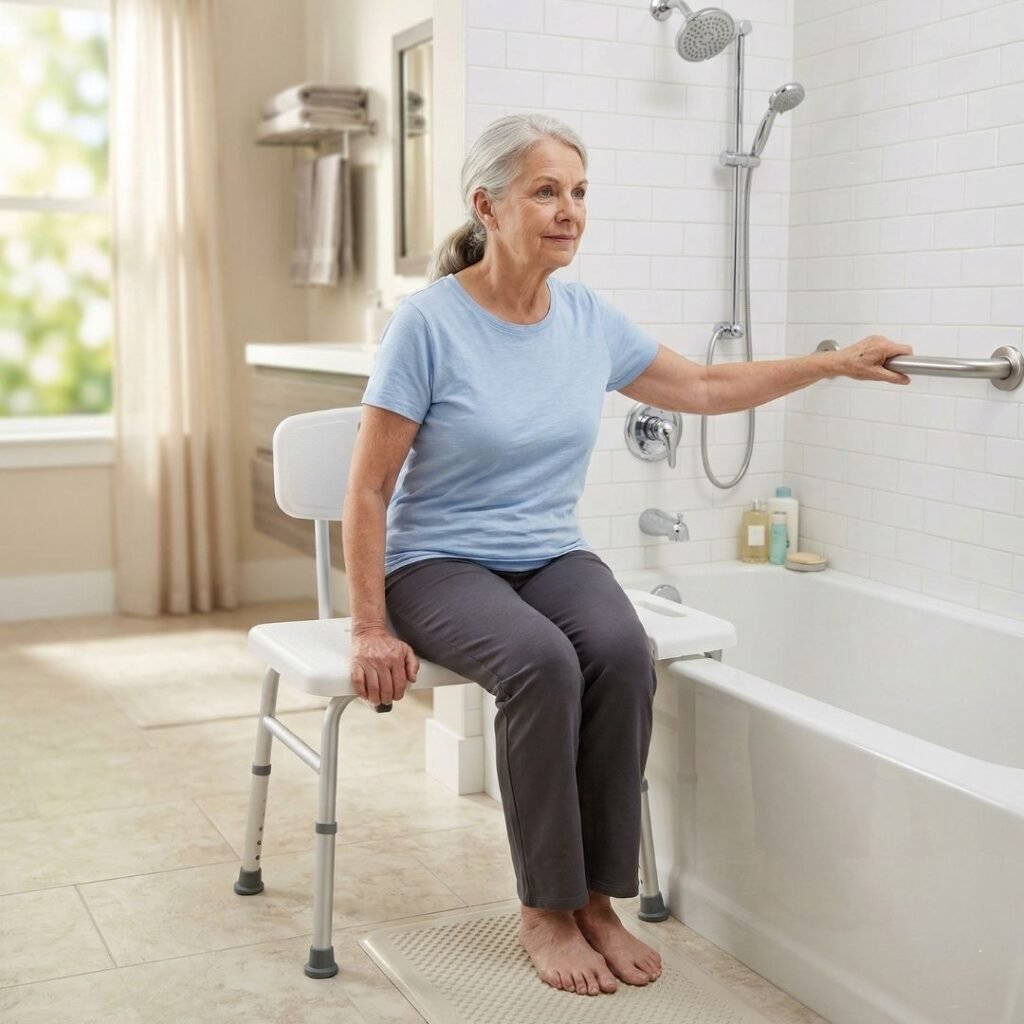
A shower transfer bench for seniors is most effective when the surrounding bathroom environment supports safe movement. The floor beside the tub should have a non-slip bath mat that stays firmly in place when stepped on with wet feet. Inside the tub, a non-slip mat or adhesive strips prevent the bench legs from shifting and provide additional traction for the user’s feet during bathing.
Grab bars are the most important companion to a shower transfer bench for seniors. A wall-mounted grab bar within arm’s reach of the bench seat provides a secure handhold during the sliding transfer. A second bar near the showerhead gives the user something to hold while adjusting water or reaching for soap. The combination of a stable seated surface and fixed handholds creates a layered support system that addresses multiple phases of the bathing process.
A handheld showerhead significantly improves the bathing experience when using a transfer bench. Standard fixed showerheads mounted high on the wall are difficult to use from a seated position. A handheld unit on a flexible hose allows the user to direct water exactly where it is needed while staying seated and stable. Most are inexpensive and can be installed without professional plumbing work.
For a complete approach, see our guide to creating a senior-friendly bathroom that addresses every surface and fixture. Small improvements like adequate lighting, accessible soap and shampoo storage within arm’s reach, and a warm towel placed on the bench before use all contribute to a safer, more dignified bathing routine. The goal is to make the entire process feel manageable and predictable so that the senior continues using the equipment consistently rather than skipping baths due to anxiety or inconvenience.
Physician’s Tips for Long-Term Use
A shower transfer bench for seniors that works well today should be reassessed periodically as the user’s mobility changes. After a hospitalization, surgery, illness, or noticeable change in balance or strength, I recommend re-evaluating whether the current bench model still meets the person’s needs. A senior who was able to slide across a standard flat bench six months ago may now benefit from a sliding or swivel model if upper body strength has declined. Equipment should match current ability, not past ability.
Pay attention to how the bench is being used over time. If the user begins gripping the armrest or grab bar with visible tension, hesitates before initiating the transfer, or avoids bathing altogether, new discomfort or fear may be developing. These behavioral changes are early warning signs that should not be ignored. Addressing them promptly — through equipment adjustment, physical therapy referral, or a conversation about what has changed — can prevent a decline in hygiene, confidence, and overall safety.
Skin health is an important consideration for seniors who use a transfer bench daily. Sliding across a hard plastic surface can cause friction irritation, especially on thinner or more fragile skin. Padded benches or a folded towel placed on the seat surface can reduce friction and improve comfort. Users with diabetes, circulation issues, or skin conditions should inspect the areas that contact the bench surface regularly and report any redness, soreness, or breakdown to their healthcare provider.
Maintenance checks extend the life of the bench and keep it safe for daily use. Inspect the leg tips monthly for wear, cracking, or loss of suction. Check that all push-button height pins are fully engaged and that no leg has slipped from its set height. Wipe down the seat and frame weekly with a mild cleaner to prevent soap buildup and mildew, which can make surfaces slippery. A transfer bench is a piece of medical equipment, and like all medical equipment, it performs best when maintained consistently.
The National Institute on Aging recommends bathroom modifications as a key step in fall prevention for older adults. I echo this guidance and encourage families to view a shower transfer bench not as a sign of decline but as a proactive measure that protects independence. The goal is to keep bathing safe and sustainable for as long as possible, and the right equipment — properly selected, properly installed, and properly maintained — makes that achievable.
Shower Transfer Bench Comparison for Seniors (Features & Safety)
Frequently Asked Questions
1. What is a shower transfer bench for seniors and how does it work?
A shower transfer bench for seniors is a seated support device that spans the bathtub wall, with two legs on the bathroom floor and two legs inside the tub. The user sits on the outside portion, slides across the bench surface into the tub, and bathes while remaining seated. This eliminates the need to step over the tub wall, which is the most common cause of bathtub falls among older adults. The bench provides a stable, non-slip surface that keeps the body’s center of gravity low and supported throughout the entire transfer.
2. How do you use a shower transfer bench for seniors safely?
Always check bench stability before sitting down. Press firmly on the seat to confirm all four legs are secure and the suction tips are gripping. Sit on the outside portion first with both feet on the bathroom floor. Lift one leg at a time over the tub wall, then slide across the bench into the tub. Reverse the sequence to exit. Never rush the transfer. Using a grab bar mounted on the wall above the tub provides an additional handhold during the sliding motion.
3. What weight limit should I look for in a transfer bench?
Select a bench rated at least 50 pounds above the user’s body weight. Standard models typically support 300 to 400 pounds. Bariatric models are available with capacities up to 500 pounds or more. Exceeding a bench’s rated weight capacity creates a structural failure risk and should never be done. Check the manufacturer’s specifications carefully before purchasing.
4. Will a shower transfer bench fit my bathtub?
Most standard transfer benches are adjustable and fit bathtubs with an inside width between 21 and 26 inches. Measure the inside width of your tub at the widest point, the outside width including the tub wall, and the height of the tub wall. Compare these measurements to the bench specifications before ordering. Some models are designed specifically for wider or narrower tubs, so matching dimensions is important for proper fit and stability.
5. Are shower transfer benches covered by Medicare?
Shower transfer benches may qualify as durable medical equipment under Medicare Part B if a physician documents medical necessity. Coverage varies based on the specific product, the patient’s diagnosis, and whether the supplier is Medicare-approved. For details on covered durable medical equipment, visit Medicare.gov’s DME coverage page or speak with your healthcare provider about eligibility.
6. What is the difference between a shower chair and a transfer bench?
A shower chair sits entirely inside the tub and requires the user to step over the tub wall to reach it. A transfer bench spans the tub wall with legs on both sides, allowing the user to sit down outside the tub and slide into the bathing area without stepping over the edge. For seniors with limited leg strength or balance issues, the transfer bench is significantly safer because it eliminates the step-over entirely.
7. How do I keep a shower transfer bench from sliding?
Most quality transfer benches include non-slip rubber tips or suction cups on the leg bottoms. Ensure these are clean, undamaged, and making full contact with the floor surface before each use. Adding a non-slip mat inside the tub beneath the bench legs provides additional grip. Check the suction cups monthly for wear or cracking and replace them if they no longer hold firmly. Soap residue and mineral buildup can reduce suction effectiveness, so wipe the tips and floor surfaces regularly.
Final Thoughts
The best shower transfer benches for seniors solve a specific, well-documented problem: the dangerous step over the bathtub wall. By providing a stable, seated bridge across the tub edge, these benches remove the single movement most responsible for bathroom falls among older adults. Whether you choose a standard bench for everyday reliability, a padded model for comfort, a sliding bench for reduced physical effort, or a bariatric model for maximum support, the core benefit is the same — safer tub entry and exit without the one-legged balancing act that causes so many injuries.
Selecting the right shower transfer bench for seniors means matching the product to the person and the bathroom. Consider the user’s weight, grip strength, and ability to push themselves across the seat. Measure the tub dimensions carefully. Look for non-slip leg tips, adjustable height, and a weight capacity that exceeds the user’s needs by a comfortable margin. Pair the bench with grab bars, a handheld showerhead, and non-slip mats to create a complete bathing safety system.
When installed correctly and used consistently, a shower transfer bench can preserve bathing independence, reduce caregiver strain, and prevent the kind of fall that changes everything. For many families, this single piece of equipment makes the difference between a daily routine that feels safe and one that feels like a risk. Regular maintenance and periodic reassessment ensure the bench continues to meet changing needs and keeps bath time safe, comfortable, and sustainable for the long term.
Medical Disclaimer: This guide is for general educational purposes only and is not intended to serve as personalized medical advice. Always consult a qualified healthcare professional before making changes to medical equipment or care plans.
Last update on 2026-03-25 / Affiliate links / Images from Amazon Product Advertising API