
Affiliate Disclaimer: This article contains affiliate links. As an Amazon Associate, Mobility With Ease may earn a small commission from qualifying purchases at no additional cost to you.
Introduction
Standing up from a couch, chair, or bed becomes more challenging as strength, balance, and joint stability decline with age. What used to be a smooth, automatic motion can gradually turn into something that requires planning, effort, or even a helping hand. Many seniors begin to notice subtle changes first—needing to “rock” forward to build momentum, using furniture edges to push off, or hesitating before rising because the movement feels unsteady. Over time, these small shifts can increase the risk of slips and forward falls, especially when leg strength and core stability continue to diminish.
A reliable standing aid bridges that gap between effort and safety. It provides leverage, stability, and predictable support during the moments that matter most—getting out of a recliner, rising from a low sofa, transitioning out of bed, or moving from a seated position after resting. The right device doesn’t just make the movement easier; it helps restore confidence, reduces strain on joints and muscles, and supports independence in everyday routines. Caregivers also benefit from safer body mechanics and reduced lifting demands, which is crucial for preventing injuries on both sides.
Every senior’s mobility needs are different. Some require only light assistance to stand comfortably, while others need structured support or a controlled lifting mechanism. In this guide, you’ll find the best standing aids for seniors in 2025—ranging from simple support rails to more advanced sit-to-stand devices—along with doctor-informed insights to help you match the right solution to the right mobility level. Whether you’re looking to improve safety, reduce fatigue, or support a loved one who struggles with rising independently, this list will give you clear, practical options to make daily life smoother and safer.
Why Standing Aids Matter for Senior Safety
Rising from a seated position is one of the most frequently performed movements in daily life, yet it becomes progressively harder as the body changes with age. Even before noticeable weakness sets in, seniors often begin adapting their movements—using armrests more heavily, shifting weight unevenly, or pushing off their thighs to gain momentum. These compensations may seem small, but they increase stress on the wrists, shoulders, knees, and lower back, and can eventually contribute to discomfort or chronic pain.
The challenge isn’t only physical strength; it’s also about coordination and timing. Standing requires several things to happen in the right order: leaning forward, engaging the core, shifting weight, and extending the legs. When one part of that sequence slows down or becomes less reliable, the whole movement becomes unsteady. This is why some seniors feel as though they “can’t get going” or feel wobbly during the first few seconds after rising.
Standing aids help simplify that sequence. By providing a stable point of leverage, they reduce the amount of force needed from the legs and core. Gripping a secure handle allows seniors to control the pace of the movement, avoid sudden shifts in balance, and position their feet safely before fully standing. This improves not only safety, but also comfort—especially for those with arthritis, knee pain, or fatigue.
Another key reason standing aids matter is confidence. Many older adults who experience near-falls or slips become hesitant to move, which can lead to reduced activity, further weakness, and even greater fall risk. A well-chosen support tool helps break that cycle by restoring trust in the movement itself. Seniors who feel stable are more likely to stay active, maintain strength, and move throughout the day without fear.
Standing aids also benefit caregivers, who often take on the physical burden of assisting with transitions. Repeated lifting, pulling, or supporting a loved one from awkward angles can strain the back, shoulders, and wrists. A standing aid transfers much of that load to the device, making the motion safer for everyone involved.
Ultimately, the right standing aid isn’t just a convenience—it’s a critical component of maintaining independence, preventing falls, and supporting healthier mobility patterns as the body changes over time. Whether a senior needs gentle leverage or robust mechanical lifting, having the appropriate tool ensures the standing transition remains safe, predictable, and sustainable.
Doctor’s Note
Many seniors experience gradual changes in how their body manages the standing motion long before they realize they’ve lost strength or stability. What often begins as a subtle shift—such as relying more on armrests or taking an extra moment before rising—can progress into more noticeable compensations. When someone repeatedly pushes off furniture, rocks forward excessively, or loses momentum during the standing phase, the risk of a forward fall increases sharply. These patterns often indicate underlying challenges with leg strength, balance coordination, or joint control.
Standing also requires the body to momentarily redistribute weight and quickly stabilize once upright. If that stabilization phase is slow or incomplete, seniors may feel unsteady during the first few steps, which further elevates fall risk. For individuals with arthritis, neuropathy, or cardiovascular symptoms, that instability can be even more pronounced.
To better understand why these challenges happen and how fall patterns develop, refer to our more detailed guide on understanding fall risks in seniors. Recognizing fall patterns early allows families and caregivers to intervene before a major injury occurs.
In clinical practice, several warning signs often tell me that a senior would benefit from a standing aid:
- They must “rock” repeatedly to generate momentum.
- They push down on their thighs or knees to stand.
- Their knees feel wobbly or unstable during the first few seconds upright.
- Rising from soft or low furniture has become noticeably harder.
- They feel dizzy, lightheaded, or out of breath after standing.
- They brace against furniture that is not designed to support weight.
If dizziness, knee buckling, or shortness of breath occurs with standing, reassess support needs immediately, as these symptoms may signal cardiovascular, neurological, or strength-related concerns that require attention.
Standing aids work best when combined with routine strength training, balance reinforcement, and regular mobility checks. Even small improvements in leg strength or posture can dramatically change standing performance and reduce fall risk.

Best Standing Aids for Seniors (2025 Top Picks)
Below are the top recommended standing aids, categorized to match different mobility needs, home setups, and support levels.
Best Overall Standing Aid for Seniors
Stander EZ Stand-N-Go, Chair Lift Assist for Elderly
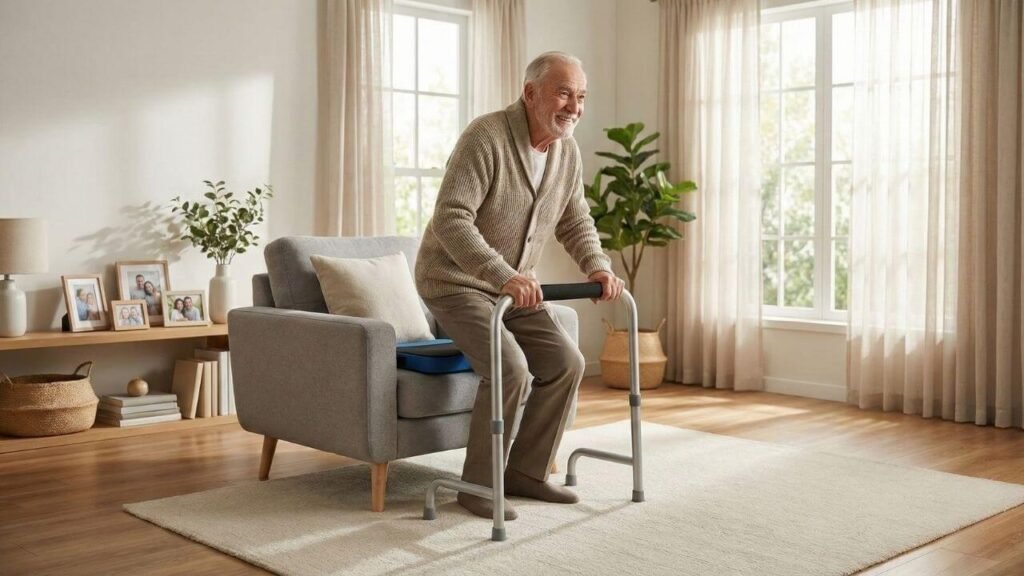
The Stander EZ Stand-N-Go offers stable leverage from almost any couch, recliner, or armchair. Its adjustable width and cushioned handles make rising smoother and safer for seniors with mild to moderate mobility limitations.
Pros:
- Adjustable frame width allows it to fit securely on most couches, recliners, and armchairs without wobbling.
- Cushioned foam handles provide a firm, comfortable grip that reduces strain on wrists and hands during standing.
- Offers reliable leverage for seniors who need predictable support without relying on unstable furniture edges.
Cons:
- Requires assembly and adjustment during initial setup, which may take extra time for caregivers.
- Not ideal for extremely low seating or very deep recliners where added leverage may still be insufficient.

Best Budget Standing Assist Device
Vive Stand Assist – Mobility Standing Aid Rail
This budget-friendly support rail offers simple leverage to help seniors stand from couches, chairs, or recliners without slipping or overexertion. Its lightweight frame makes it easy to position and adjust.
Pros:
- Budget-friendly option that still offers dependable support for rising from most chairs.
- Slip-resistant handles improve safety, especially for seniors with weaker grip strength.
- Compact, lightweight design makes it easy to reposition or move from room to room as needed.
Cons:
- Not designed for heavier individuals who may require a sturdier or reinforced frame.
- Provides less lateral stability than premium models, especially on softer furniture.

Best Bedside & Chair Standing Handle
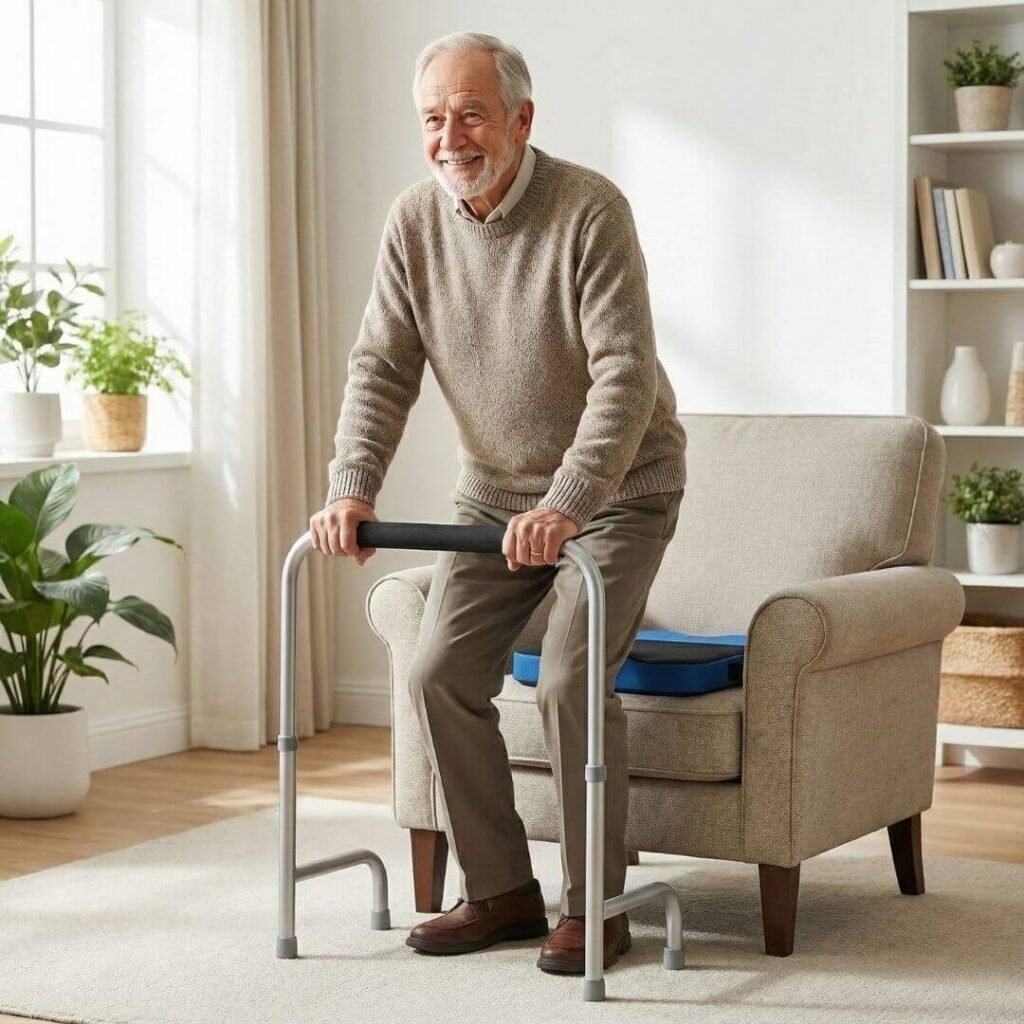
Able Life Universal Stand Assist
This frame slides beneath a bed or chair cushion to provide firm, two-handed support. It’s ideal for seniors who need assistance rising from low or soft seating while maintaining better posture during transitions.
Pros:
- Slides under cushions to create a stable anchoring point that won’t shift during standing.
- Dual padded handles support balanced, two-handed leverage for improved posture alignment.
- Works equally well for beds and chairs, making it versatile for bedroom and living room use.
Cons:
- Installation takes more effort compared to standalone devices, especially on heavier furniture.
- Not the best option for seniors who need a portable solution that can be moved often.
Best Portable Stand-Assist Tool
Liberty Lift Portable Standing Aid
This highly portable grip handle allows caregivers to assist seniors during standing transitions without strain. Multiple grip positions make it comfortable for both parties.
Pros:
- Ultra-portable handheld design allows caregivers to assist safely without pulling from the shoulders or arms.
- Multiple grip positions accommodate different hand sizes and caregiver angles for comfortable lifting.
- Ideal for transfers in tight spaces where larger standing aids won’t fit.
Cons:
- Requires two people to operate—one senior and one caregiver—so it’s not an independent-use device.
- Provides leverage but not full-body stability, making it unsuitable for those with severe balance issues.

Best Floor-to-Stand Lift Assist Device
MAIDeSITe Electric Chair Lift (JC35M3)
For seniors who need assistance rising from the floor after a fall or during low-level activities, this electric lift raises the user safely into a seated or standing-ready position.
Pros:
- Electric lifting platform smoothly raises seniors from floor level, supporting safe fall recovery at home.
- Wide, stable base prevents tipping and offers secure support throughout the lift cycle.
- Strong 300-lb weight capacity accommodates a broad range of users and home-care situations.
Cons:
- Must be plugged in or charged, which reduces convenience compared to manual devices.
- Larger structure takes up more space and may not fit easily in compact living areas.

Best Heavy-Duty Standing Aid (High Weight Capacity)
Stander Heavy Duty EZ Stand-N-Go (Bariatric)
This reinforced version of the EZ Stand-N-Go is built for seniors who require additional support and higher weight capacity during sit-to-stand transitions.
Pros:
- Reinforced construction offers superior strength and stability for users who need greater weight support.
- Wide-grip handles provide comfortable leverage, reducing pressure on arthritic hands and wrists.
- Excellent option for deep, soft, or plush seating where standard models may feel less supportive.
Cons:
- Bulkier design can make repositioning or adjusting the device slightly more cumbersome.
- Requires careful measurement and setup to ensure proper fit and maximum stability.
Best Sit-to-Stand Support for Mobility-Limited Seniors
Vive Mobility Sit-to-Stand Patient Lift
Designed for seniors with significant mobility limitations, this lift supports safe transitions from sitting to standing with caregiver assistance. It’s ideal for home-care environments where additional stability and controlled lifting are required.
Pros:
- Provides structured support for seniors who cannot stand without controlled mechanical assistance.
- Knee pads, grab bars, and safety features help maintain proper posture throughout the lift cycle.
- Reduces caregiver strain by handling the majority of lifting force in a safe and predictable manner.
Cons:
- Requires a caregiver to operate, making it unsuitable for independent use.
- Bulky design means it may be difficult to store in smaller homes or shared living spaces.

Educational Overview: How Standing Aids Support Mobility
Standing is one of the most complex movements the body performs. It requires coordinated effort between the legs, core, hips, and upper body, along with quick balance adjustments once upright. As these systems naturally change with age, the simple act of rising from a chair becomes more difficult—not just physically, but biomechanically.
One of the earliest signs of standing difficulty is trouble generating enough forward momentum to rise smoothly. Seniors often compensate with repeated rocking, pushing off unstable surfaces, or leaning too far forward. These strategies may feel intuitive, but they increase the risk of tipping forward and falling. Standing aids help by giving the user a secure point of leverage, reducing the need for forceful momentum and helping guide the body into a safer alignment.
Pain and joint stiffness also play a major role. Conditions such as knee arthritis, hip weakness, and lower-back discomfort make it harder to bear weight evenly or transition smoothly into an upright position. A standing aid reduces the load on painful joints and helps the user control the pace of movement, which minimizes strain and improves comfort.
Common Factors That Make Standing More Difficult
A few challenges—shared by many older adults—tend to make standing especially hard:
- Uneven leg strength, which causes twisting, instability, or pushing off to one side during the rise.
- Weak or unreliable balance responses, making the first seconds after standing feel wobbly or unsafe.
- Environmental barriers, such as deep recliners, overly soft couches, or low seating that forces the body into awkward angles.
Even when strength is adequate, poor furniture height or lack of hand support can make the standing motion unnecessarily risky.
When standing difficulty persists beyond what leverage alone can solve, additional mobility tools may be helpful. For seniors who rise safely but feel unstable once upright, walkers can provide the next level of support. Our guide to best folding walkers for seniors outlines lightweight options that integrate well with standing aids and offer continuous stability during movement.
The importance of proper support becomes clearer when looking at fall statistics. The CDC reports that more than one in four older adults experiences a fall each year—many of them occurring during transitions like rising from a chair:
Standing aids directly reduce this risk by improving leverage, promoting safer body positioning, and decreasing the likelihood of sudden loss of balance during the transition.
How to Use Standing Aids Safely
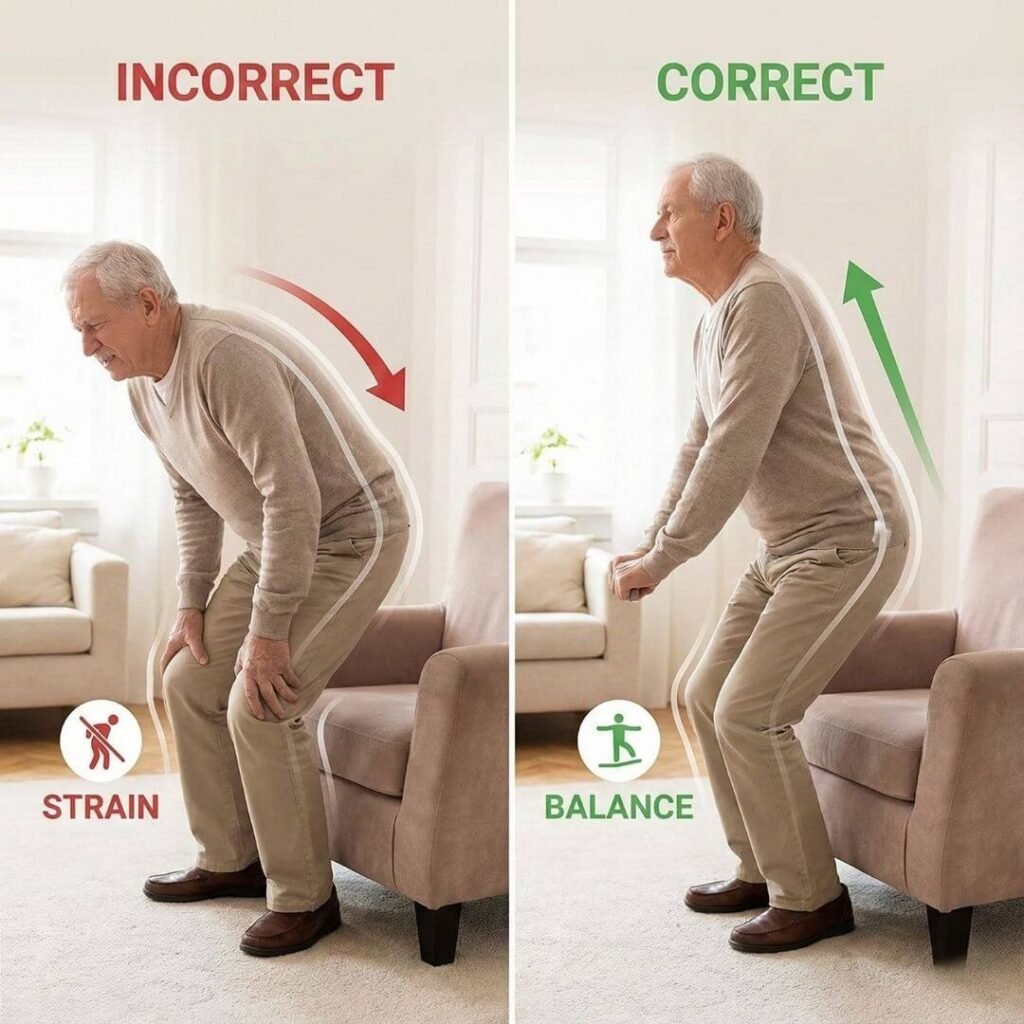
Safe use of a standing aid starts with proper body positioning and understanding how leverage works during the standing motion. Seniors should approach the device slowly, place their hands securely on the designated grips, and ensure the aid is positioned at a height that allows the elbows to bend slightly without overreaching. A device set too low or too high can reduce stability and increase strain on the wrists or shoulders.
Foot placement is equally important. Feet should be shoulder-width apart, with one foot slightly behind the other if additional momentum is needed. This staggered stance helps maintain balance while transitioning weight forward. Once the hands are secure and the feet are stable, the senior should lean forward from the hips—not the shoulders—to shift their center of gravity over their feet. Only then should they begin extending the legs to rise.
A controlled pace is essential. Moving too quickly can cause dizziness or imbalance, while moving too slowly can lead to fatigue. Seniors should rise at a steady, comfortable speed, using the standing aid for supplemental support rather than pulling aggressively. The device is meant to guide and stabilize—not replace—leg strength entirely. If significant pulling is required, the aid may be inappropriate for that individual or improperly positioned.
Key Safety Principles to Remember
- Avoid twisting while rising. Twisting the knees, hips, or feet while pushing upward can increase joint stress and destabilize the movement.
- Check furniture height. Very low chairs can make safe standing harder; in such cases, a firmer or higher seat cushion may improve leverage.
- Ensure the aid is stable before each use. Devices that slide, shift, or sit unevenly on cushions or flooring should be readjusted.
- Pause before walking. After standing, seniors should take a moment to steady themselves and allow their balance to reset before taking the first step.
For seniors who consistently lean too far forward or feel unsteady once upright, a standing aid alone may not be enough. In those situations, upright mobility aids can offer additional postural support and improve confidence during walking. Our guide to best upright walkers for seniors explains how these devices encourage better spinal alignment and reduce forward flexion, which is especially important for individuals with back pain or balance concerns.
Caregivers should also monitor for signs that standing technique may need to be adjusted—such as wincing, pushing unevenly, heavy reliance on the arms, or hesitation during the initial lean-forward phase. These early cues often suggest that positioning, strength, or device selection should be reevaluated.
Lifestyle Synergy: Supporting Strength, Balance & Daily Function
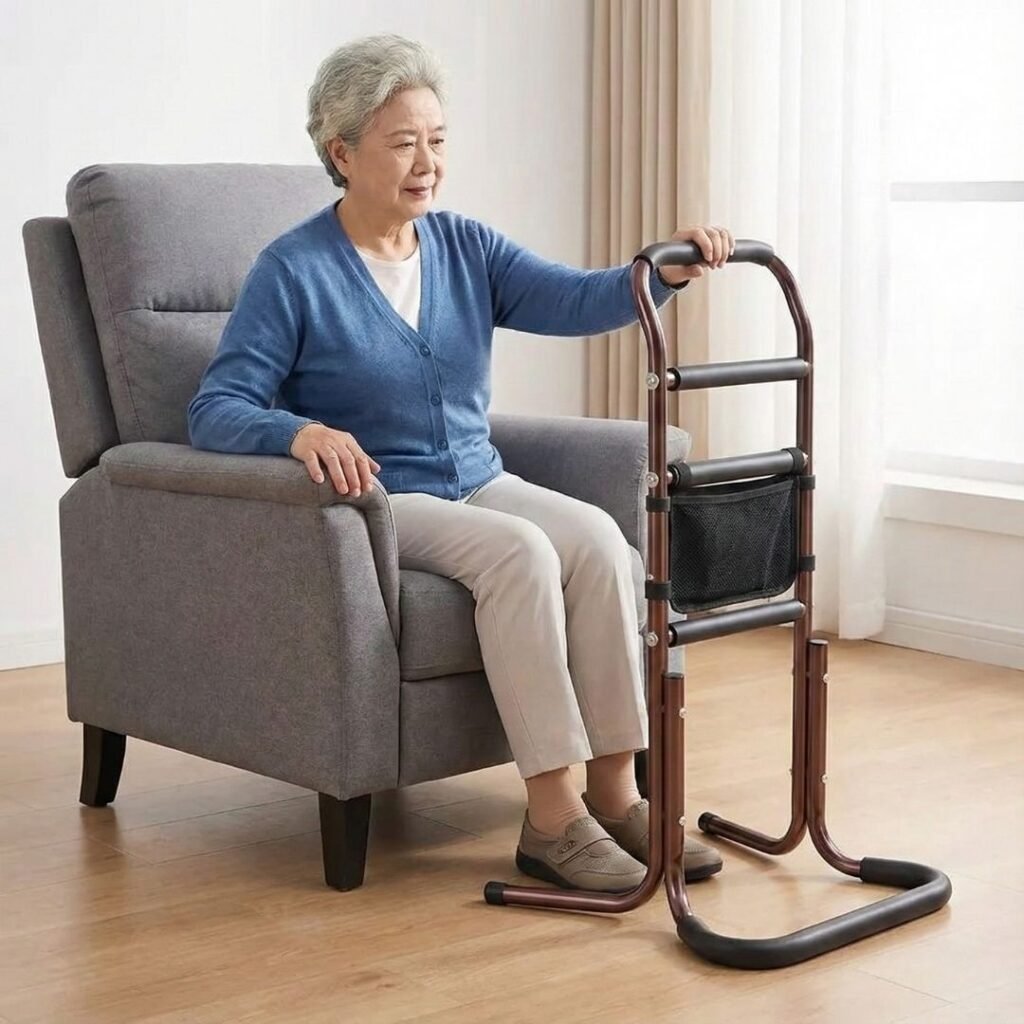
Standing aids are most effective when they’re part of a broader, lifestyle-focused approach to mobility. The strength of the legs and core, the flexibility of the hips, and the layout of the home environment all influence how safely and confidently a senior can rise from seated positions. Even small adjustments—performed consistently—can create significant improvements over time.
Regular leg strengthening exercises, such as controlled sit-to-stand repetitions, seated leg raises, or gentle resistance work, help the muscles involved in rising coordinate more effectively. Flexibility routines for the hips and ankles improve range of motion and reduce stiffness, making the forward-lean phase smoother. Balance activities reinforce the body’s ability to stabilize during and after the standing motion.
Lifestyle habits that improve standing transitions
- Use firmer seating instead of low, deep, or overly soft furniture, which reduces leverage and increases knee strain.
- Keep pathways clear and well-lit to support safer transitions once upright.
- Choose stable, non-slip footwear to improve traction and initial balance.
- Avoid long periods of inactivity, which increase stiffness and make the first stand of the day more difficult.
- Stay hydrated, as dehydration can contribute to dizziness and balance issues.
Age-related mobility changes often progress slowly, and many seniors adapt without recognizing the underlying decline. The National Institute on Aging highlights how subtle shifts in balance, gait, and strength accumulate over time and can influence daily function:
When combined with the right standing aid, these lifestyle strategies build a foundation of better movement mechanics and greater confidence, helping seniors stay active and independent throughout the day.

Physician Tips for Choosing the Right Standing Aid
Choosing a standing aid should go beyond selecting a comfortable handle or a model that fits a specific chair. The ideal device matches the senior’s movement patterns, health status, strength level, and daily routines. A well-fitted aid enhances stability, reduces joint stress, and makes standing a predictable, safe movement rather than a risky or exhausting one.
A good starting point is to observe how the senior currently rises from different seating surfaces. Struggling from deep recliners may indicate the need for firmer seating or a more supportive aid. Hesitancy or wobbliness during the first few steps suggests issues with balance reactions rather than strength alone. Pain in the knees or lower back during the initial lean-forward phase may mean the aid should be placed higher or closer to the body.
Comfort and ergonomics are equally important. Handles that feel too narrow, too wide, or too firm can discourage consistent use. Devices with cushioned, contoured grips typically allow for better hand alignment and reduce strain—especially for seniors with arthritis.
Key considerations when selecting a standing aid
- Match support level to mobility needs. Light leverage may be enough for some, while others require structured lift assistance.
- Evaluate handle comfort. Ergonomic grips reduce hand strain and encourage proper use.
- Check compatibility with home furniture. The device should fit securely on the most commonly used chairs and beds.
- Think through daily routines. Seniors who move between rooms frequently may benefit from portable or multi-room setups.
- Reassess regularly. Mobility needs can shift due to illness, medication effects, fatigue, or strength changes.
Complementary home modifications also play a powerful role in fall prevention and mobility ease. Our guide on making your home safer for seniors offers simple, high-impact adjustments that work alongside standing aids to improve overall safety.
Comparison Table: Best Standing Assist Devices for Seniors (2025 Options)
FAQs
1. What is the safest standing aid for seniors?
The safest standing aid is one that matches the senior’s mobility level and allows for stable, two-handed leverage without requiring excessive pulling. For mild to moderate needs, structured devices like the Stander EZ Stand-N-Go provide secure, adjustable support. For seniors with significant mobility limitations, a mechanical sit-to-stand lift offers the most controlled and predictable movement.
2. How do I know which standing aid is right for my mobility level?
Start by observing how much help is needed during the standing motion. If you can rise with some effort but need better grip or leverage, a simple frame or rail may be sufficient. If standing causes imbalance, knee buckling, or heavy reliance on arm strength, you may need a more supportive device. Seniors who cannot rise safely without major assistance often benefit most from a sit-to-stand lift.
3. Can standing aids prevent falls?
Yes. Standing aids reduce fall risk by improving leverage, stabilizing posture, and preventing the forward-rocking or momentum loss that commonly leads to falls. They guide users into a safer body position and allow controlled weight shifting. While not a complete fall-prevention solution, they are an important component of a broader safety strategy that includes home modifications and regular strength training.
4. Do standing aids work with recliners and soft furniture?
Many standing aids are compatible with recliners and soft seating, especially models that slide beneath cushions for added stability. Deep or low furniture may require more adjustability to achieve proper leverage. Checking the device’s height range and frame width ensures it will anchor securely in softer seating environments.
5. When should a sit-to-stand lift be used instead of a rail?
A sit-to-stand lift is recommended when a senior cannot rise safely using leverage alone or when imbalance, weakness, or fatigue makes manual standing risky. These lifts support most of the rising motion, reducing strain on both the user and the caregiver. They are ideal for home-care settings where hands-on assistance is needed or when progressive mobility changes make standard rails ineffective.
Final Thoughts
Standing aids play a crucial role in supporting independence, reducing fall risk, and improving daily transitions for seniors. Whether someone needs light leverage or full lift assistance, there is a safe, reliable option to match every mobility level. With the right device—and proper technique—seniors can stand more confidently, move more freely, and maintain a higher level of functional safety at home.
Medical Disclaimer: This guide is for general educational purposes only and is not intended to serve as personalized medical advice, diagnosis, or treatment. Always consult a licensed healthcare professional for recommendations tailored to your specific medical condition, mobility needs, or safety concerns.
Last update on 2026-04-02 / Affiliate links / Images from Amazon Product Advertising API