

Introduction
Few conversations in family life are harder than the one where you talk to a parent about mobility aids. The cane, the walker, the rollator — these objects are small, but they carry an enormous psychological weight. To an adult child, they look like obvious safety equipment. To an aging parent, they can feel like the first visible sign that the body is no longer fully their own. Pride, fear, and a lifetime of independence collide in the few seconds it takes to say the word “walker” out loud, and that is why so many of these conversations end in defensive standoff instead of calm agreement.
This guide walks through how to plan, open, and finish that conversation in a way that respects your parent’s dignity while still moving the family toward a safer outcome. Drawn from physician guidance and decades of caregiver experience, the principles below help you choose the right moment, use words that do not trigger pushback, bring in trusted medical voices, and respond well when the first attempt does not land. The goal is never to win an argument. The goal is to give your parent the information and the autonomy they need to choose a mobility aid willingly — ideally before a fall forces the family’s hand.
Why This Conversation Is Often Harder Than Expected
Adult children often underestimate how loaded this conversation is until they are already in it. From the outside, suggesting a cane looks like the obvious next step. From the inside — from your parent’s chair, looking up at you — it can feel like a verdict on every part of their life. Most aging parents have spent sixty or seventy years building a self-image around being capable and in charge. A walker can feel like someone has handed them a different identity they did not ask for.
The resistance is rarely about the device itself. It is about what the device represents: the loss of driving privileges, the move to a smaller home, the children scheduling visits “in case something happens.” Understanding what is really driving that pushback makes the talk far easier, so it helps to first read why seniors resist mobility devices — and how to help. Older adults read mobility aids as the first domino in a much longer chain of independence losses, and the brain often refuses the first domino as a way to protect against all the rest. Understanding that emotional logic is the first step in figuring out how to talk to a parent about mobility aids without triggering a wholesale defensive response.
Caregiving research from AARP confirms that the most successful family conversations about mobility happen in stages, not in a single dramatic sit-down. Adult children who pace the conversation across weeks almost always reach acceptance more quickly than those who try to settle the matter in one Sunday afternoon. There is no medal for finishing the conversation in one session, and real harm in pushing too hard, too fast. For the broader caregiving frame, our guide on how to support a loved one with limited mobility covers the relational ground beneath every conversation like this one.
The Three Pillars of a Productive Conversation
Every successful effort to talk to a parent about mobility aids rests on three pillars. The first is respect for autonomy. Your parent is an adult, and even when their judgment about safety appears flawed to you, the legal and moral right to decide what enters their daily life still belongs to them. The conversation has to be framed as a request for their input, not a delivery of your verdict. Phrases like “I’d love to think about this together” sit very differently in the ear than “We need to talk about you using a walker.”
The second pillar is specificity over generality. Vague concerns about “your safety” feel like criticism. Specific concerns about a specific moment — the way Mom held the wall walking back from the bathroom last Thursday, the way Dad’s left knee buckled getting out of the car at church — feel like observations. Specifics also give your parent something concrete to engage with rather than a fuzzy character judgment to defend against. When a son says “I noticed you steadied yourself on the kitchen counter twice while making coffee,” the parent does not have to argue with the broader claim that they are getting older. They only have to consider whether the kitchen counter is enough.
The third pillar is collaboration on the solution. There are dozens of mobility aids on the market in many styles, colors, and sizes. Letting your parent help research and choose transforms the aid from something imposed on them into something they selected for themselves. That sense of ownership is often the difference between a cane that lives in a closet and a cane that actually gets used. The conversation about whether to use a mobility aid bleeds naturally into the conversation about which one, and the second is far easier than the first.
What Resistance Actually Sounds Like at the Kitchen Table
Most resistance does not arrive as a flat refusal. It comes wrapped in deflection, humor, and changes of subject. A parent who hears the word “walker” might respond with “Oh, I’m not that bad yet,” or “Your aunt Marge had one of those and she still fell,” or by pivoting to “How are the grandkids?” Each of these is a soft no. None of them are a hard no, and recognizing the difference matters. A soft no is an invitation to keep listening; a hard no is a signal to step back and try again later.
According to the CDC, more than one in four adults aged sixty-five and older fall every year, and falls remain the leading cause of injury for that age group. Statistics like these can occasionally help, but they can also backfire if dropped into the conversation as ammunition. Most aging parents have already heard the numbers. What they have not heard is your honest description of what you saw last Thursday in their kitchen. Personal observation is almost always more persuasive than national data when you talk to a parent about mobility aids. Save the statistics for the doctor’s office, where they carry institutional weight.
Watch also for resistance that hides as agreement. A parent might say “Sure, I’ll think about it” with no intention of doing so. When you hear that, gently name the next step out loud: “Great. Would you be open to trying one out at the medical supply store this weekend?” Concrete actions surface real willingness; vague agreement protects the status quo. The difference between a productive conversation and an empty one is often whether anyone names a specific next step before everyone walks away.

How to Choose the Right Moment and Setting
Where and when you start matters more than what you say. Hospital rooms, family dinners with grandchildren, parking lots after appointments, holiday gatherings — these are all the wrong setting. They mix the conversation with stress, performance, audience, or fatigue, raising defensive walls before you have even said the word “cane.”
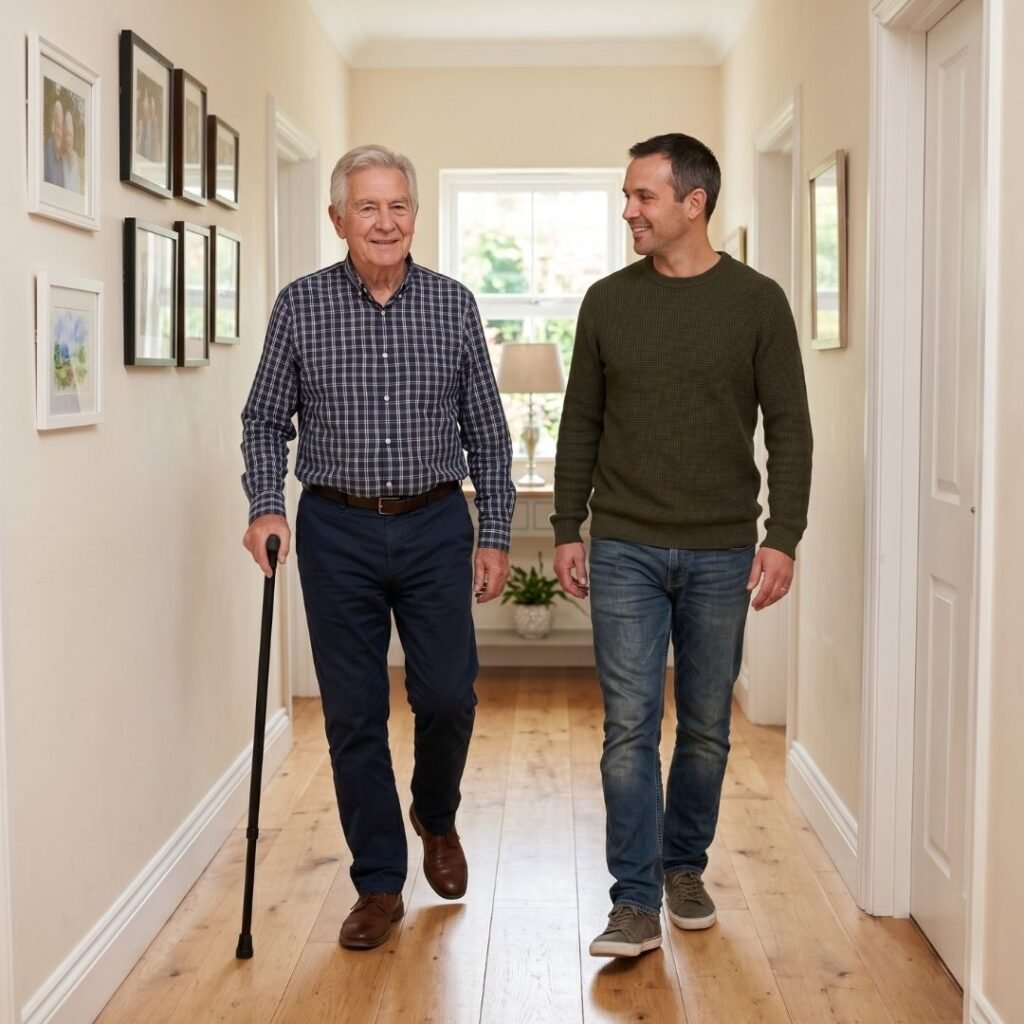
The right setting is private, unhurried, and emotionally neutral. A quiet weekday morning over coffee at the kitchen table works for many families. A walk in a familiar park, where you can talk side by side rather than face to face, works for parents who get defensive in formal sit-downs. The key is that no one is performing for anyone else, no one is in pain, and no one is on a clock.
Timing also includes recognizing whether the conversation is even appropriate yet. If your parent is still managing well, an early conversation can plant a seed for later: “I read an article about how more older adults are using rollators these days even before they really need to. Do you ever think about that kind of thing?” That is very different from an urgent sit-down after a stumble. For parents in the gray zone — not yet falling but clearly slowing — our guide to recognizing when a cane is no longer enough can help you calibrate whether a fresh conversation about an upgrade is warranted now or whether the current aid is still doing its job.
The Words to Use — and the Words to Avoid
Word choice is where most adult children go wrong when they talk to a parent about mobility aids. The instinct is to be direct, but directness here often reads as judgment. The most effective opening lines are observational and curious rather than diagnostic. “I’ve been thinking about something I noticed last weekend — can I share it with you?” lands very differently than “We need to talk about your balance.” The first invites the parent into a conversation; the second announces a conversation is being done to them.
Avoid words that imply finality or decline: “old,” “frail,” “elderly,” “weakening.” Even when clinically accurate, they hit the ear like a verdict. Replace them with neutral descriptors: “I noticed you steadying yourself,” “I saw your knee giving you a little trouble.” Neutral language describes a moment without making a global claim about who your parent has become. It leaves room for them to say “yeah, that knee has been bothering me” without having to concede that they are now in a category they have spent decades resisting.
Avoid imperative language — “you should,” “you need to” — in favor of collaborative language: “What if we tried,” “Would it help to,” “I’d love to look into this with you.” Replace closed yes-or-no questions with open ones: “What would make this easier?” instead of “Would you use a cane?” Open questions invite your parent to think alongside you. They also surface the real concerns — “I’d hate for the neighbors to see me with a walker” only comes out when the conversation feels safe enough to admit it.
Bringing in Doctors, Therapists, and Other Trusted Voices
One of the most reliable ways to talk to a parent about mobility aids is to not be the one talking. A physician’s recommendation, a physical therapist’s evaluation, or even a casual comment from a respected friend or pastor often lands more cleanly than the same words spoken by an adult child. This is not a failure on your part. It is simply how authority works inside many families. Your parent has spent decades being your parent, and that role makes it harder for them to accept advice flowing the other direction. A neutral medical voice removes that dynamic entirely.
Before the next routine appointment, send a private message to your parent’s primary care doctor or office nurse explaining what you have observed at home. Most clinics are happy to add a fall-risk screening or a mobility assessment to the visit if they know there is a family concern. The doctor can then raise the topic during the exam in a way that feels routine rather than intervention-shaped. Many seniors who flatly reject the suggestion from a son or daughter will accept it within minutes from a physician they trust. That is not stubbornness — it is the same dynamic at work in nearly every family in the country.
Physical and occupational therapists carry similar weight, and they can demonstrate the device in action. A therapist can show a parent the difference between a poorly fitted cane and a properly sized one and answer practical questions that adult children often cannot. If the doctor recommends a therapy evaluation, jump on it. The therapy session is often where the real persuasion happens — through hands-on experience rather than argument.

When the Conversation Stalls or Goes Sideways
Sometimes the conversation does not work, no matter how careful the preparation. A parent shuts down, gets angry, changes the subject, or agrees in the moment and then never follows through. When that happens, the right response is almost always to step back rather than push harder. Pushing through resistance turns a difficult conversation into a fight, and a fight makes the next attempt harder rather than easier. Give the topic a week or two of rest, then come back gently with a slightly different angle — a new article, a doctor’s note, a conversation with a sibling who can offer a fresh voice.
If multiple attempts go nowhere, look closely at whether something else is in the way. Cognitive decline can change how a parent processes safety information — a parent with early dementia may genuinely not remember the stumble you witnessed. Depression can flatten motivation in ways that look like stubbornness but are actually treatable. Hearing loss can make group conversations feel overwhelming, leading a parent to refuse simply to end the discomfort. When repeated efforts to talk to a parent about mobility aids hit the same wall, it is worth asking whether the wall is really about the cane.
Family dynamics also matter. Siblings who disagree about the urgency can create cross-currents that confuse the parent. If one sibling says “you really should get a walker” while another says “you’re fine, don’t let them push you,” the parent will almost always side with the sibling whose advice requires no change. Aligning the family before raising the topic is unglamorous work, but it is often the difference between a conversation that succeeds and one that circles for months.
Frequently Asked Questions
1. When is the right time to talk to a parent about mobility aids?
The best time is before a fall, not after one. Watch for early warning signs — furniture cruising, hesitation before standing, holding the wall in a hallway, gripping countertops while cooking. Waiting until after an injury usually means the conversation happens in a hospital or rehab setting, where stress and embarrassment make a defensive response far more likely. The window between “noticing” and “needing” is the right one.
2. What if my parent refuses to even discuss using a cane or walker?
A flat refusal at the start is normal, not the end. Step back for a week or two and re-approach gently from a different angle: an article they might read, a video about a peer who uses a stylish modern cane, a mention woven into a conversation about something else. If two or three calm attempts go nowhere, bring the issue to the family doctor and let the recommendation come from a neutral medical voice. The goal is to keep the door to a future conversation open.
3. Should I bring up mobility aids in front of other family members?
Almost always no. A first conversation should be private and one-on-one. Audiences turn an emotional topic into a performance, and your parent will feel cornered even if no one intends that. Once your parent has had time to process privately, family members can be brought in for follow-up if your parent agrees.
4. How can a doctor help us talk to a parent about mobility aids?
Send a discreet message to the primary care office before your parent’s next visit, sharing specific observations from home. Ask whether the doctor can include a fall-risk screening or mobility assessment as part of the appointment. Many seniors who refuse a son or daughter’s suggestion will accept the same recommendation from a physician within minutes, especially when paired with a referral to physical therapy. The therapy visit often does more persuading than any home conversation.
5. What if my parent agrees to a mobility aid but never uses it?
Quiet non-use usually means the device was technically accepted but emotionally rejected. Look at where the aid is stored: a cane in the back of a closet is one the parent does not feel ready to be seen with. Move it to a more visible, accessible place and watch for opportunities to model use. Pair the aid with a positive activity the parent values — gardening, visiting grandchildren, attending church — so it becomes associated with what they love rather than with what they are losing.
Final Thoughts on Talking With Your Parent About Mobility Aids
The conversation when you talk to a parent about mobility aids is not really a conversation about a cane. It is a conversation about identity, autonomy, and how the family will navigate the long arc of aging together. The cane is just the surface object. Underneath, your parent is asking whether the people who love them can still see them as the same person they have always been — capable, useful, in charge of their own life — and whether the family is going to honor that identity or replace it with something smaller. The way you handle the words on the surface signals everything about the answer underneath.
When the conversation goes well, the device becomes one tool among many, freely chosen and easily picked up. The parent feels seen, and the future feels less like a slope and more like a path with options. Once the door is open, the natural next step is the practical one: helping your parent choose the right mobility aid for their specific home, body, and routine. That conversation is far easier, because the hardest one — the one about whether to use any aid at all — is already behind you.
Medical Disclaimer: The information provided on this website is for educational purposes only and should not replace professional medical advice. Always consult your physician or qualified healthcare provider regarding any medical condition or treatment decisions.
