
Affiliate Disclaimer: This article contains affiliate links. As an Amazon Associate, Mobility With Ease may earn a small commission from qualifying purchases at no additional cost to you.
Introduction
Mobility aids for weak legs are the products designed to bridge the few seconds each day when a senior’s legs cannot generate enough force — rising from a favorite armchair, swinging the legs out of bed at three in the morning, climbing out of a car at the doctor’s office. Most senior falls happen in those small ordinary moments, not during long walks. The right transition aid gives a safe handhold or mechanical assist during the change from sitting to standing.
This guide compares the best mobility aids for weak legs in 2026, focused on transition products rather than primary walking aids. Each pick supports a specific high-risk moment: getting out of bed, rising from a couch or armchair, or exiting a car. A coordinated set turns a home from a series of fall hazards into a chain of supported, predictable transitions — even as underlying strength continues to decline.
If you already know what you need, use the button below to jump straight to the comparison table.
Why Transition Mobility Aids Matter for Seniors Losing Strength
Leg strength does not disappear all at once. It fades through a slow process called sarcopenia — the gradual loss of muscle mass and power that begins around age thirty and accelerates after sixty-five. The earliest noticeable symptom is almost never weakness during a long walk. It is hesitation before standing up. The senior plants both feet, rocks forward two or three times, and finally pushes off the chair arms with every ounce of upper-body strength they have. That moment of doubt is when a fall becomes likely, and it is exactly the moment mobility aids for weak legs are designed to support.
The CDC reports that more than one in four adults age sixty-five and older fall every year. What the data does not capture is where in the day those falls happen. A large share occur during transitions — rising from a chair, lowering into a tub, swinging legs out of a car — not during steady walking. That pattern is why bathroom grab bars, hallway handrails, and primary walking aids only solve part of the problem. The other part is the chair, the bed, the couch, and the car seat — the moments when families realize that when a cane is no longer enough, the right answer is rarely a bigger walking aid but a set of supports at every spot the senior sits or lies down.
The case for installing these aids early is also financial. A single hip fracture in an older adult can cost forty thousand dollars or more in the first year of care, and recovery often ends in permanent loss of independent living. A complete set of transition aids runs a few hundred dollars, does not look medical when chosen carefully, and installs with no tools.
Doctor’s Note: Choosing the Right Aid for Weak Legs
I see patients in their seventies and eighties every week who tell me they have not fallen yet, but who arrive unable to rise from the waiting-room chair without using both arms to push. That is the warning sign. The fall has not happened, but the muscle reserve is already gone. When I help families pick mobility aids for weak legs, I walk through the senior’s day with them. Where do they sleep? What chair do they sit in for television? How do they get to the doctor? Each location is a transition point that needs its own support.
The first piece of advice I give is to match the aid to the chair, not to the person. A senior who lives in a deep sectional sofa needs a different solution than one who uses a firm wingback. A low platform bed needs a different rail than a tall hospital bed. The wrong aid in the right room is as dangerous as no aid, because it teaches the senior to expect support that does not fit. For families starting from scratch, our guide on choosing the right mobility aid walks through the questions room by room.
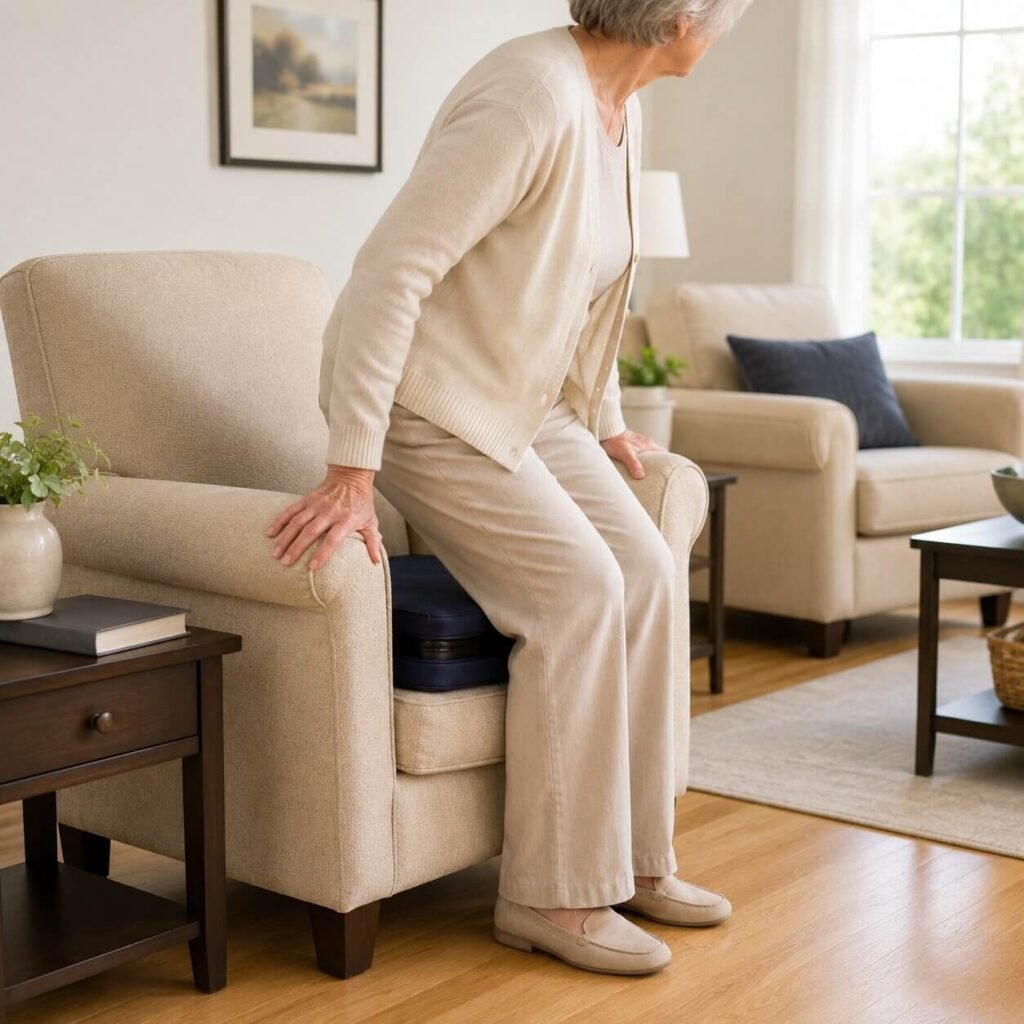
The second thing I look at is whether the senior still has reliable upper-body strength to lever themselves up. If they do, a passive aid like a bed cane or couch cane is enough — the device gives them something stable to push against and the arms do the rest. If the upper body is also weakening, or the patient has shoulder pain, severe arthritis, or recent surgery, I move straight to a powered lift cushion. The right aid depends on which muscles are still working.
Best Mobility Aids for Weak Legs (Top Picks)
Best Overall Bed Aid
Stander BedCane Adult Bed Rail and Support Handle
The Stander BedCane is the highest-impact bedroom upgrade for a senior with weak legs, and the rail I recommend first to nearly every family I see. The unit slides between the mattress and box spring, secures with an included safety strap, and provides a tall padded ergonomic handle directly at the bedside. The senior grips the handle while still lying down, pulls themselves up to sitting, and uses the same handle to lever up to standing — all in one continuous motion. The BedCane is ASTM F3186-17 safety approved, supports up to 300 pounds, fits twin through California king beds, and includes a small organizer pouch for a phone, glasses, or remote. Tool-free assembly takes about ten minutes.
Pros
- ASTM F3186-17 safety approved — one of the only bed rails on the consumer market that is
- Tool-free assembly — slides between mattress and box spring with safety strap
- Padded ergonomic top handle gives a stable grip from lying, sitting, and standing
- Supports up to 300 pounds; fits twin, full, queen, king, and California king beds
- Storage pouch keeps phone, glasses, and remote within reach overnight
Cons
- Does not work with platform beds that lack a box spring or with adjustable beds where the strap cannot anchor
- Single-side rail — a senior who exits both sides of the bed needs two units
No products found.
Best Couch / Chair Stand Aid
Stander CouchCane Standing Assistance Aid
The Stander CouchCane is the living-room equivalent of the BedCane and one of the most underrated mobility aids for weak legs in the transition-aid category. A wide stabilizer base slides under any standard four-legged sofa, recliner, or armchair, with a tall vertical handle rising to between thirty-four and forty inches at the user’s chosen side. The base feet adjust from twenty to thirty-six inches wide so the rail fits under almost any furniture footprint, and the unit installs on the right or left depending on which hand is stronger. The vertical grip is far more leverage-efficient than pushing on chair arms — the same biomechanical principle that makes a stairwell handrail safer than a banister. A small saddle pouch holds the remote and phone, so the senior never has to twist sideways and slide forward.
Pros
- Fits almost any four-legged sofa, recliner, or armchair without modification
- Adjustable handle height (34 to 40 inches) and adjustable base width (20 to 36 inches)
- Right- or left-hand mounting to suit the user’s stronger arm
- Vertical grip provides better leverage than pushing on chair arms
- Includes a saddle pouch for remotes, phone, and small items
Cons
- Does not work with sofas built on a solid base or platform without legs
- Visible piece of equipment — not invisible the way a bathroom grab bar can be

- Prevent Falls: The Couch Cane provides stability and balance when sitting or standing from your favorite chair, couch, or recliner; reduces the need for caregiver assistance, preventing back pain from...
- Ergonomic Handle: The ergonomic safety handle provides a comfortable and secure place to grip and supports up to 250 pounds; use the included 4-pocket pouch to keep personal items close by; Swivel...
- Provides Independence: Perfect for seniors or anyone needing mobility assistance; the low-profile design of the stand up assist will match the look and feel of your home; the reversible base can be...

Best Inflatable Lift Cushion
Vive Inflatable Seat Assist Lifting Cushion
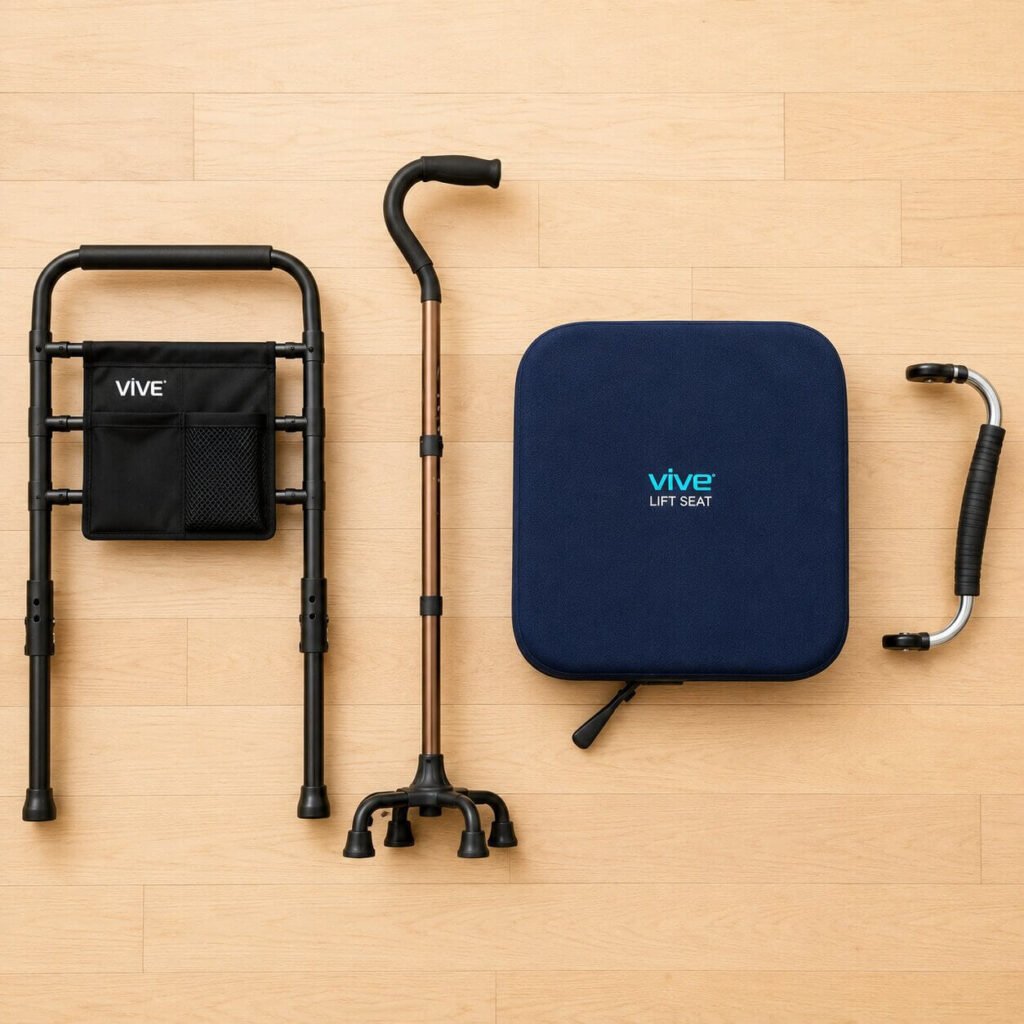
For a senior whose upper-body strength is also fading — common with rheumatoid arthritis, Parkinson’s, post-stroke recovery, or advanced sarcopenia — a passive grab bar is no longer enough. The Vive Inflatable Seat Assist Cushion replaces the standing motion entirely. The 17 by 17 inch cushion sits flat on any chair, sofa, or car seat, and a remote-controlled pump inflates it evenly under the user, gradually raising the body toward a standing position with no forward push that would unbalance them. The remote means the senior never has to bend or reach for a side switch, the cushion supports up to 220 pounds, and a one-year pump warranty backs the lift mechanism. Because the same cushion works on hard sedan seats and contoured armchairs, one Vive unit covers the chair, the couch, and the car. This is the lift cushion to choose when the senior cannot reliably stand on their own.
Pros
- Remote-controlled inflation — no upper-body strength required from the user
- Even inflation lifts smoothly without pitching the user forward
- Works on chairs, sofas, recliners, and car seats — one cushion covers the whole house
- Compact 17 by 17 inch profile fits most household and vehicle seating
- One-year warranty on the pump and rechargeable so it travels easily
Cons
- 220 pound weight capacity — heavier users need a different solution
- Pump must be charged before use; cannot operate during a power outage without a charge

- ASSISTED STANDING SUPPORT: The inflatable air seat cushion provides a gentle lift to help users transition from sitting to standing with less effort. It offers added support for everyday chairs...
- STABLE LIFT DESIGN: The cushion inflates evenly to create a secure, balanced lifting surface. This stable design is ideal for use during daily sitting and standing routines.
- VERSATILE SEATING USE: This cushion works on a variety of seating surfaces, including chairs, couches, and car seats. Its compact design makes it suitable for home use or travel, ensuring convenient...
Best Spring-Powered Lift Cushion
Carex Uplift Premium Seat Assist Plus with Memory Foam
The Carex Uplift Premium is the spring-powered counterpart to the electric Upeasy, and it fits seniors who still have meaningful leg strength but need a controlled boost to launch the standing motion. A hydro-pneumatic gas spring stores energy when the user sits and releases it gradually as they stand, providing about 70 percent of the lift force needed. The user contributes the remaining thirty percent with their own legs — which actually helps maintain leg strength over time instead of replacing it. The Plus version supports up to 350 pounds, uses no batteries, and at nine pounds is light enough to carry anywhere. The memory foam top is comfortable enough for hours of normal sitting, so the cushion never has to be removed when not in use.
Pros
- No batteries or electricity needed — gas-spring lift mechanism
- Provides 70 percent stand assist; user’s remaining strength preserves leg muscle
- Plus version supports up to 350 pounds
- Memory foam top is comfortable for all-day sitting, not just standing assist
- 9 pounds and includes a carry handle — truly portable
Cons
- Requires the user to weigh enough to compress the spring — underweight seniors may not trigger it
- Gas-spring assist is firm; some users prefer a fully passive cushion
- THIS PORTABLE LIFTING seat and chair lift provides 70% assistance for those up to 350lbs. The patented LeveLift Technology ensures gentle & safe lift without pushing forward. An affordable alternative...
- WORKS ON MOST ARMCHAIRS, COUCHES, AND SOFAS. Use inside or outside the home on most armchairs and sofas. The standing aid is portable so you can also take it on the go. Trust Carex Health Brands, a...
- WASHABLE & PORTABLE: The waterproof cover is easy to clean & the foam cushion is easy to care for. This lift assistance device for elderly is a comfortable portable lightweight lift assistance device...
Best Car Transfer Aid
Stander HandyBar Portable Vehicle Support Handle
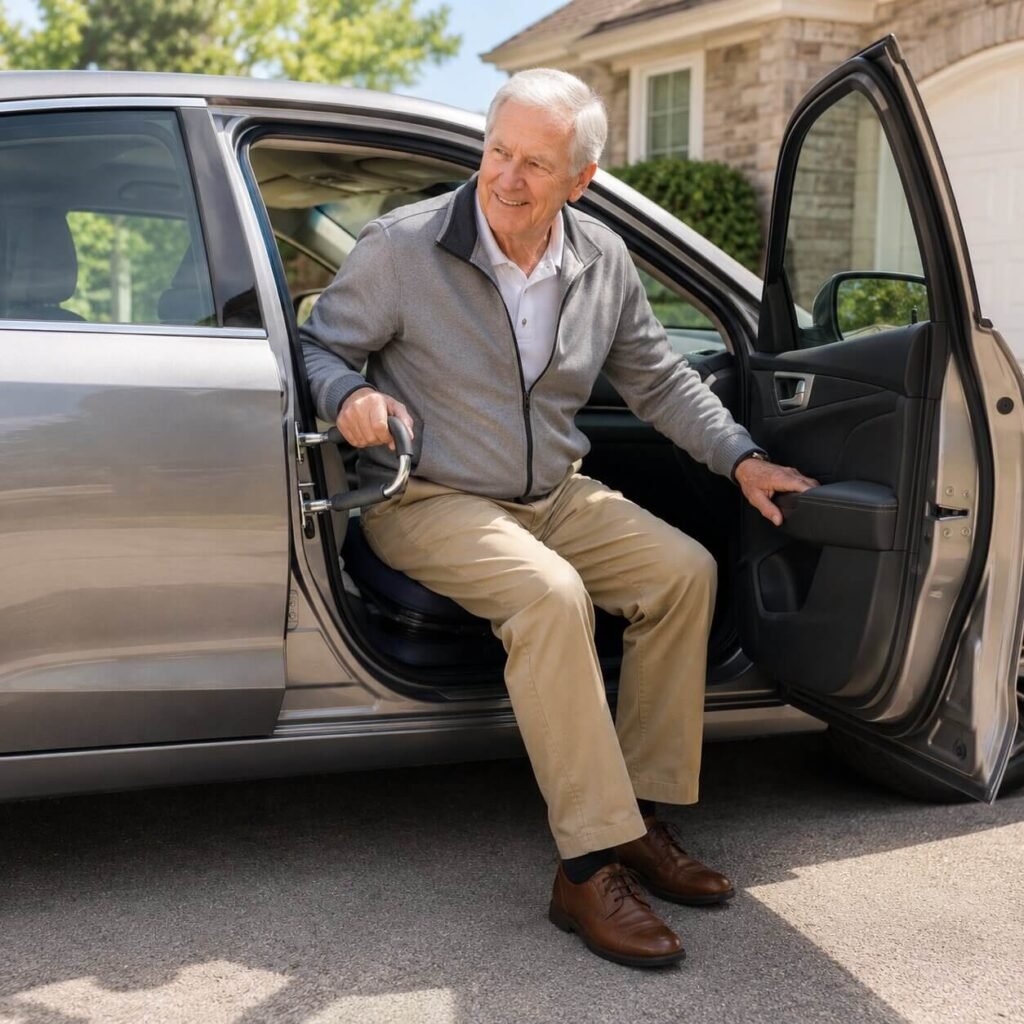
The most overlooked transition for seniors with weak legs is exiting a car. There is no grab bar, the door is unstable to lean on, and the legs must stand the body up from a low twisting position — often in a parking lot with uneven pavement. The Stander HandyBar is a brilliantly simple solution: a one-pound steel handle that slides into the U-shaped striker of any standard car door latch and provides a stable grip exactly where one is needed. The bar requires no tools or permanent install, works in any vehicle with a standard striker bolt, and stores in the glove box, door pocket, or purse between uses. It also includes a window-breaker tip and a recessed seat-belt cutter for emergency escape. For any senior who still drives or rides regularly, this is the first car-related upgrade to make.
Pros
- Slides into the car door latch striker — no tools, no permanent install
- Compatible with any vehicle that has a standard U-shaped striker bolt
- Includes window-breaker tip and seat-belt cutter for emergency escape
- One-pound, 9-inch design fits in glove box, door pocket, or purse
- High-strength steel with rubber grip handle
Cons
- Will not work on a small minority of vehicles with non-standard latches
- Single-hand grip — users who need two-hand support out of a car still need a swivel cushion paired with it

- Prevent Falls: The HandyBar provides users with stability and balance when standing or sitting from the car; compatible with most vehicles, the handle fits parallel to your car when inserted into a...
- Lightweight and Portable: Store the 1-pound car assist grab bar in your glove box, door compartment, or purse; always have your assistive mobility handle within reach when traveling; the handle...
- Provides Independence: Perfect for the elderly, injured, or anyone needing mobility assistance; maneuver in and out of cars using the non-slip grip handle without caregiver assistance, preventing back...
Best Swivel Seat Cushion
HealthSmart 360 Degree Swivel Seat Cushion
The HealthSmart 360 Degree Swivel Seat Cushion solves the second half of the car-transfer problem — the awkward leg-twisting motion that turns a senior’s hips, knees, and lower back into a single overloaded joint. The 15-inch padded low-profile cushion sits on top of the existing car seat and rotates 360 degrees on a smooth low-friction bearing, letting the user pivot both legs together toward the open door. Instead of forcing the body to rotate through the spine and hip, the cushion does the rotation for them — a critical advantage for anyone with hip arthritis, recent hip replacement, or weak-leg fatigue. The non-slip base keeps the cushion in place during driving, and the same disc doubles as a transfer aid in dining-room chairs, recliners, or beside the bed at home. Paired with the HandyBar above, the entire car-transfer problem becomes a smooth two-step motion: rotate, stand.
Pros
- 360-degree rotation lets legs swing out as one unit
- Non-slip base stays in place during driving and exit
- 15-inch diameter fits flat sedan seats and contoured SUV seats
- Padded for everyday comfort, not just transfer use
- Pairs naturally with the HandyBar for a complete car-transfer kit
Cons
- Adds about an inch of height — very tall users may feel close to the roof
- Padded fabric cover requires periodic cleaning

- 360 DEGREE SWIVEL SEAT CUSHION converts any stationary chair into a swiveling chair. Swivel Seat Base helps relieve back, knee, or hip strain caused by twisting and turning when getting in and out of...
- CHAIR ASSIST FOR THE ELDERLY designed with high grade foam holds that it's shape and feels soft and comfortable, helping to reduce pressure on the back and tailbone. Non-skid, flexible swivel base...
- SWIVEL SEAT CUSHION features increased height at 12.5 and 15 inches assists in road view, scooters, or small chairs. Great for chairs, offices, home, and more. May not fit in all cars but will fit...
Educational Overview: What Are Transition Mobility Aids?
Transition mobility aids are products designed to support a person during the few seconds of changing position — sitting to standing, lying to sitting, exiting a car — rather than during steady walking. They are a distinct category from primary walking aids like canes, walkers, and rollators, which support the body while it is already upright and moving. For many seniors, transition aids are the difference between staying at home and moving to a higher level of care.
According to the National Institute on Aging, muscle weakness is one of the most common contributors to falls in older adults. Sarcopenia — age-related muscle loss — begins in the thirties, accelerates after sixty-five in women and seventy in men, and is closely linked with difficulty standing, walking, and climbing stairs. Transition aids do not reverse sarcopenia, but they compensate for the muscle deficit at the moments it is most dangerous, keeping the body safely upright through the highest-risk seconds.
Within the category, mobility aids for weak legs divide into two types. Mechanical aids — passive grab bars and rails like bed canes, couch canes, and car door handles — give the senior a stable handhold to push against, and remaining strength does the lifting. Powered aids — spring-loaded or electric lift cushions — mechanically raise the user from seated position. Mechanical aids preserve leg strength because they require user effort. Powered aids replace effort entirely, which is the right answer when leg and arm strength have both declined. Many seniors benefit from a combination, layered with small mobility aids that prevent falls elsewhere in the home.
How to Use Mobility Aids for Weak Legs Safely
Plant the working hand on the rail before shifting weight forward. The most common misuse of these aids is reaching for the rail mid-stand, when the body is already off-balance. The correct sequence is the opposite: while still seated, the senior places their stronger hand firmly on the bed cane, couch cane, or chair arm. Only then do they rock forward and push up. This makes the rail the load-bearing anchor instead of a last-second grab. Caregivers should physically guide the hand into position the first several times until the sequence becomes muscle memory.
Match the height and width of the aid to the user, not the room. A bed cane handle that is too short forces the senior to bend forward and lose balance. A couch cane handle that is too tall removes leverage. The Stander products in this guide adjust to fit, but the adjustment must actually be done. As a rule, the top of any vertical handle should sit between the user’s hip and lower-rib level when standing — high enough to leverage from, not so high that the shoulder strains overhead. For lift cushions, the seat must match the chair: a cushion that overhangs the seat or compresses past the edge can pitch the user forward unexpectedly.
Test the aid under controlled conditions before relying on it. Every product in this guide should be tested with a caregiver present the first three to five times. Have the senior sit and stand in slow motion while someone stands beside them ready to steady. This builds confidence and surfaces installation problems — a wobbling base, a loose strap, a swivel that slides — before those problems show up during a real full-speed transition. Test lift cushions in the actual chair the senior will use, since seat depth changes lift dynamics significantly.
Inspect the aids on a recurring schedule. Bed straps loosen, base feet shift, batteries discharge, and springs lose tension. Every six to eight weeks, physically check each transition aid: tighten the bed cane strap, square the couch cane base, charge the electric cushion, and confirm the swivel still rotates freely. The biggest predictor of a failed aid is not age — it is missed maintenance. Aids checked quarterly outlast the warranty on most of them; aids installed and forgotten tend to fail at exactly the wrong moment.
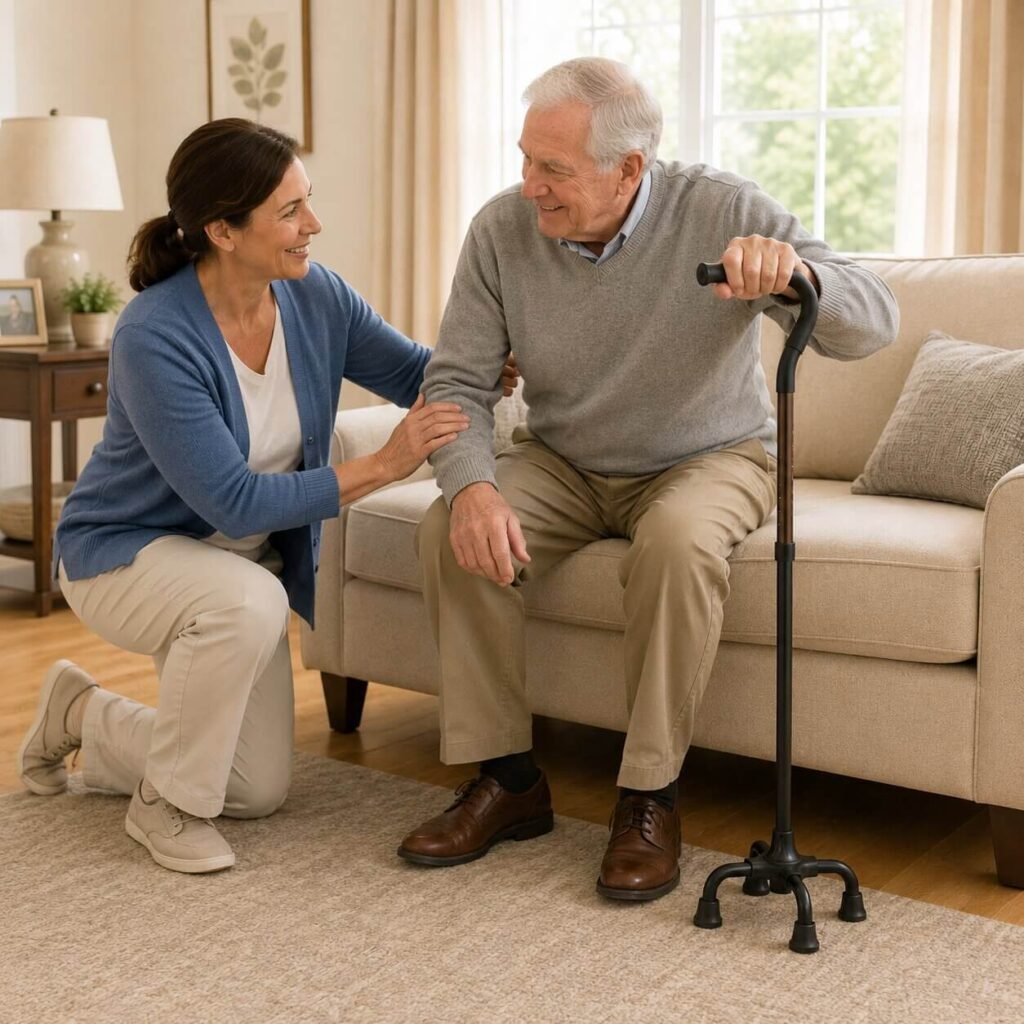
Lifestyle Synergy: Building a Coordinated Transition System at Home
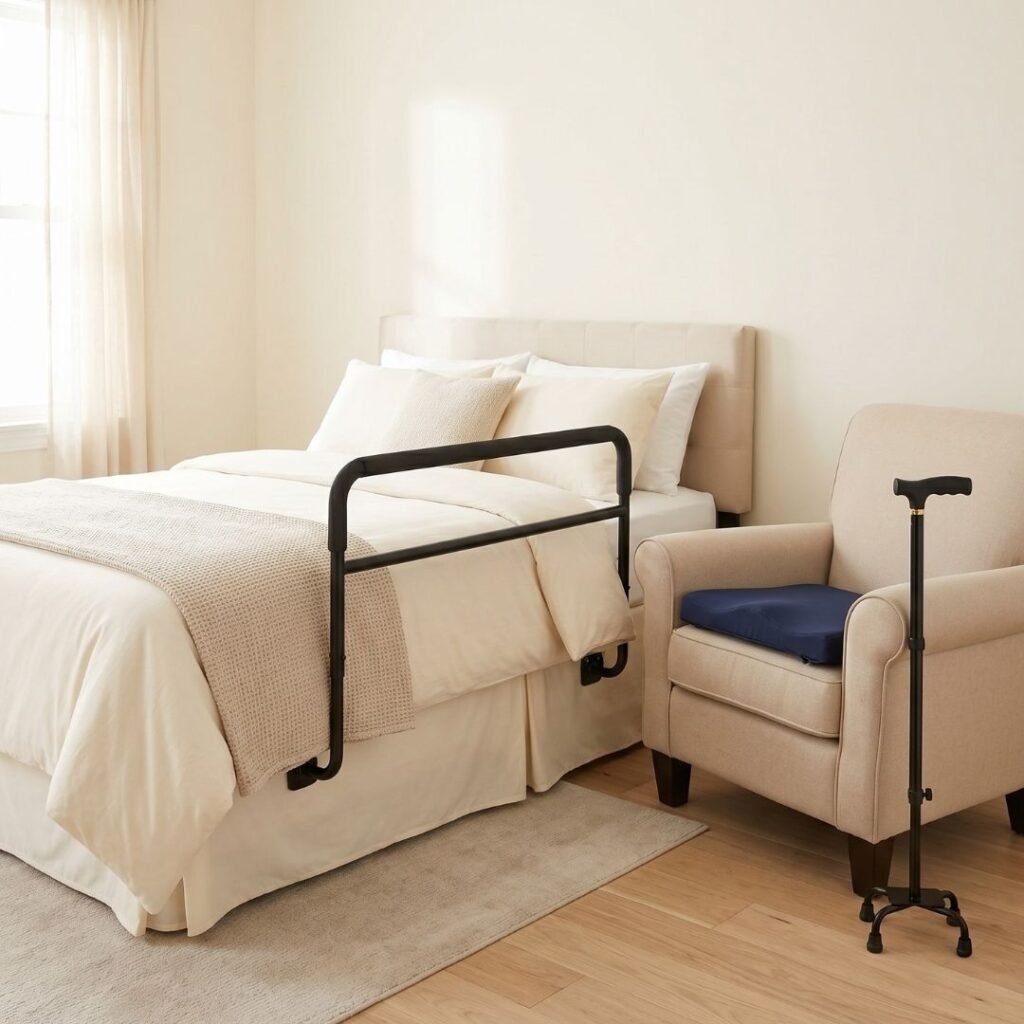
Mobility aids for weak legs do their best work in coordinated sets, not as isolated products. Treat every place the senior sits or lies down as a separate transition station, and install one aid at each. The bedside gets a bed cane. The favorite armchair or sofa gets a couch cane, a lift cushion, or both. The car gets a door support handle paired with a swivel cushion. The total cost runs under five hundred dollars, and once the system is in place the senior can move through a whole day without ever standing unsupported.
The bedroom is the right place to start. Most overnight falls happen during the trip to the bathroom, when leg strength is at its lowest after lying flat for hours. Pair a bedside rail with the techniques in our guide to help a senior get out of bed safely — rolling onto the side, pushing up to sitting, then standing slowly — and the entire bed-to-floor transition becomes a coachable sequence instead of a fumble in the dark.
The living room is the second priority. Seniors with weak legs spend most waking hours in one or two specific seats, and that is where stand-assist aids belong. The rule of thumb is upper-body strength: if the senior can still pull themselves up using a fixed rail, the couch cane wins on cost and simplicity. If the upper body is also fading, a lift cushion does the work. Some households install both — a couch cane in the living room, a portable lift cushion that travels to dining-room or visiting chairs.
The garage and driveway are the most overlooked station. Even seniors who no longer drive still ride regularly — to the doctor, to family events, to grocery pickups. A car door handle and swivel cushion together are the most cost-effective addition to a senior-safe home, and they travel with the user automatically because they live in the vehicle.
Physician’s Tips for Long-Term Use
I tell my patients the goal of mobility aids for weak legs is not just safety today — it is preserving the strength they still have. A passive grab bar like a bed cane or couch cane forces the senior to use their own muscles, keeping them active. A spring-powered cushion provides a partial assist that still requires effort. A fully powered cushion replaces the motion entirely. Each step up the assist scale is a real safety improvement, but it also means a predictable loss of muscle tone. I start patients on the lowest-assist aid that keeps them safe, and move them up only when their own strength can no longer carry the gap.
I also encourage families to pair every transition aid with a short daily strength routine. Sit-to-stand repetitions from the same chair the senior uses for television, performed slowly with the couch cane as a safety handhold, are one of the most effective exercises in geriatric medicine. They directly target the muscles that fail first in sarcopenia and build confidence in the aid itself. The rail becomes a piece of training equipment, not just a safety device. A senior who does ten supported repetitions before breakfast and ten before dinner usually maintains independent standing months or years longer than one who does not.
Finally, I tell every family that transition aids should be installed before they are needed, not after the first fall. The classic mistake is waiting for the wake-up call — a hip fracture, a hospital admission — before installing equipment that should have been in place a year earlier. By that point the senior is already deconditioned, and the aids have to be learned during the hardest weeks of their life. The right time to install is the moment a family member first notices the senior hesitating before standing.
Mobility Aids for Weak Legs Comparison (Features & Stability)
Frequently Asked Questions
1. What are the best mobility aids for weak legs in seniors?
The best mobility aids for weak legs depend on which transition is hardest. For getting out of bed, a bedside assist rail like the Stander BedCane is the highest-impact upgrade. For rising from a couch or armchair, a couch cane or a lift cushion does the work, depending on whether the user still has upper-body strength to push with. For getting in and out of a car, a door support handle paired with a swivel cushion solves both the grip and the leg-rotation problem. Most seniors benefit from a coordinated set of three or four products, one at each station where they sit, lie down, or transfer.
2. At what age do leg muscles start losing strength?
Leg-muscle mass and strength peak between ages thirty and thirty-five and then decline gradually for the rest of life. The decline accelerates after sixty-five in women and seventy in men, when sarcopenia — the medical term for age-related muscle loss — reaches a stage where standing up, climbing stairs, and walking long distances become harder. The first warning sign is usually hesitation before standing rather than weakness during walking. That hesitation is the moment to begin installing transition aids, even before any fall has occurred.
3. Are sit-to-stand cushions safe for seniors with arthritis?
Yes, with the right type of cushion. Spring-powered lift cushions like the Carex Uplift Premium Plus are well-suited to seniors with arthritis because they reduce the load on knees and hips during standing. Fully powered cushions like the Vive Inflatable Seat Assist are even gentler because the controlled inflation removes the sudden movements that could aggravate joints. Test the cushion in the actual chair the senior will use, because some seats are too narrow or too soft to support the cushion base safely. A physical or occupational therapist can advise on the right model for a specific arthritis pattern.
4. Does Medicare cover mobility aids for weak legs?
Coverage is mixed. Standard Medicare Part B covers some durable medical equipment when prescribed as medically necessary — certain lift chairs may have the lift mechanism partially covered, even if the chair itself is not. However, accessory products like bed canes, couch canes, lift cushions, car door handles, and swivel cushions are typically classified as home modifications rather than medical equipment, and are usually not covered by standard Medicare. Some Medicaid waiver programs, VA Home Improvements and Structural Alterations (HISA) grants, and private long-term-care insurance policies may cover part or all of the cost. Contact the senior’s plan before purchasing to confirm.
5. Can a senior use a bed cane and a couch cane in the same home?
Yes, and most seniors with significant leg weakness benefit from both. The bed cane handles the bedroom transition — lying to sitting to standing — while the couch cane handles the living-room transition from a sofa, recliner, or armchair. The two products solve different problems and do not duplicate each other, so installing both is the standard recommendation. Many families add a portable lift cushion as a third aid that travels with the senior to dining-room and visiting chairs.
Final Thoughts on Mobility Aids for Weak Legs
Mobility aids for weak legs are not about replacing what a senior can still do. They are about protecting the few seconds each day when the legs cannot generate the force the body needs — the rise from bed, the lift from the couch, the step out of the car. Those seconds are where falls happen, and they are where the right transition aid quietly does the work. A coordinated set of these products, installed before any fall has occurred, is one of the highest-return safety investments a household can make.
Every product in this guide has been selected for its build quality, safe-use design, and suitability for seniors with declining leg strength. Whether you start with a single bed assist rail, a chair-and-couch system, or a car-transfer kit for trips to the doctor, the right combination lets a senior move through their own home with confidence — and lets their family stop holding their breath every time the senior stands up.
Medical Disclaimer: This guide is for general educational purposes only and is not intended to serve as personalized medical advice. Always consult a qualified healthcare professional before making changes to medical equipment or care plans.
Last update on 2026-09-15 / Affiliate links / Images from Amazon Product Advertising API
