
Affiliate Disclaimer: This article contains affiliate links. As an Amazon Associate, Mobility With Ease may earn a small commission from qualifying purchases at no additional cost to you.
Introduction
For a senior who spends most of the day in a wheelchair, the seat cushion is not an accessory. A good cushion works best alongside the rest of a comfort-first setup, which we cover in our guide to comfort-focused mobility aids for advanced age. It is the single most important piece of equipment standing between healthy skin and a slow-developing pressure injury that can take months to heal. The right wheelchair cushions for pressure relief do the quiet, unglamorous work of redistributing body weight off the bony points — the sit bones, the tailbone, the hips — that take the brunt of long seated hours. The wrong cushion, or a cushion that has flattened and lost its loft, can quietly do the opposite.
What makes this category confusing is that the cushion market does not separate “comfort cushions” from “clinical pressure relief cushions” by clear labels. A $40 foam pad and a $400 air-cell cushion both call themselves “pressure relief.” For a healthy adult who sits a few hours a day, the difference may not matter. For a senior who is in the chair eight or ten hours daily, the difference is the difference between intact skin and a wound clinic referral. Choosing well means knowing which design solves which problem.
This 2026 guide reviews our top five wheelchair cushions for pressure relief, organized by the use case each one solves best. We cover air cell, gel, memory foam, heavy-duty bariatric, and budget hybrid options. Each pick was chosen for a specific senior and a specific clinical situation, not as a generic recommendation. The goal is to help families and caregivers match the cushion to the actual sitting profile of the user.
Why Wheelchair Cushions Matter
The clinical reality is sobering. Skin and underlying tissue can begin to break down after just two hours of continuous, unrelieved pressure over a bony point like the sit bones (the ischial tuberosities) or the tailbone (the sacrum). MedlinePlus describes pressure sores as wounds caused by unrelieved pressure on the skin — the same kind of wounds that develop most often over bony prominences. Once a pressure injury opens, it heals slowly and can become life-threatening in a frail senior.
A senior who spends most of the day in a wheelchair faces this exact biomechanical problem for hours at a time. Standard wheelchair sling seats — the canvas or nylon factory seat that comes on most chairs — offer almost no pressure redistribution. Body weight concentrates on the sit bones and the tailbone, and after a few hours that concentration is enough to start the cascade of tissue damage that ends in a pressure ulcer. The right wheelchair cushions for pressure relief change that math by spreading body weight across a wider surface area and softening the contact at the bony points.
The math gets worse for seniors with diabetes, peripheral vascular disease, low albumin, or limited ability to shift their own weight. Reduced blood flow to the tissue means damage happens faster and heals slower. A senior who once shifted reflexively every few minutes may lose that habit after a stroke, with cognitive decline, or simply with fatigue. Without a cushion designed to do the redistribution work that the body is no longer doing automatically, the timeline to a pressure injury collapses from “a long time” to “this week.”
This is a different category from a general comfort cushion. Our broader roundup of the best wheelchair cushions for seniors covers comfort and support across all wheelchair users, including part-time chair users. This guide narrows the focus specifically to clinical pressure relief — the cushions that matter for seniors at higher risk of skin breakdown, longer daily sitting time, or an existing wound history.
Because pressure injuries don’t care which chair the senior is sitting in, the right cushion is only part of a broader seating picture. A senior who spends six hours in the wheelchair and another four in a recliner accumulates pressure across both surfaces, and the cushion in the wheelchair can only do so much if the other seated hours are spent on an unsupportive seat. Pairing a quality wheelchair cushion with one of the best power lift chairs for seniors — which redistribute weight during the long stretches out of the wheelchair — gives a more complete pressure-prevention setup for seniors who divide their day between the two.
Doctor’s Note: Choosing the Right Wheelchair Cushion for Pressure Relief
When families ask me about wheelchair cushions for pressure relief, the first question I ask is how many hours per day the senior actually spends seated. A senior who is in the chair for a couple of hours after lunch is in a different category from a senior who transfers to the chair after breakfast and stays there until bedtime. The two situations call for fundamentally different cushion classes. Light seated time tolerates a basic foam cushion. Eight-plus hours of daily sitting demands an air cell or gel-foam hybrid built for genuine pressure redistribution.
The second question I ask is whether the senior has any history of skin breakdown — even a small reddened area that took longer than expected to fade. A history of stage 1 or stage 2 pressure injury elevates the senior into a high-risk category for the rest of their life. A senior with that history should be in a true clinical pressure relief cushion, not a comfort cushion with marketing language. The cushion is acting as a medical device, not a piece of furniture.
The third question concerns the senior’s ability to shift their own weight. A senior who can press up on the wheelchair arms every fifteen or twenty minutes is doing meaningful pressure relief work on their own. A senior who cannot shift — because of stroke, advanced arthritis, paralysis, or cognitive decline — is depending entirely on the cushion. That dependence changes the cushion specification: it needs deeper immersion, more contour, and more aggressive pressure redistribution than the cushion for someone who self-shifts.
The fourth question is about transfers. Some pressure relief designs are excellent at static load but poor at withstanding the shear forces during a sit-down or stand-up transfer. A senior who transfers independently or with a caregiver multiple times per day benefits from a cushion design that includes a firmer base — usually a foam base under the gel or air layer — so the cushion holds its shape during transfer. Pure air or pure gel cushions can shift unpredictably during the transfer and create a small fall risk that families do not anticipate.
Finally, I ask about heat. Some seniors run warm and develop moisture under a cushion, which softens skin and accelerates breakdown. Others run cold and find gel cushions uncomfortably chilly. The cover material and the cushion’s airflow design matter more than spec sheets suggest. Breathable mesh covers and ventilated gel layers are the right answer for seniors who run warm; insulated covers work for seniors who don’t.
Best Wheelchair Cushions by Type — 2026
Best Overall — Air Cell
ROHO Mosaic Air Wheelchair Cushion
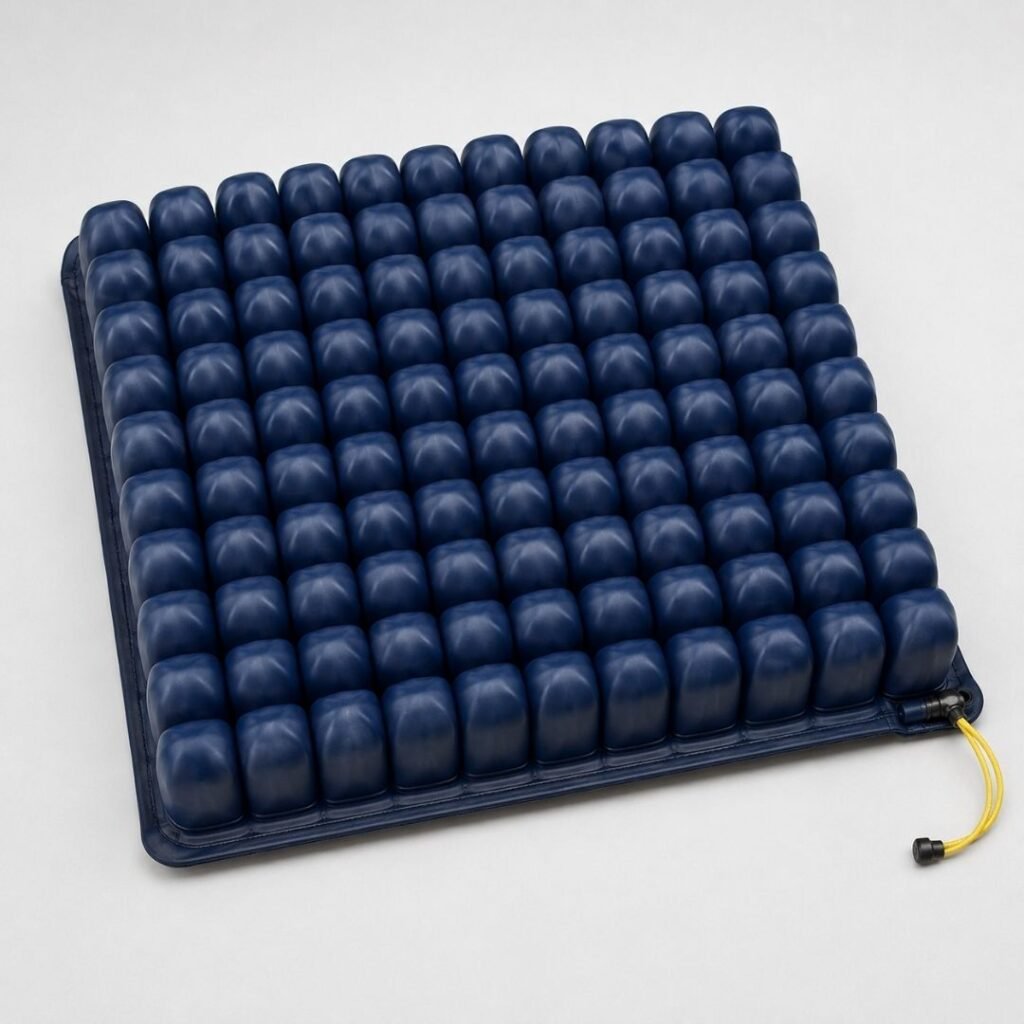
The ROHO Mosaic is the wheelchair cushion I recommend most often for seniors who spend long hours in the chair and need genuine clinical pressure redistribution. ROHO’s air cell design uses interconnected inflated cells that each compress independently under the user’s body, contouring to the shape of the sit bones and tailbone rather than fighting against them. That immersion is what removes the pressure concentration that causes ulcers. The Mosaic is the entry point of the ROHO line — less expensive than the higher-end Quadtro and Hybrid Elite, but still using the same air cell principle. For high-risk seniors who don’t need full clinical-grade adjustment, this is the right balance of price and performance among wheelchair cushions for pressure relief.
Pros
- True air cell pressure redistribution, not foam padding marketed as pressure relief
- Adjustable inflation to match user weight and shape
- Recognized by clinicians as the gold standard for pressure prevention
- Cleanable, durable cover that holds up to long-term use
Cons
- Requires occasional re-inflation to maintain proper firmness
- Less stable during transfers than foam-based cushions

- RESPONSIVE AIR CELL DESIGN FOR ALL-DAY COMFORT: Interconnected air cells create a flexible seating surface that adjusts to your shape as you move; ideal for wheelchair users, office chairs, and...
- STANDARD 16" x 18" SIZE WITH STRONG SUPPORT: Fits most chairs while supporting up to 315 lbs; lightweight construction makes it easy to carry between home, work, travel, or events without hassle
- CUSTOMIZABLE FIRMNESS WITH EASY INFLATION: Includes hand pump for quick setup and adjustment; personalize the feel of your seat cushion to match your comfort preference in minutes
Best Gel Cushion
Drive Medical Skin Protection Gel “E” Wheelchair Seat Cushion
For seniors who need pressure redistribution but want a cushion that feels more like a traditional seat, the Drive Medical Gel “E” is the right pick. The viscous gel bladder sits on top of a fire-retardant polyurethane foam shell, which gives the user a familiar firm surface with a soft, cooling top layer. The gel does not flow the way pure air does, but it spreads pressure noticeably better than foam alone. The foam base keeps the cushion stable during transfers, which is a real advantage for seniors who get in and out of the chair multiple times per day. Drive Medical designed this cushion specifically to assist in the prevention and management of pressure ulcers, which is a meaningful claim coming from a clinical equipment maker.
Pros
- Gel-over-foam construction balances pressure relief with transfer stability
- Cooling effect benefits seniors who run warm or perspire
- More affordable than air cell options without sacrificing core function
- Hard foam base prevents bottoming-out during sit-down
Cons
- Less aggressive pressure redistribution than true air cell designs
- Gel can feel cold to seniors who run cool
- Gel Seat Cushion: Gel wheelchair cushion with pressure redistributing cushion design assists in the prevention, treatment and management of pressure ulcers
- Liquid Gel Core: The viscous gel bladder of this wheelchair cushion is encased in a fire-retardant polyurethane foam shell and provides optimal pressure redistribution, support, and comfort
- Waterproof: Removable and replaceable top cover of the gel wheelchair seat pad is a urethane-coated nylon that is low-shear, vapor permeable and water resistant; the non-slip vinyl base is also...
Best Memory Foam
Aulase Wheelchair Memory Foam Cushion (High-Density with Inner Springs)
For seniors at moderate pressure risk who prioritize comfort and a stable transfer feel, a high-density memory foam cushion is often the right pick. The Aulase cushion pairs a high-density memory foam top layer with internal springs underneath, which gives it a resilience that pure memory foam loses over time. Memory foam works by slowly conforming to the body under heat and pressure, providing a softer initial sit and a more even weight distribution than ordinary foam. The integrated springs prevent the bottoming-out that plagues cheaper memory foam cushions after a few months of daily use, which makes this a meaningfully better long-term value for daily seated users.
Pros
- Contoured shape supports good pelvic positioning
- Stable surface for confident transfers
- Affordable mid-tier price point
- Breathable cover keeps skin dry over long sits
Cons
- Less aggressive pressure redistribution than air or gel for the highest-risk users
- Memory foam can soften further in hot environments

- [Size 18"x16"x4" Extra Comfort Memory Foam Spring Cushion] - Engineered to distribute pressure over a larger area, this cushion provides enhanced comfort unlike traditional hard cushions that can...
- [Combination of Springs and Memory Foam Innovative Design] - The cushion core is made of high quality memory foam and features a built-in array of stainless steel springs, offering both the support of...
- [Safe Materials and Non-Slip Bottom] - Premium Memory Foam that is health and odorless, along with durable stainless steel springs, ensures safety. The bottom of the cushion is designed with anti-slip...
Best Heavy-Duty / Bariatric
Equagel General Wheelchair Cushion
For larger seniors or users whose body weight bottoms out softer cushions, the Equagel General is the heavy-duty option I recommend. Equagel’s elastic gel grid is structurally different from the gel-pad-over-foam design of most consumer gel cushions: the grid is a single piece of interconnected gel walls that flex independently like a column-style air cell, but stay stable enough not to require inflation maintenance. The grid handles higher body weight without flattening and resists shear forces during transfers, which is important for larger users who shift more weight during a stand-up. Among wheelchair cushions for pressure relief, this is the model that consistently performs for users in the 250 to 400 pound range.
Pros
- Elastic gel grid handles higher body weight without flattening
- Excellent shear-force resistance during transfers
- No inflation maintenance required
- Easy to clean — the gel grid wipes down with mild soap
Cons
- Heavier than foam or basic gel cushions
- Higher price point than entry-level options

- 100% EquaGel 2-Stage Gel - Made in the USA
- 1st Stage (Top) has small open cells with thin walls for comfort
- 2nd Stage (Bottom) has larger cells with thick walls for support
Best Budget
Vive Wheelchair Cushion with Gel Insert
For families who need meaningful pressure relief at an entry-level price, the Vive Wheelchair Cushion is the budget pick I recommend. It uses a memory-foam base with a gel insert at the sit-bone area, which delivers a real pressure benefit without the price of a clinical-grade air cell. It will not match a ROHO or an Equagel for the highest-risk users, but for a senior at low or moderate risk — or as a starter cushion while families assess long-term needs — it provides genuine pressure redistribution at an affordable price.
Pros
- Affordable entry into real pressure redistribution
- Gel insert specifically targets the sit-bone contact area
- Washable, breathable cover included
- Good starter cushion while assessing long-term needs
Cons
- Not designed for the highest-risk users or all-day sitting
- Gel insert may shift inside the cover over time

- FOUR LAYERS OF SUPPORTIVE COMFORT: Experience unmatched comfort with our cushion’s four layers. The water-resistant cover is soft to the touch and is made with a non-slip base for greater stability...
Best Coccyx / Tailbone Relief
ComfiLife Premium Comfort Seat Cushion (Memory Foam Coccyx Cutout)
For seniors with tailbone pain, a prior coccyx injury, or significant pressure-related discomfort at the base of the spine, a U-shaped cutout cushion solves a problem the other cushion classes do not. The ComfiLife Coccyx Cushion is built around a tailbone cutout that floats the coccyx in open space, eliminating direct contact pressure entirely while still supporting the sit bones and surrounding tissue. High-density memory foam handles the support load. This is not the right cushion for the highest-risk full-pressure-redistribution case, but it is the right cushion for the very common scenario of a senior whose specific complaint is tailbone discomfort. Among wheelchair cushions for pressure relief, this is the targeted design for that one problem.
Pros
- U-cutout design eliminates direct tailbone contact pressure
- High-density memory foam supports the sit bones during long sits
- Washable cover and lightweight design travel well between chairs
- Affordable price for a targeted clinical problem
Cons
- Cutout design is less effective for general pressure redistribution
- Not a substitute for an air cell cushion in highest-risk users

- Assist in Back Pain & Sciatica Relief - Ergonomically designed, provides support and comfort while reducing pressure on the tailbone with the U-shaped cut out for healthy posture. Supports recovery...
- All-in-one High Density Memory Foam Cushion - ComfiLife's all-in-one features are unrivaled: Non-slip rubber bottom, built-in handle for easy transport and machine-washable zippered velour cover for...
- For Office Chair, Driving and Traveling - Provides comfort on most hard surfaces; office chair, desk chair, kitchen, car seat, airplane, rocking chairs and wheelchairs, office use, truck drivers...
Educational Overview: What Wheelchair Cushions for Pressure Relief Actually Do
A pressure relief cushion does one job well: it spreads body weight across a wider surface so no single bony point takes a damaging concentration of force. The clinical term is “pressure redistribution.” A standard wheelchair sling seat concentrates roughly 60 percent of seated body weight under the sit bones, which sit just below the buttocks. A good pressure relief cushion drops that concentration significantly by letting the cushion deform around the bony points so weight is carried by the surrounding tissue instead.
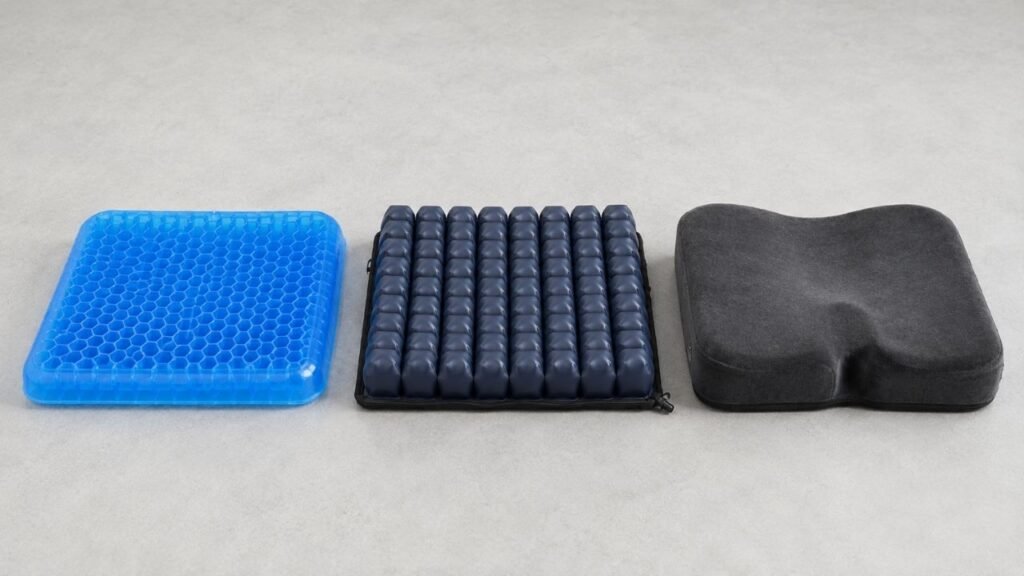
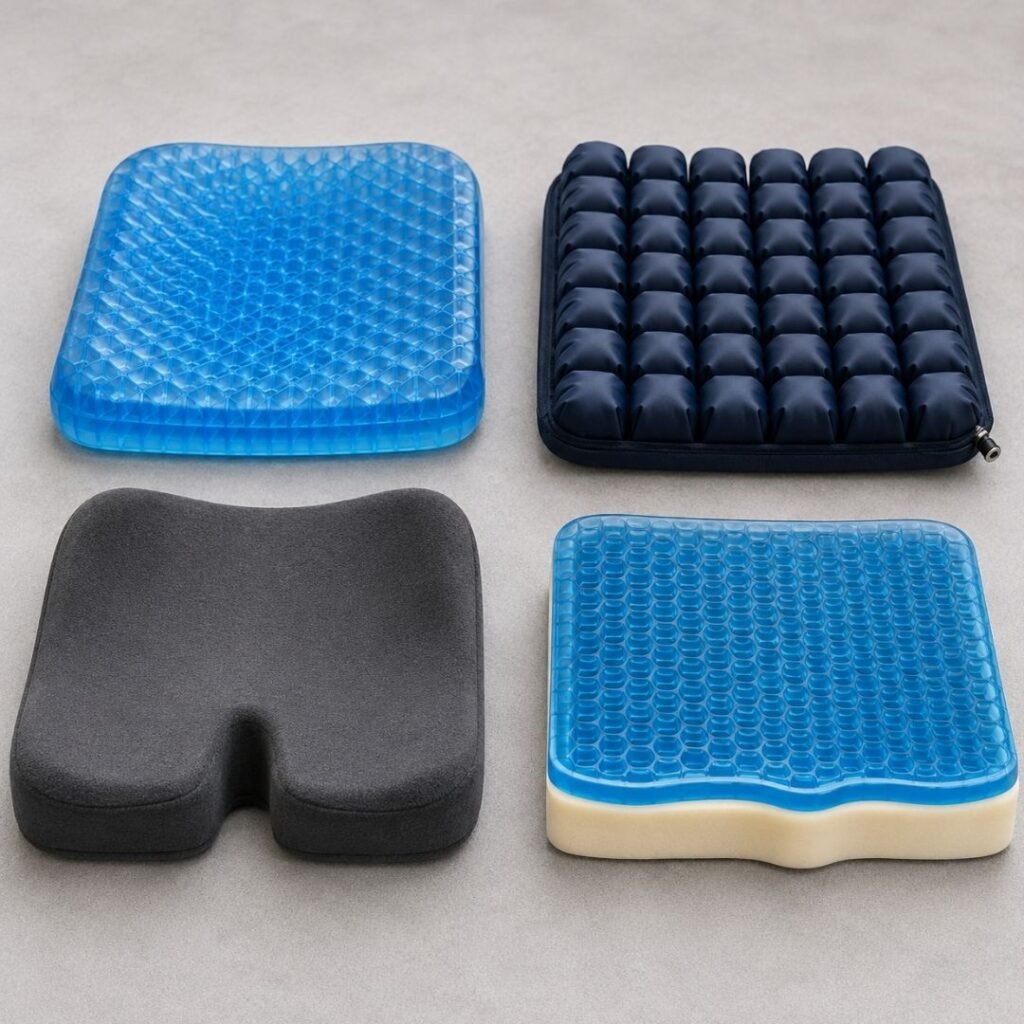
Wheelchair cushions for pressure relief typically fall into four design categories. Air cell cushions use rows of inflated cells that compress independently under the body. They offer the deepest immersion and the best pressure redistribution but require occasional re-inflation. Gel cushions use a viscous gel pad to spread pressure. They are stable, easy to maintain, and offer a cooling effect, but redistribute less aggressively than air. Foam cushions use contoured shapes and high-density foam to support and cradle the pelvis. They are stable for transfers but less effective for the highest-risk users. Hybrid cushions combine two materials — usually a foam base with a gel or air top layer — to balance pressure relief with transfer stability.
The cushion does not work alone. Cushion choice is one part of a larger pressure prevention strategy that also includes regular weight shifts, skin inspection, hydration, and protein intake. Our companion guide on how to prevent pressure ulcers covers the full prevention framework that pairs with the right cushion. A cushion alone is not enough; a cushion plus a prevention routine is what reliably keeps skin intact.
One question that comes up often is whether wheelchair cushions for pressure relief eliminate the need for the senior or caregiver to shift weight. The honest answer is no. Even the best cushion still allows some pressure concentration under the bony points; weight shifts every 15 to 30 minutes remain the single most effective pressure prevention behavior. The cushion reduces the urgency of those shifts and extends the safe interval between them, but it does not replace them. Caregivers who treat the cushion as a “set it and forget it” device are the caregivers who eventually face a wound that did not need to happen.
How to Use Wheelchair Cushions for Pressure Relief Safely
Position the cushion correctly every time. Most pressure relief cushions are contoured, which means they have a front, a back, a top, and a bottom. Sliding a contoured cushion on backwards changes the pressure points and can put the gel pad or air cells in the wrong position relative to the sit bones. Verify orientation at every sit-down. Many cushions have a tag, a label, or a directional marker on the cover — use it. A cushion installed backwards is a cushion not doing its job.
Shift weight even with the best cushion. MedlinePlus guidance on preventing pressure ulcers recommends that seated users shift their weight every 15 to 20 minutes. A push-up on the wheelchair arms, a side lean, or a forward stretch is enough to relieve pressure under the sit bones briefly. Even the best pressure relief cushion still allows enough residual pressure that long uninterrupted sitting can cause problems for high-risk users. The cushion extends the safe interval; the weight shift keeps it safe.
Inspect the skin daily. A simple visual check of the buttocks and tailbone area at bath time or bedtime is the single most effective early-warning system for pressure problems. Look for any reddened area that does not fade within 15 to 30 minutes after pressure is removed. Any non-blanching redness is an early-stage pressure injury and means the cushion, the sitting routine, or both need adjustment immediately. Catching it at stage 1 prevents the much larger problem of an open wound.
Keep the cover clean and dry. Moisture softens the skin and accelerates breakdown. Spilled drinks, incontinence episodes, or perspiration that gets trapped under a non-breathable cover create exactly the conditions where pressure injuries develop fastest. Most quality pressure relief cushion covers are removable and machine washable. Wash weekly at minimum, and immediately after any incontinence episode. A second cover in rotation makes this routine practical.
Re-inflate air cushions properly. An air cell cushion that has lost air is no longer doing its job — the cells flatten under the user’s weight and the cushion behaves like a thin foam pad. Most air cushions include a hand pump and instructions for proper inflation. The standard test is the “hand check”: with the user seated on the cushion, slide a flat hand under the bony point. There should be about an inch of inflated cell between your hand and the cushion’s base. Too little air means re-inflate; too much air means release some.
Do not stack cushions. A common mistake is layering a comfort cushion on top of a pressure relief cushion to make the seat feel softer. This defeats the purpose. The second cushion either compresses the first beyond its working range or holds the user too high off the pressure relief surface. Use one cushion at a time, chosen correctly, and address comfort concerns by selecting a different primary cushion rather than layering.
Lifestyle Synergy: Making Wheelchair Cushions for Pressure Relief Work Better at Home
A pressure relief cushion earns its keep when it is used consistently and integrated into the daily routine. That means the cushion travels with the senior — from the wheelchair to the recliner to the car seat — whenever the senior moves to a different seated surface for any meaningful length of time. A senior who has perfect cushion support in the wheelchair but transfers to a hard kitchen chair for an hour of breakfast is still accumulating pressure damage during that hour. Some families buy a second, less-expensive cushion specifically for the other seated locations to keep prevention continuous.
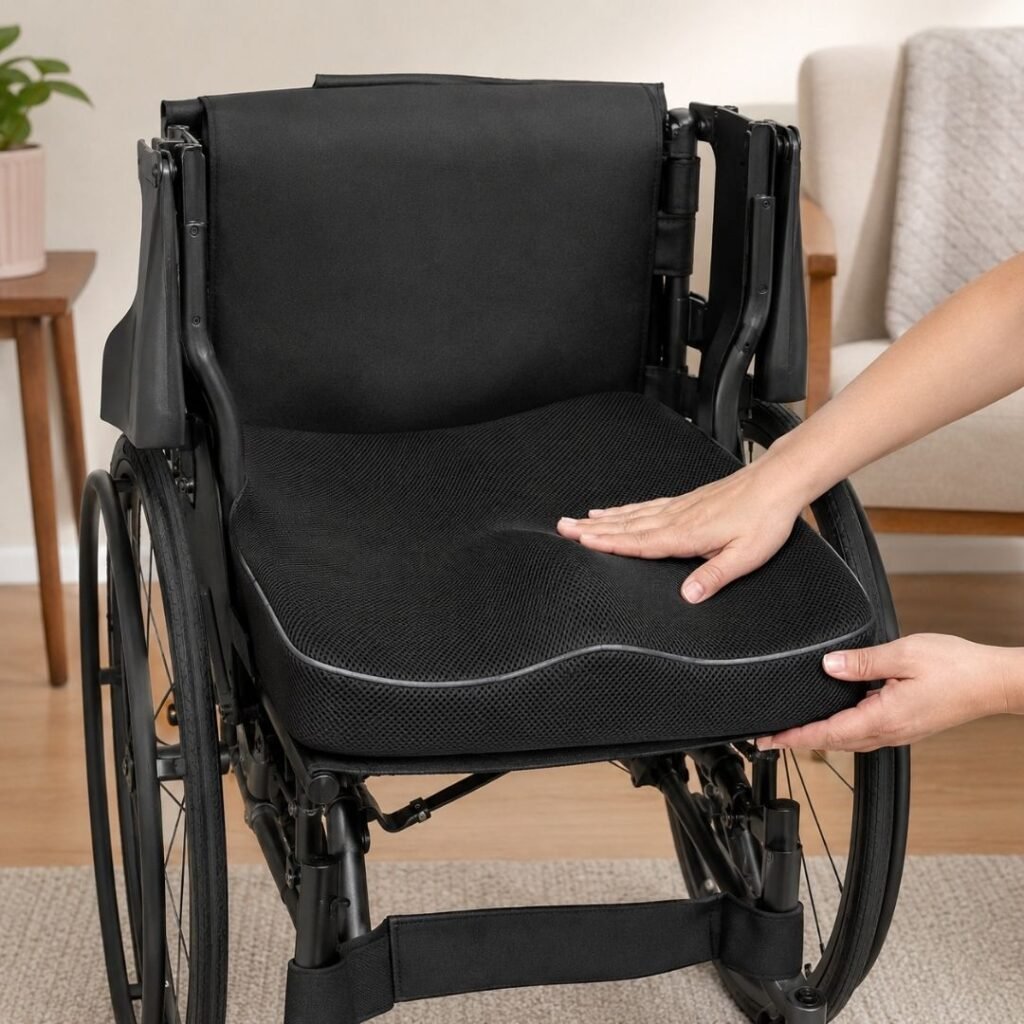
The right wheelchair pairs with the right cushion. A modern lightweight wheelchair with a properly tensioned seat upholstery presents an even surface for the cushion to rest on. A wheelchair with a sagging sling seat creates an uneven base that compromises the cushion’s design. Our guide to the best lightweight wheelchairs for seniors covers the chair-and-cushion pairing in detail, including how to check seat tension and when to consider a solid seat insert.
Plan the cushion’s care into the weekly routine. The best wheelchair cushions degrade fastest when ignored. A weekly inspection — remove the cover, look at the surface, feel for any flattened or compressed areas — takes five minutes and catches small problems before they become big ones. The user’s primary caregiver should do this inspection. The senior may not be able to see or feel the cushion well enough to assess it.
Build pressure prevention into a daily rhythm that does not depend on the cushion alone. Hydration, protein intake, and skin care are the unglamorous but high-impact partners to the cushion. A well-hydrated senior with adequate protein intake heals small skin issues quickly; a dehydrated senior with low albumin does not. The cushion is the equipment; the lifestyle is the long game.
Consider how the senior transfers in and out of the chair. A senior who slides forward to stand creates significant shear force on the cushion and on the skin underneath. Practicing a square-up-and-press transfer — scooting hips forward, planting feet flat, pressing up through both arms rather than dragging across the cushion — protects both the cushion and the skin. For seniors who can no longer transfer under their own power, pairing the cushion with safer transfer board options reduces the drag and shear that quietly damage skin and shorten cushion life. Caregivers who supervise transfers can verbally cue this technique without it feeling intrusive.
Physician’s Tips for Long-Term Use of Wheelchair Cushions for Pressure Relief
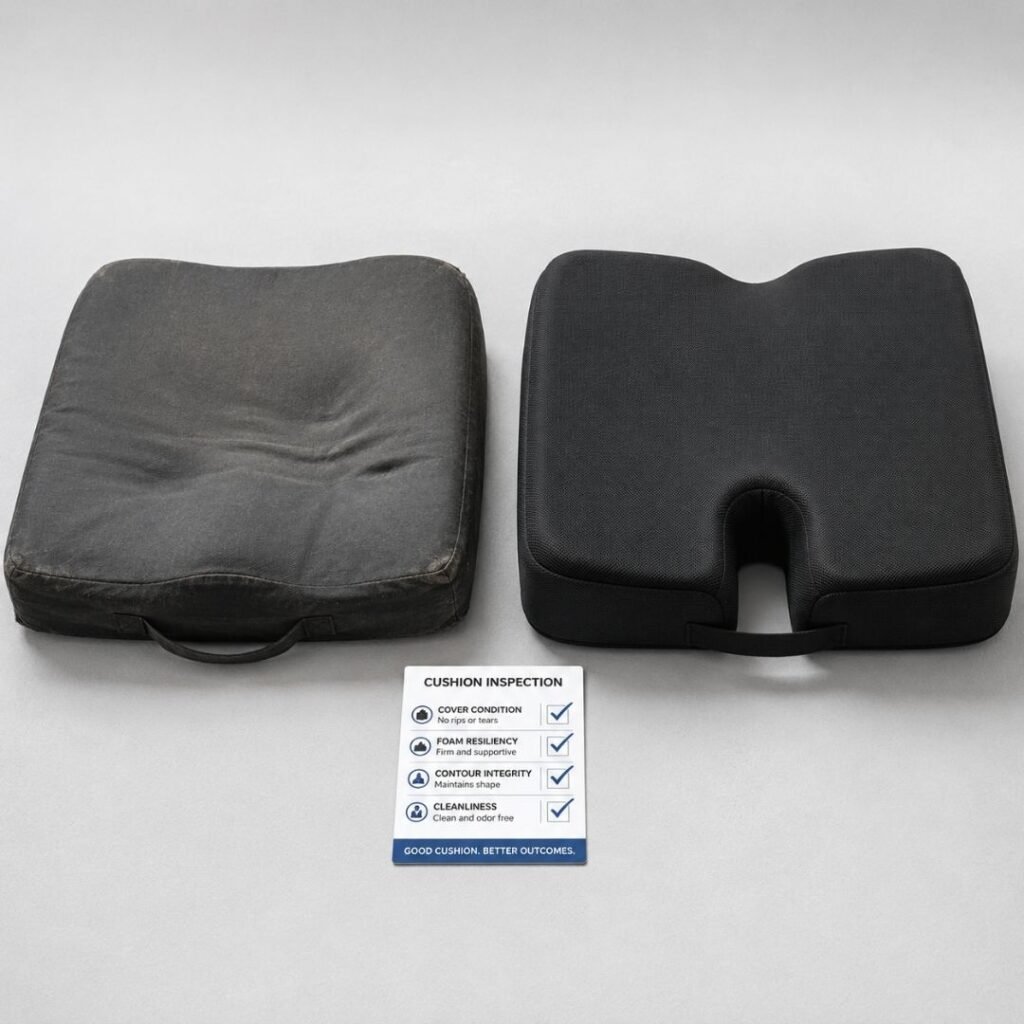
Replace the cushion when it has done its time. Most quality wheelchair cushions for pressure relief have a useful life of two to five years depending on daily sitting hours and user weight. After that, the foam compresses, the gel loses its rebound, or the air cells lose elasticity. A cushion that has gone beyond its useful life looks fine but no longer redistributes pressure. The visual cue is permanent indentation: if the cushion shows a clear depression after the user stands up and does not return to its original shape within a few minutes, it is time to replace.
Document the cushion in the senior’s care plan. The cushion model, purchase date, and any clinical justification should be written down somewhere the family can reference. This helps with insurance reimbursement, with continuity between caregivers, and with future replacement decisions. A senior may have three or four caregivers across a year; the cushion plan should be portable across all of them.
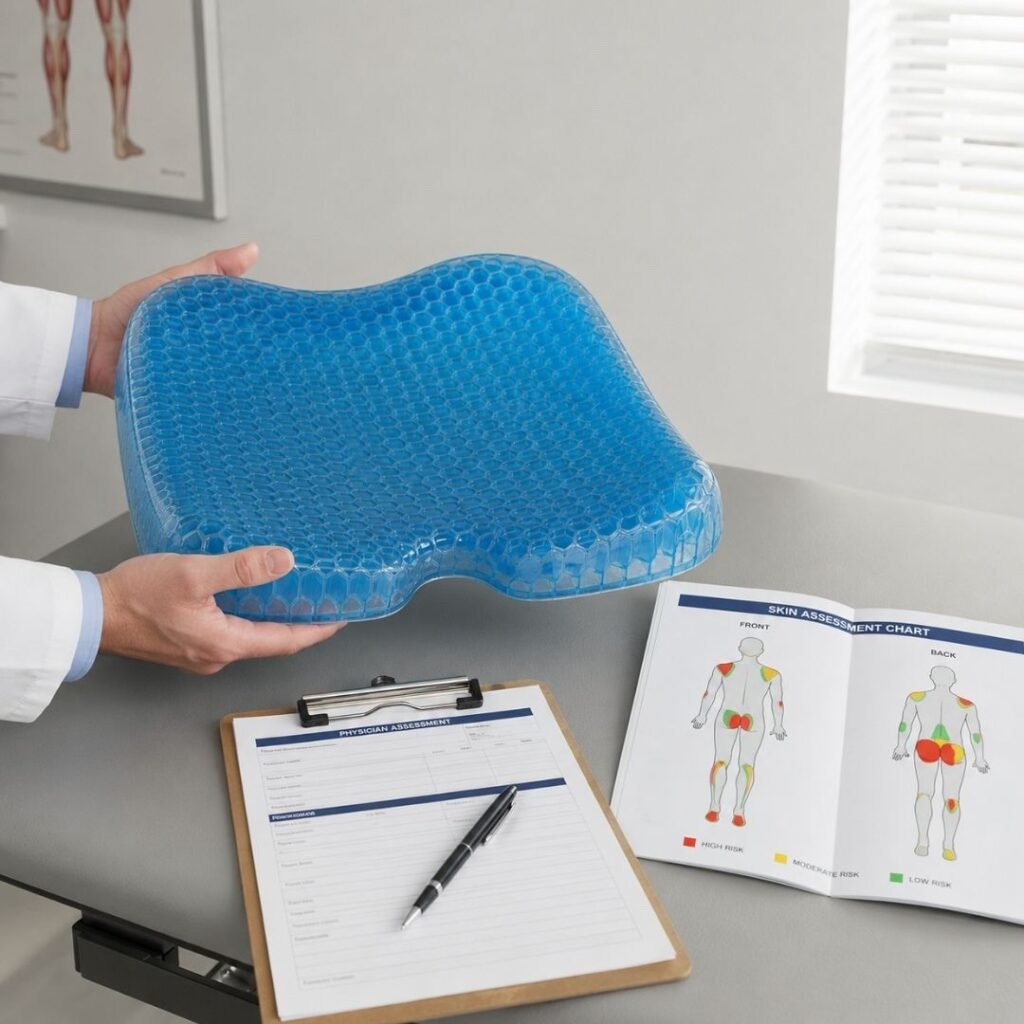
Coordinate with a wound care professional if the senior has a history. Any senior with a prior pressure injury — even fully healed — benefits from periodic review by a wound care nurse or physical therapist trained in seating. The professional can run a pressure mapping assessment that shows exactly where the user’s weight is concentrating, and recommend cushion adjustments or upgrades. Many medical equipment providers offer pressure mapping as a free service at the time of cushion purchase.
Watch for changes in the senior’s body composition. A senior who loses weight loses some of the soft tissue padding over their sit bones, which raises pressure risk significantly even if they were stable before. A senior who gains weight may overload a cushion that was previously adequate. Any significant change in body weight is a prompt to re-evaluate the cushion against the new body habitus.
Pay attention to seasonal changes. Cold weather, layered clothing, and indoor heating all change the moisture and temperature dynamics under the cushion. Seniors who do fine in moderate weather can develop skin problems during winter when heavy clothing traps perspiration. Switching to a more breathable cover during the colder months — counterintuitive, but effective — can prevent winter skin breakdown.
Have a backup cushion ready. A cushion that develops a leak, a tear, or a sudden problem cannot wait for a two-week replacement shipment to arrive. A spare cushion of similar specification — even a less-expensive backup — means the senior is not forced onto a bare wheelchair sling during the gap. Wheelchair cushions for pressure relief are not equipment families want to be without for a single day.
Top Recommendations: Best Wheelchair Cushions in 2026
Frequently Asked Questions
1. How often should a senior shift weight on a pressure relief wheelchair cushion?
Most clinical guidelines recommend a weight shift every 15 to 20 minutes during long seated periods. A weight shift can be a push-up on the wheelchair arms held for 15 to 30 seconds, a side lean to the left and right, or a forward stretch that briefly takes weight off the sit bones. Even with a high-quality pressure relief cushion in place, residual pressure under the bony points still accumulates and weight shifts remain the most effective single behavior for preventing skin breakdown. Seniors who cannot shift independently should be assisted to shift every 30 minutes by a caregiver.
2. Are gel or air wheelchair cushions better for pressure relief?
For the highest-risk users — those who sit eight or more hours per day, have a history of pressure injury, or cannot shift their own weight — air cell cushions like the ROHO line generally provide better pressure redistribution than gel cushions. Air cells immerse the body deeper and contour more aggressively around bony points. Gel cushions are more stable for transfers, easier to maintain (no re-inflation needed), and cooler in temperature. For moderate-risk users, a gel or gel-foam hybrid is often the better practical choice. For the highest-risk users, air cell wins on pressure performance even with the maintenance trade-off.
3. How long do wheelchair cushions for pressure relief last before they need replacing?
Most quality pressure relief cushions have a useful life of two to five years under daily use. Foam cushions degrade fastest, typically lasting two to three years before the foam compresses past its working range. Gel cushions last three to four years. Air cell cushions can last five years or more if maintained properly, with periodic cell replacements available for premium models. The visual cue for replacement is a permanent depression: a cushion that does not return to its original shape within a few minutes of the user standing up has lost the rebound that makes pressure redistribution work.
4. Can a pressure relief cushion prevent bedsores entirely?
No single cushion can prevent pressure injuries entirely. The cushion is one piece of a broader prevention strategy that includes regular weight shifts, daily skin inspection, adequate hydration and protein, and a clean dry cushion surface. A high-quality pressure relief cushion significantly lowers risk and extends the safe interval between weight shifts, but it does not eliminate the need for any of the other prevention behaviors. Seniors at the highest risk — with a history of pressure injury, advanced age, diabetes, or limited mobility — benefit from the cushion plus a full prevention routine, not the cushion alone.
5. Does Medicare cover wheelchair cushions for pressure relief?
Medicare Part B covers wheelchair seat cushions classified as durable medical equipment when prescribed by a physician for a senior who uses a covered wheelchair. The cushion must meet specific medical necessity criteria, typically tied to skin condition, mobility level, or a history of pressure injury. Higher-end air cell cushions usually require additional documentation of the senior’s risk profile. Out-of-pocket cost for a quality pressure relief cushion typically ranges from $50 for budget hybrid options to $400 for premium air cell models. Families should ask the prescribing physician to document medical necessity clearly to maximize coverage.
Final Thoughts
The right cushion does not look like much. It is a piece of gel, foam, or air on a wheelchair seat. But for the senior who spends most of the day in that chair, it is the single piece of equipment standing between intact skin and a wound that can take months to heal and complicate every other aspect of care. Wheelchair cushions for pressure relief are the quiet, low-glamour equipment that pays back the most over time. The picks in this 2026 guide were chosen to match real seniors and real sitting profiles, not idealized ones. Whichever model fits your situation, the right cushion is the one that gets used every day, inspected weekly, and replaced before it stops working — not the one that ends up on the closet shelf.
Medical Disclaimer: This guide is for general educational purposes only and is not intended to serve as personalized medical advice. Always consult a qualified healthcare professional before making changes to medical equipment or care plans.
Last update on 2026-09-15 / Affiliate links / Images from Amazon Product Advertising API
