
Affiliate Disclaimer: This article contains affiliate links. As an Amazon Associate, Mobility With Ease may earn a small commission from qualifying purchases at no additional cost to you.
Introduction
Daily mobility accessories for seniors are the small purchases that quietly fix the moments the big devices never reach. A walker solves the walking, a wheelchair solves the rolling, and a recliner solves the resting — but none of them solve the dropped phone the senior cannot bend down to pick up, the cane that keeps falling off the back of the chair, the doorknob a swollen knuckle cannot turn, or the bed that sits two inches too low to stand up out of. The accessory tier is where caregivers say the real daily improvements come from.
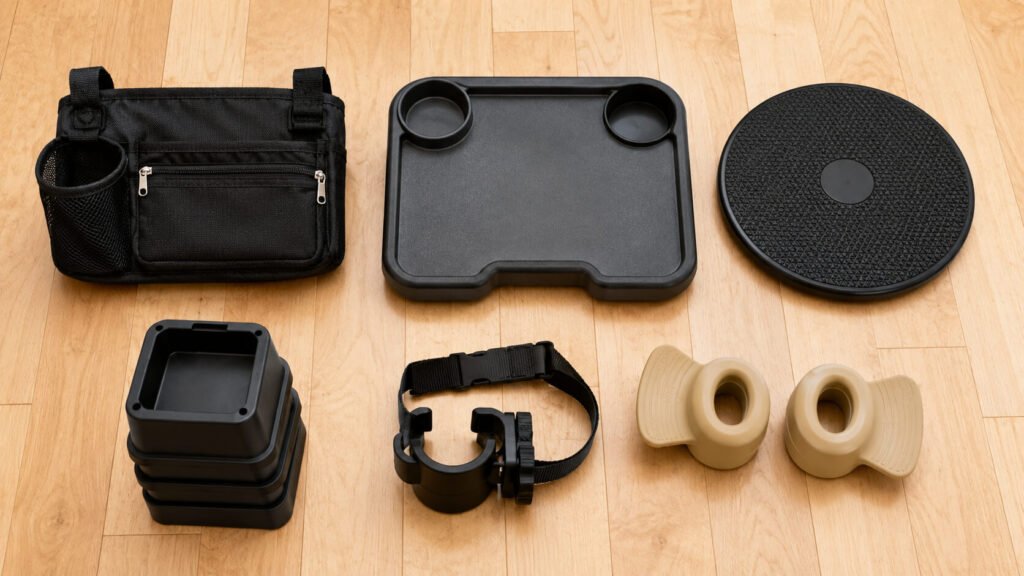
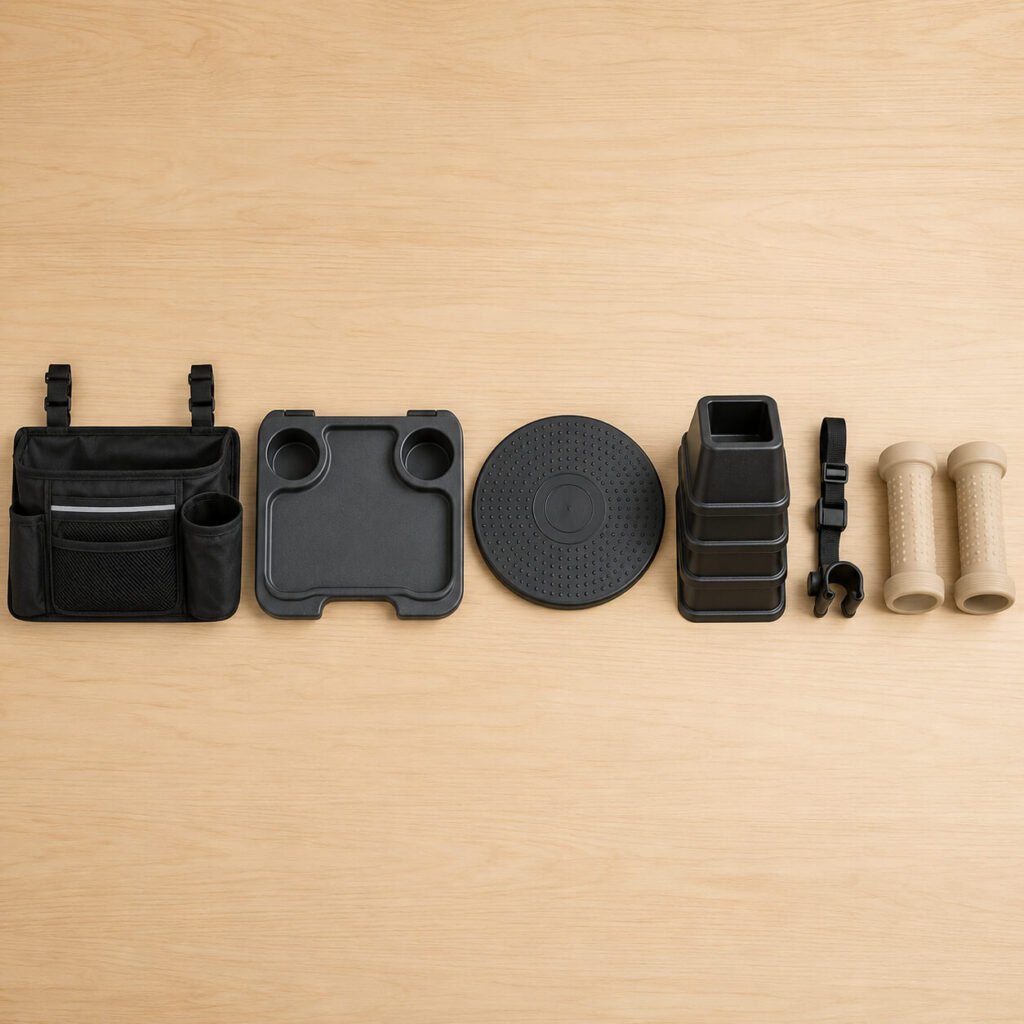
The picks in this guide are six of the best daily mobility accessories for seniors recommended by home-care nurses, physical therapists, and family caregivers in 2026. Each one is small, low-cost, and fixes a moment the bigger equipment leaves unsolved. They are the items the caregiver buys after the walker, the cane, and the wheelchair are already in the house and the family realizes the day is still not running smoothly. Add three of these and the daily routine usually clicks into place.
If you already know which moment of the day is the problem, use the button below to jump straight to the comparison table.
Why Daily Mobility Accessories for Seniors Matter
The clinical case is short. The CDC reports that more than one in four adults age sixty-five and older fall every year, and most of those falls happen during routine daily tasks — walking from the bed to the bathroom, bending down to pick up a fallen object, reaching for something just out of arm’s reach. The big mobility devices do not cover those small reach-and-bend moments. The accessories do. A walker bag that keeps the phone clipped to the rollator removes one of the most common reasons a senior bends down at the wrong angle.
The other half of the equation is caregiver strain. Most family caregivers are spouses or adult children with full-time jobs and zero formal training in patient handling. The daily mobility accessories for seniors that caregivers actually recommend are the ones that subtract from the caregiver’s physical load — the pivot disc that removes the twist out of a bed-to-chair transfer, the bed riser that ends the deep squat to help the senior stand, the cane holder clip that stops the caregiver from chasing a fallen cane across the floor three times a day. Each accessory looks tiny on its own. Together they are the difference between a sustainable caregiving routine and a burned-out family.
For families building out a complete protection layer around the senior, our guide to small mobility aids that prevent falls walks through the broader category of low-cost upgrades that catch the moments the walker and the grab bar miss. The accessories in this post sit inside that same protection layer — the small inexpensive items that punch far above their price tag on actual daily safety.
Doctor’s Note: Choosing the Right Daily Mobility Accessories for Seniors
I see the same pattern in nearly every home I visit. The family has invested in a good walker, a good cane, and sometimes a transport wheelchair — the big mobility devices are all there. The senior is still struggling. Not with walking, but with all the small surrounding moments: keeping a phone within reach, drinking water without setting down the rollator, standing up from a sofa that has gradually become too low, opening a front door with an arthritic hand. The big device solved one slice of the day. The other twenty-three hours are running on willpower.
The first question I ask families is how often the senior is left holding something while also holding the walker. Every time the answer is “all the time,” a walker bag and a walker tray are the first two accessories to add. Both attach to the existing rollator in minutes, both cost less than a single physical-therapy copay, and both remove the most common reason a senior loses balance at home. For families still researching the rollator itself, our guide to the best walkers and rollators for seniors walks through the base device the accessories attach to.
The second question is whether a caregiver is involved in transfers — bed to chair, chair to wheelchair, wheelchair to car. If yes, the pivot disc is the single highest-impact accessory in this entire guide. It removes the rotation that arthritic knees cannot perform safely and that caregiver backs cannot absorb repeatedly. The accessory tier is where the smartest caregivers focus their second wave of spending, and it is usually the place where the daily routine finally starts running on its own instead of running on the caregiver’s nervous system.

Best Daily Mobility Accessories for Seniors (Top Picks)
Best Overall (Walker Bag)
Double Sided Walker Bag with Cup Holder & Organizer Pouch
The double-sided walker bag is the default first accessory for any senior who uses a walker or rollator. The bag clips to the front bar of the walker in seconds, sits balanced on both sides so the rollator does not tip, and includes a cup holder for a water bottle or coffee mug plus zippered pockets for a phone, keys, glasses, medication, and the TV remote. The fabric is wipeable, the strap closures fit standard walker and folding-walker frames, and the bag stays out of the way of the brake levers. This is the accessory that ends the dropped-phone routine, the cold-coffee routine, and the “where is my purse” routine in a single twenty-dollar purchase. Most caregivers add it within the first month of the walker arriving.
Pros
- Double-sided design balances weight across the walker frame
- Built-in cup holder for a water bottle or coffee mug
- Multiple zippered pockets for phone, keys, glasses, medication
- Universal strap closures fit standard walkers and rollators
- Wipeable fabric — cleans up easily after a spill
Cons
- Bag sits forward of the brake levers — takes a day to learn the new reach
- Not waterproof — bring it inside in heavy rain

- Conveniently carry your essentials with this double-sided walker bag, perfect for users of folding walkers
- Keep your drinks within reach with the built-in cup holder, ideal for staying hydrated on the go Organizer Pouch, Storage Tote
- Compatible with Rollators, Rolling Walkers
Best Walker Tray
DMI Walker Tray
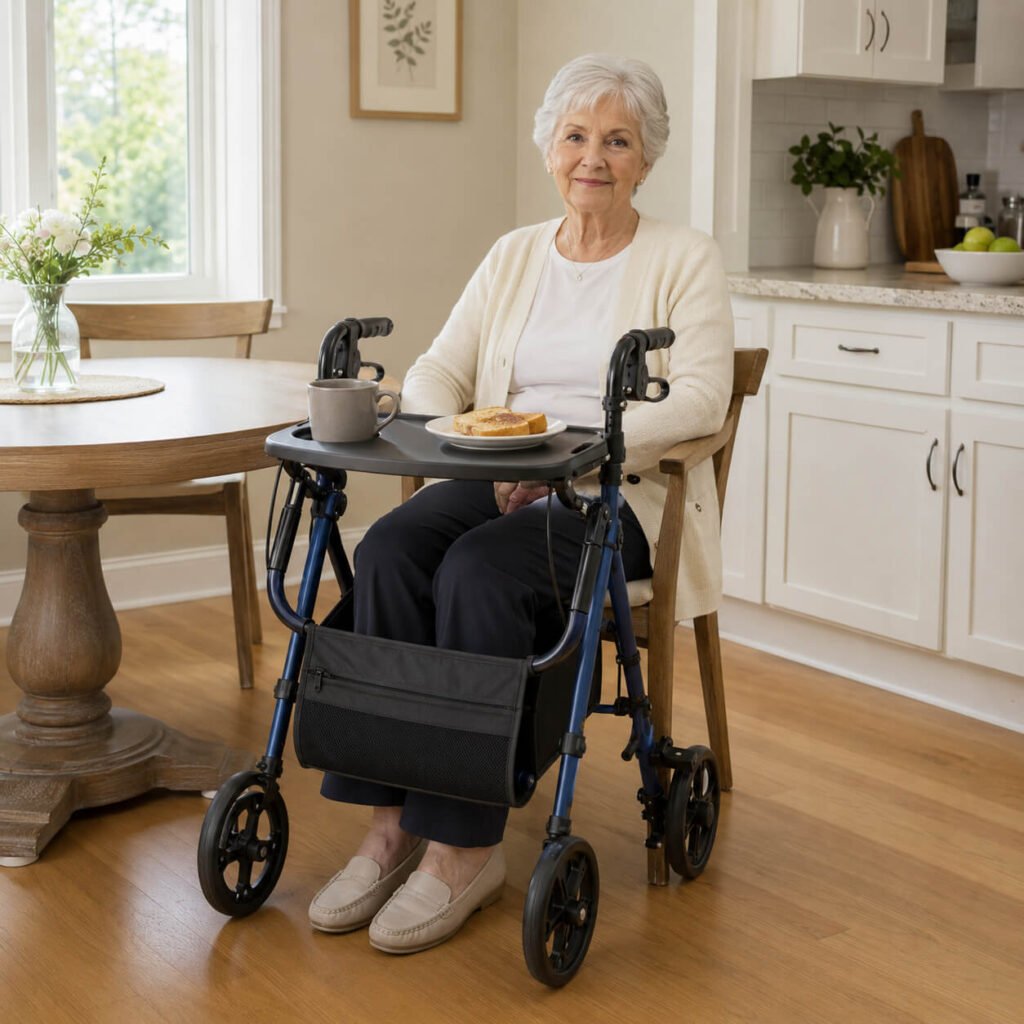
The DMI walker tray is the second accessory most rollator users add and the one that surprises families with how often it gets used. The tray straps onto the top of any standard walker in under five minutes with no tools required, sits flat enough to hold a coffee mug or a plate without tipping, and includes two built-in cup holders so a drink does not slide off. Once it is on, the senior can eat breakfast in the kitchen with the rollator pulled close, carry a bowl of soup from the stove to the table without a free hand, sort the mail at the front door without setting down the walker, or eat a snack on the back patio. The DMI is sized for the standard 18.5-inch walker width, which covers most folding walkers and rollators on the U.S. market.
Pros
- Tool-free assembly — on the walker in under five minutes
- Fits most standard walkers and folding walkers
- Two built-in cup holders prevent drink spills
- Flat tray surface holds a plate, mail, or paperwork
- Removable for storage when not needed
Cons
- Adds weight at the top of the walker — senior should test balance first
- Not designed for rollators with a built-in seat that flips up

- Walker tray for folding walker is compatible with most standard walkers, as well as folding walkers that are approximately 18.5 inches wide. attaches easily to most walkers by connecting and adjusting...
- Tray for walker easily opens and locks in place and conveniently folds down when not in use. two inch lip around the edge helps prevent items from rolling off and deep, stable cup holders prevent...
- Walker accessories for seniors, handicapped and disabled have no tool assembly and quickly and easily snaps in place. tray locks in place while raised for safety and reliability of carrying around...

Best for Caregiver-Assisted Transfers (Pivot Disc)
Vive 360° Pivot Disc
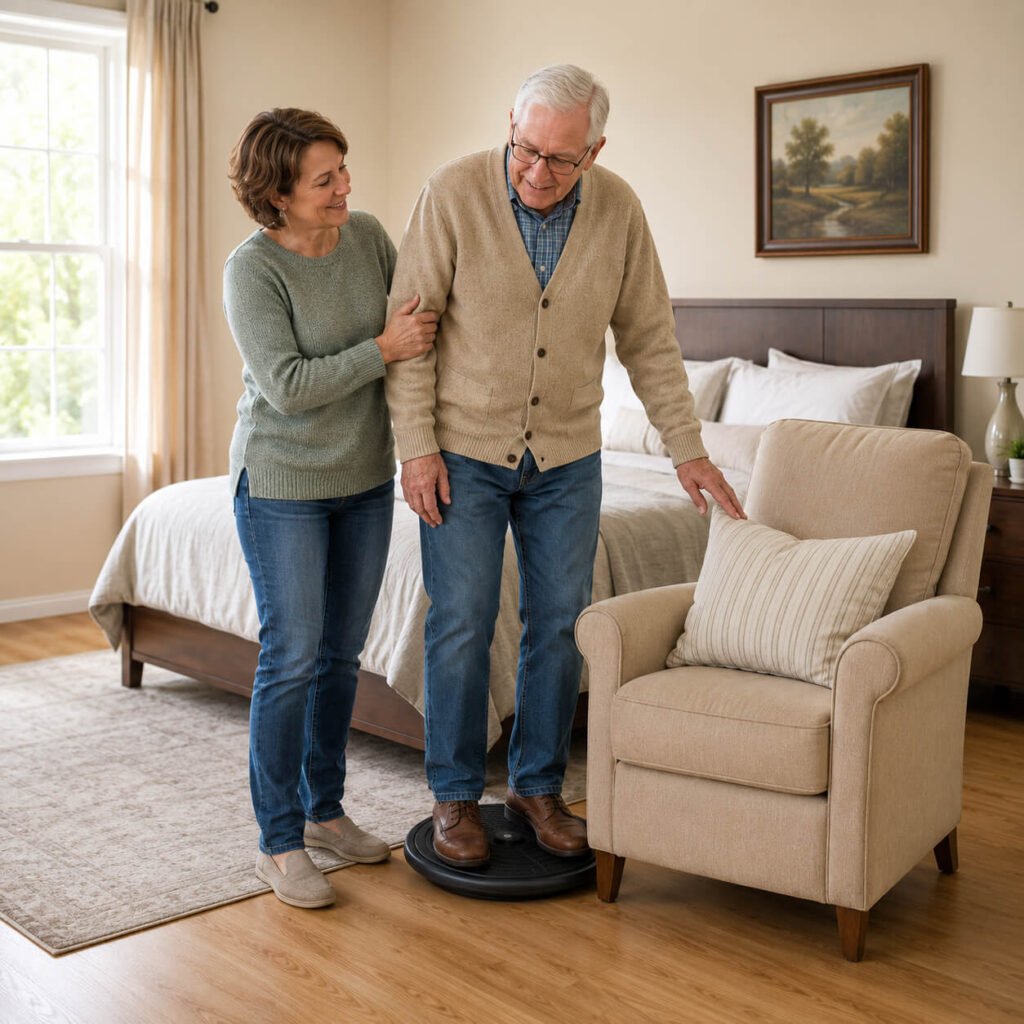
The Vive pivot disc is the single most caregiver-loved accessory on this list and the one home-care nurses recommend most often. The disc sits on the floor between the senior’s starting and ending position — bed to wheelchair, chair to commode, wheelchair to car — and rotates 360 degrees on a smooth bearing. The senior stands on the disc, the caregiver pivots them gently a quarter-turn or half-turn, and the disc absorbs the rotation that arthritic knees, weak ankles, and recovering hips cannot safely perform on their own. The non-slip top surface prevents foot slip during the turn, and the 350-pound capacity covers most users. For a caregiver who performs three to six transfers a day, the pivot disc is the difference between a sustainable routine and a back injury.
Pros
- 360-degree rotation eliminates knee twist during transfers
- Non-slip top surface prevents foot slip during the pivot
- 350-lb weight capacity covers most users
- Portable — moves between bedroom, bathroom, and car
- Saves the caregiver’s back during repeated daily transfers
Cons
- Senior must be able to stand briefly with support to use it safely
- Not a substitute for a sit-to-stand lift when standing is not possible
- MINIMIZE TWISTING AND TURNING: Featuring a nonslip platform that smoothly rotates, the Vive transfer disc facilitates easy transfers to and from the bed, wheelchair, commode and more. Safely...
- SMOOTH 360 DEGREE ROTATION: Ideal for those with limited mobility, the transfer disc smoothly rotates a full 360 degrees. The transfer disc allows individuals to pivot and turn with minimal effort.
- SAFE NONSLIP LINING: Providing greater traction, the 15.75” Vive transfer disc surface is lined with a textured material for safe use with appropriate footwear.
Best Bed & Furniture Risers
Vive Bed Risers Heavy Duty (4 Pack — 3 Inch)
The Vive bed risers solve a problem most families do not realize they have until it is pointed out. A bed, sofa, or armchair that is too low forces the senior into a deep squat to stand up — the exact movement arthritic knees and weak quads cannot perform without assistance. Slipping three-inch risers under each leg adds nine inches of effective height to the seat surface and turns a daily struggle into a routine stand. The risers are heavy-duty molded plastic, stackable for taller lifts, and rated to hold well over a thousand pounds across the four-pack. They fit standard bed frames, sofas, and most armchairs. This is the accessory that often cancels the planned purchase of a new lift chair, because the existing furniture suddenly works again.
Pros
- Adds three inches of effective seat or bed height per leg
- Heavy-duty molded plastic rated for high weight loads
- Stackable for taller lifts when needed
- Fits standard bed frames, sofas, and armchairs
- Often eliminates the need to replace the existing furniture
Cons
- Must be installed on all four legs — uneven lift creates a tipping risk
- Not appropriate for furniture with wheels or castors

- CUSTOMIZE TO MEET YOUR NEEDS: Customize the height of beds, sofas, and chairs to aid in sitting or rising with improved mobility. An essential piece of adaptable living, the bed risers are perfect for...
- IMPROVE DAILY MOBILITY: Four risers are included to raise objects around the house to reduce knee and back pains when getting up and laying down. Extend the height of your most used furniture around...
- SAFE FOR ALL FLOOR TYPES: Durable molded plastic risers support up to 1760 pounds. The risers are safe to use on all floor types. The non-skid risers will not snag carpets or scuff and scratch...
Best Cane Holder Clip
Crutcheze Cane Holder 3 Pack
The Crutcheze cane holder is a flexible wrap-clip that secures a cane to a walker, rollator, wheelchair, or scooter and stops the cane from sliding to the floor every time the senior sets it down. Families who use both a walker and a cane — the walker for long distances, the cane for short trips around the house — usually go through the same frustrating cycle three times a day: the senior leans the cane against a chair, the cane falls, the cane gets kicked under a table, the senior bends down to retrieve it. The wrap clip ends the cycle for the cost of a fast-food meal. The three-pack means one clip lives on the rollator, one on the wheelchair, and one on the bedroom chair, so the cane has a parking spot in every room where the senior actually uses it.
Pros
- Flexible wrap-clip fits walker, rollator, wheelchair, or scooter
- Three-pack covers multiple rooms or mobility devices
- Ends the dropped-cane routine that triggers daily bending
- Lightweight and removable for travel
- Inexpensive enough to keep extras on hand
Cons
- Sized for standard cane diameters — thicker quad canes may not fit
- Wrap-clip can loosen over time and needs occasional re-tightening
- Flexible Wrap Cane Clip Holder: Bendable wrap-style cane holder adjusts to position lightweight canes and walking sticks on walkers, rollators, wheelchairs, and scooters.
- Made for Standard Walking Sticks: Designed for single-point lightweight to normal canes, and not intended for heavy quad canes or weighted base canes.
- Keeps Your Cane Within Reach: Helps stop a walking stick from sliding to the floor when held on a walker, rollator, wheelchair, scooter, or nearby table.
Best Doorknob Aid
Able Life EZ Doorknob Grips (Set of 2)
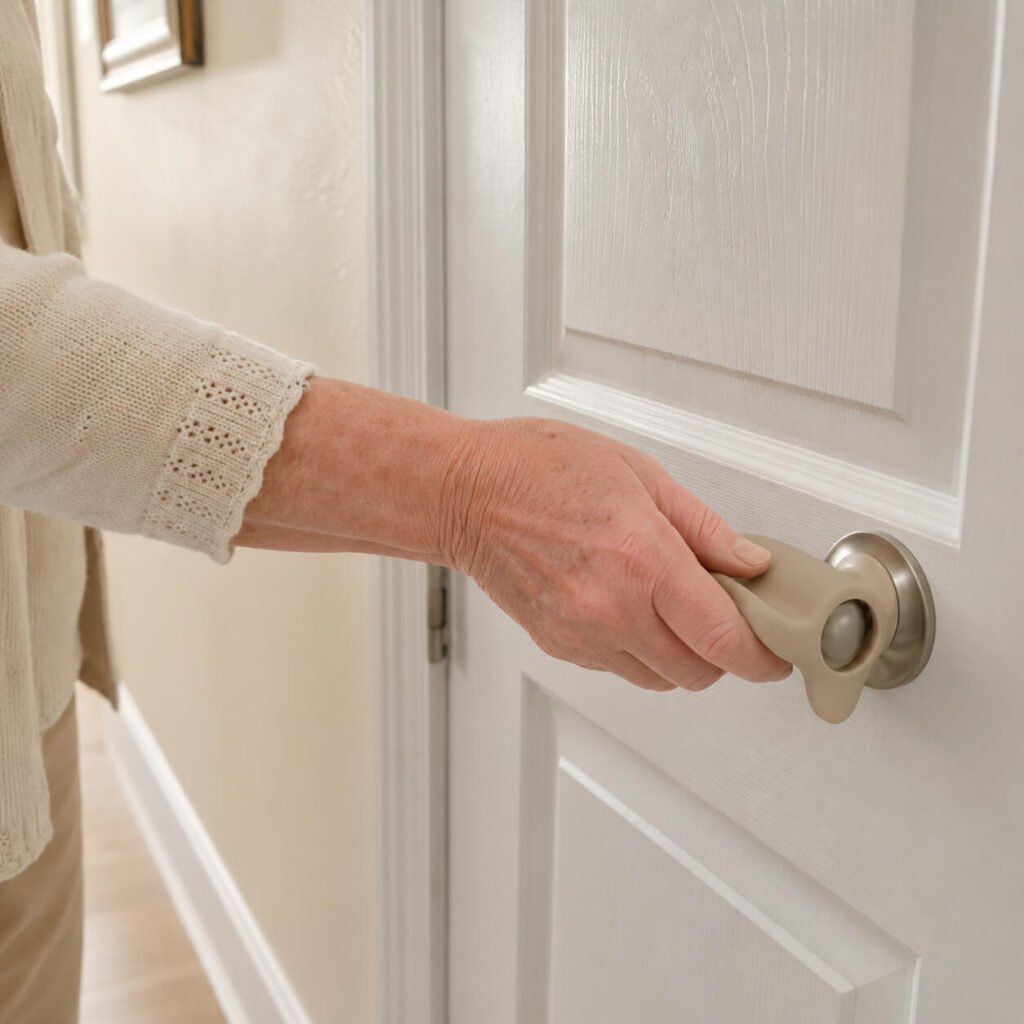
The Able Life doorknob grips are the cheapest dignity-restoring accessory in this guide. A round doorknob requires a coordinated grip-and-twist motion that arthritic hands, post-stroke hands, and Parkinson’s hands cannot reliably perform. The silicone grips slide over the existing knob, add winged tips on either side, and convert the grip-and-twist into a simple lean-and-push that any hand can do. Installation takes thirty seconds per knob with no tools, and the grips peel off cleanly for renters. Start with the front door and the bathroom door — the two highest-stakes doors in any senior’s home — and add more for the bedroom, the laundry room, and the back door. The set of two covers most homes’ priority entries.
Pros
- Converts round knobs into winged lever grips an arthritic hand can turn
- Non-slip silicone material grips the knob securely
- No tools, no hardware, no installation — slips on in thirty seconds
- Peels off cleanly for renters or future replacement
- Set of 2 covers the two priority doors in most homes
Cons
- Fits standard round knobs — not lever handles or smart locks
- Some seniors prefer a lever-extension clamp for very stiff knobs

- Open doors effortlessly
- Lower cost than a door-lever replacement
- Easy installation - stretches over door knob
Educational Overview: What Are Daily Mobility Accessories Used For?
Daily mobility accessories for seniors solve a specific class of problem: the small repeated friction moments that the big devices were never designed to handle. A walker keeps the senior upright; it does not carry their phone. A cane provides balance; it does not park itself when the senior sits down to eat. A wheelchair moves the senior across the room; it does not perform the pivot from chair to bed. Each accessory in this guide patches one specific friction point. Three or four accessories together patch most of the day.
According to the National Institute on Aging, home modifications that reduce reaching, bending, and grip strain are central to aging-in-place safety for older adults. The accessories in this guide do that work without requiring construction, contractors, or a landlord’s permission. The walker bag and tray eliminate carrying. The pivot disc eliminates twisting. The bed risers eliminate deep squatting. The cane holder eliminates bending to retrieve. The doorknob grips eliminate forceful gripping. Each accessory subtracts one risky motion from the day.
What matters most in the choice is the actual daily routine of the user. A senior who lives alone needs a different stack than one with a full-time caregiver. A senior who still drives needs accessories that travel; a homebound senior needs ones that anchor to the furniture. A senior who already has a strong walker, a stable cane, and a working wheelchair benefits most from the accessory tier; our guide to the best canes for seniors covers the base device that several of these accessories attach to. The accessory plan is built room by room, not all at once.
How to Set Up Daily Mobility Accessories Safely
Most daily mobility accessories for seniors fail at the install or the first-use moment, not at the product level. Walking through every setup step on the day the accessory arrives is the difference between an aid the senior actually uses and a bag of unopened plastic in the hall closet. The rules are short, and none of them are optional.
Install on the dominant side first. Walker bags, cane holders, and any reachable accessory should be installed on the senior’s dominant-hand side. A bag clipped to the wrong side forces the senior to cross-reach with the non-dominant arm, which costs balance and slows the daily routine. Ask which hand the senior reaches for the phone with and install the bag and tray on that side. The same rule applies to the cane holder clip — mount it where the senior’s reaching hand naturally falls when seated or standing.
Test the walker tray loaded before relying on it. A walker tray changes the rollator’s balance the first time it carries weight. Before the senior trusts the tray with a full meal, do a dry run: load it with a half-full glass of water and walk the rollator slowly across the room with the senior. Confirm the tray stays level, the brake levers still reach, and the rollator does not tip forward. If the senior senses any instability, lower the load weight or relocate the tray closer to the rollator’s center of gravity.
Practice the pivot disc in a calm moment. The pivot disc feels strange the first time a senior stands on it. Schedule a practice session in the bedroom on a non-urgent morning. The senior stands with both feet flat on the disc, the caregiver places a hand on the senior’s upper back and one on the front of the shoulder, and they perform a slow quarter-turn from facing the bed to facing the chair. Repeat three or four times in each direction. The first turn always feels unsteady; by the fifth it is muscle memory. Skipping this practice is the most common reason a family stops using the disc after the first scary transfer.
Install bed risers on all four legs at once. A bed or sofa with risers on only two legs becomes a tipping hazard. Plan the install for a Saturday morning when two adults are available to lift the furniture corner by corner. Slide one riser under each leg, confirm the riser is fully seated, and rock the furniture gently to verify no leg slips out of its riser cup. For mattresses on a metal frame, double-check the frame’s casters are removed or locked — risers and casters together create a slow-motion fall.
Position doorknob grips on the priority doors first. Start with the front door, the bathroom door, and the bedroom door — the three doors a senior must open every day no matter what. Slip the grip on, test the rotation with both hands, and confirm the door opens cleanly without the grip slipping. If the grip rotates around the knob instead of turning it, the silicone is too loose; run the grip under hot water for thirty seconds to soften it and reinstall for a tighter seal. Most fitment issues resolve with that single warming step.
Lifestyle Synergy: Making Mobility Accessories Work Day to Day
Daily mobility accessories for seniors only earn their cost if they are actually used every day. The single biggest predictor is whether the accessory lives where the senior already is — the walker bag on the walker, the cane holder on the chair the senior sits in for breakfast, the doorknob grip on the door the senior actually opens. Accessories stored in a drawer or a basket somewhere “for when we need them” never get used. The setup principle is permanent placement, not staged deployment.
The kitchen and the bathroom are the two rooms where accessories pay off fastest. The walker tray turns the rollator into a portable breakfast surface; the doorknob grip makes the bathroom door safe to push closed even with arthritic hands; the bed risers turn the morning sit-to-stand into a routine stand rather than an event. For families layering the accessory tier with the broader home upgrades that keep the senior safer without major renovations, the accessories sit alongside grab bars, motion lights, and non-slip mats as the small-cost reinforcement around the bigger structural items.
Outside the house is where most accessory plans collapse. A senior with a perfectly equipped home rollator who arrives at a restaurant with nowhere to park the cane, no cup holder for the water, and a heavy door with a slippery knob has lost the entire setup at the front of the parking lot. The portable accessories — the walker bag that travels with the rollator, the cane holder clip that lives on every device, the doorknob grip that can be added to a vacation rental in seconds — are the ones that extend the home routine into the outside world. The cost of carrying them is essentially zero.
Resistance to using the accessory tier is common, especially with the bed risers and the doorknob grips. Many seniors read these accessories as “making the house look old” or as visible reminders of decline. The framing that overcomes resistance fastest is independence rather than safety: the bed risers are the reason the senior stands up on their own instead of calling for help, the doorknob grip is the reason they answer their own front door, and the walker bag is the reason their phone stays charged and within reach. Family members who lead with the independence framing rather than the safety framing see higher consistent-use rates within the first two weeks.
Physician’s Tips for Long-Term Use of Daily Mobility Accessories
The single best physician’s tip on daily mobility accessories for seniors is to add them in waves, not all at once. A family who shows up at the house with six new accessories on the same day overwhelms the senior and triggers the same resistance that every clinical instinct warns against. Pick the highest-impact accessory for the senior’s current bottleneck — usually the walker bag or the bed risers — install it, give the senior two weeks to integrate it into the daily routine, and then add the next one. The accessories work better as a system, but the senior accepts them only as individual additions.
For long-term use, layer the accessory tier with the rest of the tools that support a loved one with limited mobility across the home. The accessories are the connective tissue between the bigger devices — they make the walker more useful, the cane easier to keep track of, the wheelchair transfer safer, and the doorways navigable. None of them replace a walker, a cane, or a wheelchair, and none of them require one. They sit alongside and inside the bigger plan rather than competing with it.
Finally, plan to refresh the accessories every twelve to eighteen months. Walker bag fabric wears through, cup holders stretch out, silicone doorknob grips lose their grip, and pivot discs develop wobble in their bearings. None of these are dangerous failures, but each one is a small daily papercut that quietly raises the friction the accessories were bought to remove. A recurring annual reminder to inspect, test, and replace the accessory tier is the same maintenance any family would give the smoke alarms or the air-conditioner filter. It is the cheapest way to keep the routine running on its own instead of running on the caregiver’s back.
Daily Mobility Accessories Comparison (Features & Coverage)
Frequently Asked Questions
1. What are the best daily mobility accessories for seniors?
The best daily mobility accessories for seniors are the ones that match the senior’s actual daily routine and the caregiver’s actual involvement. A walker bag and walker tray cover the most universal accessory needs for any walker user. A pivot transfer disc is the highest-impact addition for households where a caregiver assists with bed-to-chair transfers. Bed and furniture risers solve the deep-squat problem in homes where the existing sofa or bed sits too low. A cane holder clip ends the dropped-cane cycle, and doorknob grips restore independent access to the front door and the bathroom. There is no single best accessory for every senior — the right pick is the one that fixes the moment of the day that is currently failing most often.
2. Which mobility accessory do caregivers say makes the biggest daily difference?
Home-care nurses and family caregivers most often single out the walker bag and the pivot transfer disc as the accessories with the largest daily impact. The walker bag is the accessory the senior interacts with every time they get up to move — phone, keys, water bottle, and remote all travel with them on the rollator instead of being chased across the house. The pivot disc is the accessory the caregiver feels the most, because it removes the back-twist load from every transfer. Together those two accessories often cover ninety percent of the daily friction caregivers describe in the first home visit, which is why they sit at the top of most professional recommendation lists.
3. Do walker bags and trays fit any standard walker or rollator?
Most walker bags and trays are sized for the standard 18.5-inch walker width, which covers nearly every folding walker and four-wheel rollator sold in the U.S. The strap or clip closures on the bag wrap around the front horizontal bar of the walker, and the tray straps anchor to the upright tubes on either side. Confirm the walker’s tube diameter is within the accessory’s range before ordering — most accessories list the compatible tube range in the product details. For unusual walkers such as bariatric or pediatric models, look specifically for accessories labeled universal or extra-wide. Standard models are nearly always covered by off-the-shelf accessories.
4. How does a pivot transfer disc help during caregiver-assisted transfers?
A pivot transfer disc removes the rotation from a bed-to-chair or chair-to-wheelchair transfer. Without the disc, the senior must perform a small twisting step with their feet to change orientation, which loads the knees and ankles in a direction arthritic and weak joints cannot safely absorb. With the disc, the senior stands on the non-slip platform and the disc rotates 360 degrees on a smooth bearing so the caregiver can pivot the senior into the new position without any foot twist. The result is a safer transfer for the senior and a substantially lower back load for the caregiver, which matters most when the same transfer happens five or six times a day. The disc supports up to 350 pounds and requires the senior to be able to stand briefly with support.
5. Are bed risers safe for seniors and how much height should you add?
Bed risers are safe when installed on all four legs of the bed or furniture piece and matched to a riser with adequate weight capacity. Most heavy-duty plastic risers support more than a thousand pounds across a four-pack, which is well above the load of a senior plus mattress plus bedding. The right height to add depends on how far below the knee crease the existing bed or sofa sits. The goal is to raise the seat surface to a height where the senior’s knees bend at roughly ninety degrees with their feet flat on the floor — that is the angle arthritic knees and weak quads can stand up out of. A three-inch riser is enough for most beds and sofas that sit slightly too low; a five-inch riser is appropriate when the furniture sits very low or the senior is taller than average. Confirm the bed frame castors are removed or locked before installing the risers.
Final Thoughts on Daily Mobility Accessories for Seniors
Daily mobility accessories for seniors are the small purchases caregivers actually recommend because they fix the moments the bigger equipment was never designed to reach. The walker bag handles the carrying, the walker tray handles the surface, the pivot disc handles the transfer, the bed risers handle the stand-up, the cane holder handles the parking, and the doorknob grip handles the grip. Each one looks tiny on its own. Stacked together, they are the difference between a daily routine that requires the caregiver in every room and a daily routine that the senior runs themselves with the caregiver standing by.
The right accessory plan fits the senior’s actual routine and the family’s actual capacity. A perfect walker bag does not solve the front-door knob, and a perfect doorknob grip does not solve the bed-to-chair transfer. Pick the three or four accessories that match the three or four moments of the day that are failing most often, install them one wave at a time, and let the daily routine adjust. The big devices keep the senior moving. The small accessories keep the moving from breaking down.
Medical Disclaimer: This guide is for general educational purposes only and is not intended to serve as personalized medical advice. Always consult a qualified healthcare professional before making changes to medical equipment or care plans.
Last update on 2026-09-23 / Affiliate links / Images from Amazon Product Advertising API
